


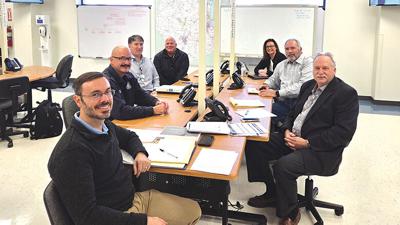

The inaugural meeting of the Jefferson County Task Force on Restricted Opioid Settlement Funds took place Dec. 5. Members established bylaws and discussed where the county’s more than $6 million in settlement funds from companies that make and distribute prescription opioids should be used.
Nationwide settlements were reached in 2021 with three of the country’s largest pharmaceutical distributors, McKesson, Cardinal Health and AmerisourceBergen, and against manufacturer Janssen Pharmaceuticals Inc., resulting in a $21 billion settlement to be paid over 18 years to qualifying states, counties and cities across the country. Johnson & Johnson, the parent company of Janssen Pharmaceuticals Inc., will pay an additional $5 billion.
In 2022, settlements were announced with pharmaceutical companies CVS, Walgreens and Walmart and manufacturers Allergan and Teva. Teva is to pay $3.34 billion over 13 years and provide $1.2 billion worth of its generic version of Narcan, a medicine that can treat narcotic overdose in an emergency, over 10 years. Allergan is to pay up to $2 billion over seven years. CVS is to pay up to $4.9 billion over 10 years. Walgreens is to pay $5.52 billion over 15 years, and Walmart is to pay up to $2.74 billion within six years.
The Missouri Department of Mental Health is the lead agency in the state for reporting settlement expenditures. The department’s second annual report was released in March. According to the report prepared by Director Valerie Huhn, the state was allocated $99.6 million in 2024 in opioid settlement funds, bringing the total to $171 million since the lawsuits were settled.
Local governments, including counties and cities with populations over 10,000, were given a total of $55.5 million in 2024.
Jefferson County began receiving settlement funds in 2023, according to budget documents. The current total balance of restricted funds in the county’s possession is $5,104,762.30. The funds are restricted to purposes related to eliminating opioid abuse, such as treatment, prevention and research. The county has a total of $1,608,042.72 in unrestricted funds.
County Auditor Kristy Apprill estimates the county will receive approximately $1,051,000 in restricted funds in 2026, and $171,000 in unrestricted funds.
The county hasn’t used its portion of the settlement fund until this point due to pending lawsuits against two firms that remain unresolved. A Jefferson County lawsuit against pharmacy benefit managers (PBMs) Express Scripts and Optum Rx that alleges widespread harm from the distribution of opioid prescriptions will likely be heard by a local jury early next year.
“The county has a lawsuit, but it’s still pending,” said County Executive Dennis Gannon. “It was going to be heard a year ago in August, and, with whatever these companies all do, it was delayed. It’s still scheduled for 2026, but who knows?
“I spent a little bit of time being deposed for this whole deal. The prosecutors have tons of staff trying to show how (the opioid crisis) affected the county.
“It’s probably one of the best lawsuits put together, regarding opioids.”
The county could continue to receive settlement funds for the next 15 or so years, said Warren Robinson, the director of the county’s Office of Emergency Management and the chairman of the task force. Other members are Gannon, Sheriff Dave Marshak, who will serve as the task force’s vice chair, Cedar Hill Fire Chief Mick Fischer, Councilman Bob Tullock (District 7, House Springs), Health Department executive director Steve Sikes and Festus R-6 Superintendent Nicki Ruess.
The task force met at the Office of Emergency Management, 1409 Herculaneum Industrial Drive in Herculaneum. The next meeting will be at 10 a.m. Friday, Jan. 16, at the same location.
“The task force was put together by the county executive in an executive order,” Robinson said. “Our purpose is to solicit, accept and recommend proposals for the usage of the restricted funds. We do, of course, have a little bit of freedom in how we’re going to accomplish that.
“This is definitely going to be a whole community effort.”
Committees
The tentative structure for the task force will include three separate committees, each dedicated to a different aspect of the allowed uses of the restricted funds. One committee will focus on finding and funding projects related to the prevention of opioid abuse; another will focus on the treatment of opioid abuse; and the third will investigate other approved abatement activities.
Robinson said the committees will make recommendations to the task force, which will in turn send the recommendations to the Jefferson County Council for final approval. The committees can be made up of community stakeholders, Robinson said.
Last year, a group of stakeholders, including representatives from the circuit court, Health Department, Compass Health Network and Chestnut Health Systems, along with local church leaders and county government staff, met to discuss the largest areas of need within the county as it relates to opioid abuse, Robinson said. The group compiled about 20 requests for funding, which could be a good starting point for the opioid task force in terms of where the settlement funds should be allocated, Robinson said.
Some of the requests include: funding for transportation for people undergoing addiction treatment; inpatient beds for treatment and recovery; treatment for the uninsured or underinsured; hiring behavioral health clinicians for the Jefferson County Jail and Mercy Hospital Jefferson; and a drug education conference and education program.
“In putting together our committees, I think the people who put those together would be some of the first ones that I would recommend we go to, to start bringing in those subject matters (of prevention, treatment and other approved abatement activities),” Robinson said.
“I know every agency that’s in this county right now has reached out to me and wants this money,” Gannon said. “This group is going to have to try to figure out what the best methods are to be most effective. You can assess those almost like grants. Spend it wisely. There will be some great things out there.”
Robinson said the task force was modeled after the St. Louis Area Regional Response System (STARRS), which similarly receives regional counterterrorism grant funding from the federal government and then distributes the funding to different jurisdictions.
“I don’t feel like we should completely reinvent the wheel, and I think this is a good way to borrow from an organization that has a similar structure to it,” Robinson said.
Applications
Robinson said he intends to adapt an investment justification form used by STARRS for the committees to put together project proposals for the task force.
What exactly is on the forms and what will be required on the application is still being determined, Robinson said. At the inaugural meeting, task force members discussed whether to prioritize projects that require a one-time reimbursement versus ongoing funding. They also discussed whether to prioritize funding agencies that work with others to combat opioid abuse in the county, versus funding an agency that works solo.
“We’ve had some funds in our account for a couple of years,” Robinson said. “We’ve not actually spent any of our restricted funds, and we are eager to begin showing that we are utilizing these funds and letting them make an impact in the community.
“Ideally, I would like to see this group able to make its initial recommendations back to the County Executive by next spring, quarter two of next year. That is kind of an ambitious timeline in some ways, but to be fair, I also have enough proposals that I’ve already heard about, and we have all the funds that we currently have. It’s not like there aren’t people out there who have been thinking about projects.”
Gannon told the task force members that it’s one of his main goals to disperse the money fairly among agencies.
“We need to figure out how we can spend the money as wisely as we can, with the most significant impact,” he said.