
Members of a Festus family flew to California in February to be guests at a ceremony honoring the memory of their son/brother, a Navy fighter pilot who was killed in a plane crash 34 years ago.
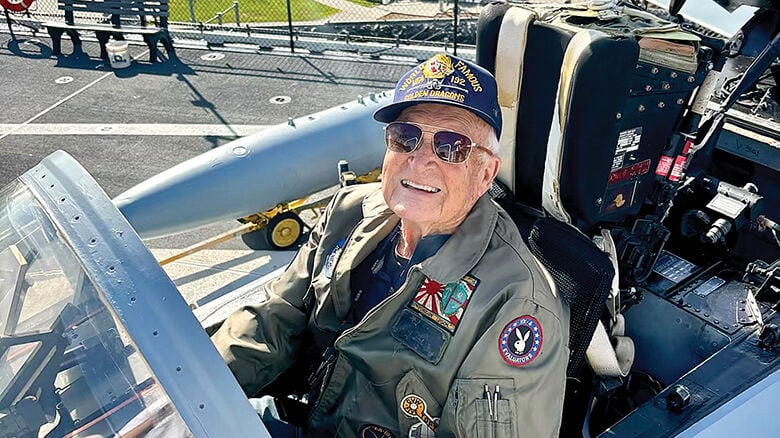
During the Valentine’s Day ceremony, the F/A-18 Hornet fighter jet flown by Lt. Kent M. Kiepe and inscribed with his name was dedicated in his memory. The jet joins several other planes as part of the flight deck display on the USS Midway, a retired aircraft carrier-turned-museum.
Kent’s father, Glenn Kiepe, and his four sisters, as well as several other family members, traveled to California at the Navy’s expense to take part in the dedication ceremony, during which the inscription “Lt. Kent Kiepe” and his call sign, “Keeper,” were unveiled on the side of the plane. Kent’s mother, Mary Jane, died in March 2025.
“They treated us like royalty,” said sister Kelly Dallas. “After the ceremony, they had a reception right there on the deck next to his plane. To think that someone would go to all that trouble and time 34 years later – it was very humbling.”
Sights on the skies
Kent Kiepe grew up in the R-7 community and graduated from Festus High School in 1980. He earned an associate degree from Jefferson College, where he played baseball, and went on to Missouri Western State College (now University) in St. Joseph, where he again played baseball and took part in Army ROTC. After graduating with a bachelor’s degree in business and agriculture, he joined the Navy in 1985.
“He wanted to fly, and the Army didn’t have anything but helicopters,” said his father, Glenn. “Fighter planes, jets, was what he wanted. There were two slots open, and he got one.
“He got a degree in agriculture; I assumed he was going to be a farmer. One day he said, ‘Dad, I want to fly.’ I told him, ‘Well, you’ve got this farm here; all you gotta do is step into it.’
“He said, ‘Tell you what: I’ll come and do crop dusting for you.’”
After graduating from flight school, Kent joined squadron VFA-192, known as the Golden Dragons, on board the Midway, flying missions as part of Operation Desert Shield. Squadron members became particularly close because of the simple geography of their situation.
“Midway was the only carrier whose home port is not in the U.S.,” sister Kim Neel said. “They would port in Japan, and the guys hung together more than the ones who ported in the U.S. and could get to their homes.”
Fellow squadron pilot Dave “Shooter” Vanderschoot said Kent was popular but humble. He served as the squadron’s legal officer and coached the naval air wing softball team.
“Kent was probably the best friend I’ve ever had,” Vanderschoot said. “He was good in every way and loved by all.”
Kent was a skilled pilot, named Tailhooker of the Year in 1990 and ranked in the Top 10 of pilots in carrier landings. He flew one particular jet, number 313, and even had his name on the side of it for a time.
“We have a lot of photos of him with it and in it,” sister Kari Kopp said.
The family got a few close-up demonstrations of his skills as well.
“He reminded me of Maverick in ‘Top Gun,’” Kelly laughed. “He was coming down the river from Scott (Air Force Base) once, and he buzzed the house – I mean, he flew low enough you could see the numbers on the plane.
“He liked to push the limits. Not dangerously, just kind of mischievous. He was adventurous.”
In late 1990, Kent was assigned to Air Test and Evaluation Squadron VX-4 in California, where he had a leading role in the development of a new radar system for the F/A-18 Super Hornet. He had been accepted into the “Top Gun” program and was scheduled to start in May 1992.
“There was nothing official on it, nothing on paper yet, but it was pretty well common knowledge that he was being groomed for the Blue Angels,” Glenn said.
Then, in February 1992, Kent and fellow pilot Craig Melton were flying in a small Cessna aircraft to attend meetings at China Lake Naval Weapons Center, about 70 miles northeast of Bakersfield, to give a report. Melton was in the pilot’s seat, since he had more hours in a small plane.
“It was later determined the crankshaft broke,” Glenn said. “They crashed in the San Gabriel Mountains, and both were killed.”
Kent’s commanding officer, Capt. Tom Perkins, kept in close touch with the family following the accident.
“He wrote a letter to Mom and Dad after Kent was killed,” Kari said, “And he said if he had to choose a pilot to ride with, ‘Keeper’ was the best.”
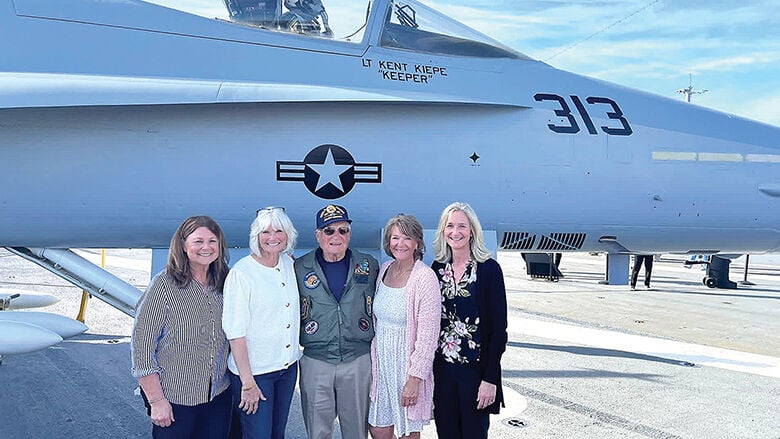
Lt. Kent Kiepe’s father and sisters in front of his plane at the dedication ceremony. From left, Kim Neel, Kelly Dallas, Glenn Kiepe, Kristi Landess and Kari Kopp.
Taking its rightful place
Not long after the accident, the Midway was taken out of commission, and the jet Kent had flown was briefly retired.
“It was painted camouflage, with a Russian star on the tail, and used as an ‘enemy’ plane for training,” Glenn said. “Then it was housed for many years in a warehouse in Florida. When they made the Midway into a museum in 2004, they got the plane back.”
The Kiepes saw it but never made the connection, since it looked nothing like it had before.
“We visited the ship, took pictures in front of (the plane), even,” Kim said. “We had no idea it was Kent’s plane.”
Former pilots Vanderschoot and Chris “The Beav” Mather visited the museum in early 2025 and noticed the plane on display had a serial number that matched the one their late friend had flown all those years ago.
They approached Navy officials about having the plane restored and putting Kent’s name back on it.
“I got a text from Dave Vanderschoot, saying it bothered him and other pilots that the jet wasn’t historically accurate,” Kari said. “He said, not only were they going to restore it, but they wanted to put Kent’s name on it in perpetuity. Those two guys got the whole thing rolling.”
In the course of doing research for the restoration, it was discovered that this particular plane had been the lead aircraft on the first strike of Operation Desert Storm in 1991, adding even more historical weight to its long career.
After three months of work, the plane was ready, and the Navy flew the Kiepe family to San Diego for the unveiling ceremony, which included several pilots who had flown with the Golden Dragons.
“The guys had a regular reunion at this ceremony,” Kim said.
The day before, the family was invited to tour the Midway, with Navy staff giving them glimpses into nearly every nook and cranny.
“We saw where Kent stayed, where he worked,” Kelly said. “It was like six hours we were there, wandering from one end to the other.
“Someone said it’s possible we saw more of the ship than Kent ever did.”
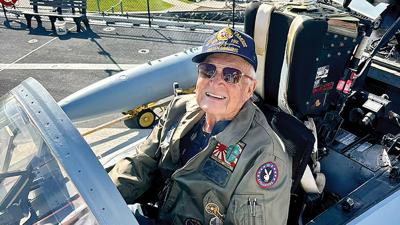
On a beautiful southern California day, Glenn Kiepe stepped to the podium, wearing his son’s flight jacket, to thank the Navy for the honor.
“Getting this plane dedicated to Keeper was something we had to do,” said retired Navy Rear Adm. James “Gib” Godwin, who commanded the squadron while Kent was a member. “It is really important to us. He was such a great guy.”
Terry Kraft, president and CEO of the Midway Museum, said, “The greatest honor is to be honored by your squadron mates, and that’s what we have here on Midway. More than 1 million guests will walk by this aircraft every year.”
Glenn said he felt the presence of his son and his wife.
“I know Kent made a difference,” he said. “This unveiling ceremony was such an honor and quite a moment for our family. It is something I will never, ever forget, and I consider it one of the highlights of my life.”