





(Photo by Shamin Haky via Unsplash)
More than half of Americans see AI certifications as the new “career currency" (57%), according to new research.
A survey of 2,000 general population adults explored the excitement and pitfalls around artificial intelligence, finding that millennials (65%) and Generation Z (Gen Z) (64%) especially see the influence of AI as career-changing.
Where the workplace is concerned, problem-solving skills (17%), adaptability (16%), communication skills (15%) and critical thinking (15%) are what respondents deem to be the most valuable qualifications as things shift in the next five years.
Younger generations have a different mindset, with Gen Z highlighting leadership skills (17%), higher education (15%), time management (13%) and creativity (13%) as necessary.
However, a survey conducted by Talker Research for Colorado State University Global (CSU Global) found that knowing how to use AI is most quickly climbing the charts for valued skills (18%).
Generally, a little less than half of Americans have a favorable opinion about AI in the workplace (48%). Gen Z (58%) and millennials (56%) are more likely to hold this perspective than older generations.
Further, 62% of employed respondents said they would use AI more often at work if they were more confident in its effectiveness, encouraged to use it more or had received training on it.
“The main barriers to AI adoption in the workplace are gaps in employee confidence, organizational culture and training. Educational opportunities and organizational leadership can help bridge that divide,” said Dr. Audra Spicer, CSU Global Interim President and CEO. “As AI becomes a more widely used tool across industries, professionals need the grounding to use AI responsibly and efficiently.”

(Talker Research)
Whether or not they already use AI, two-thirds of those in the workforce think it’ll have an impact on their career path within the next year.
Half of respondents think it’ll be just six months before every new hire will be required to know how to effectively use AI in the workplace.
In addition, Gen Z feels like AI will shift how success is measured in the workplace (15%), while baby boomers (28%), Generation X (Gen X) (20%) and millennials (16%) all agree that AI will change how people are educated and trained.
The latter three generations also believe that AI will change the kinds of skills that are considered “valuable” (baby boomers: 25%; millennials: 16%; Gen X: 16%).
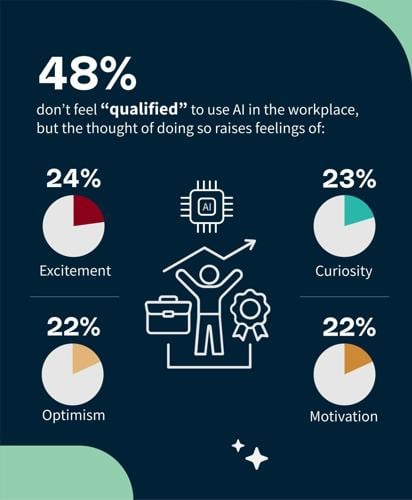
Despite feelings that AI will impact educational and professional settings, 48% don’t feel “qualified” to use it in the workplace, but the thought of doing so raises feelings of excitement (24%), curiosity (23%), optimism (22%) and motivation (22%).
With the rise of new technological tools, soft skills still remain an important part of the workplace as well. Work ethic (24%), patience (23%) and problem-solving (21%) were revealed to be the top three strengths Americans believe they bring to the office.
Being able to learn quickly (20%) and attention to detail (20%) are also high on the list.
Thirty percent of those who said empathy or emotional intelligence was one of their greatest skills said that this human-oriented skill has been helpful at work.
With their confidence in their strengths, respondents feel safe from AI replicating their empathy (55%), work ethic and discipline (50%), emotional intelligence (47%), sociability (40%) and resilience (40%).
AI integration at work continues to draw attention; however, with 48% of respondents revealing they’d want to take a course in a field of interest if it incorporated AI into the assignments to gain a deeper understanding of how it works (29%) and the opportunity to learn something new (29%).
“While AI cannot replicate all of the human-oriented strengths that individuals bring to the table, it can help supplement certain tasks in the workplace. As the technology continues to influence the professional landscape, learners increasingly want to understand how to harness its practical applications,” said Dr. Spicer. “By thoughtfully integrating these tools into higher education curricula, institutions can better align student preparation with evolving workplace demands.”
Research methodology:
Talker Research surveyed 2,000 general population Americans who have access to the internet; the survey was commissioned by CSU Global and administered and conducted online by Talker Research between July 28 and Aug. 2, 2026. A link to the questionnaire can be found here.
To view the complete methodology as part of AAPOR’s Transparency Initiative, please visit the Talker Research Process and Methodology page.