


Accounts differ on whether Swanson introduced the TV Dinner in 1953 or 1954, but Swanson took an existing frozen-dinner concept and turned it into an American institution. The meal came in an aluminum tray with three compartments and was marketed around America’s growing habit of watching television. What fills those compartments today would be unrecognizable to anyone who bought the first one.
American wives and mothers entering the workforce through the 1950s felt the TV Dinner’s appeal most directly. Widely reported at 98 cents per tray, it offered a new shortcut at a time when more women were working outside the home while still being expected to handle much of the household cooking.
Television had swept through American living rooms during the same period, and the TV Dinner arrived perfectly calibrated to both realities. Beyond convenience, the meal’s promise of a balanced dinner in a single tray gave busy families something they could feel good about putting on the table.
The original tray now sits in the collection at the Smithsonian’s National Museum of American History, donated by Campbell Soup Company, and National TV Dinner Day on Sept. 10 exists to commemorate that first grocery store appearance. The cardboard box it came in was designed to look like a television set, complete with dials, a marketing detail that made clear exactly who this meal was for. It held sliced turkey with gravy, cornbread dressing, sweet potatoes and peas arranged in a three-section aluminum tray, and a small dented piece of foil became an artifact of how America changed.
From ‘TV Dinner’ to every freezer in America
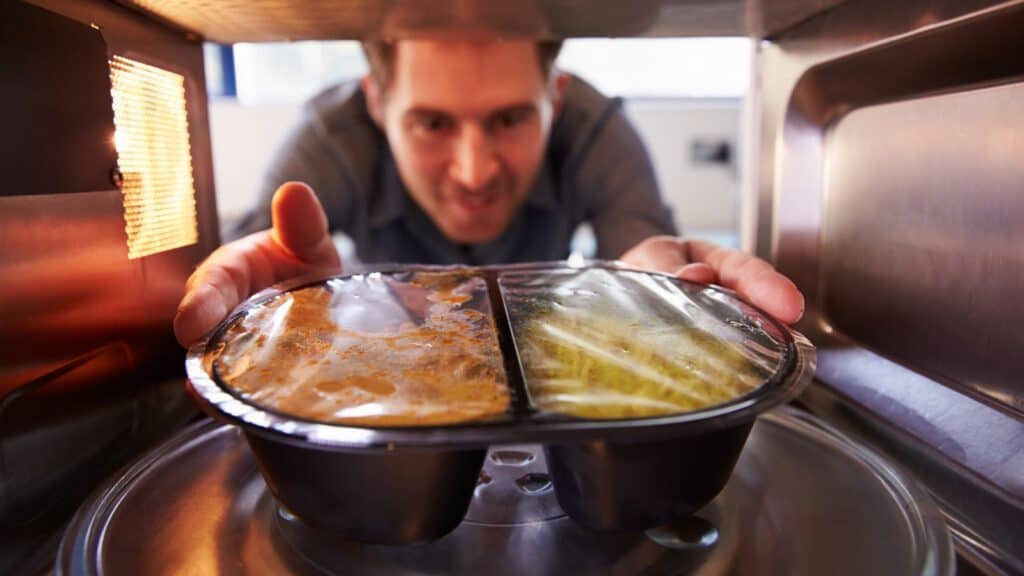
Swanson retired the name in 1962, nine years after the product launched, and the format the name described kept going long after the label disappeared. Ovens gave way to microwaves, and aluminum gave way to microwave-safe trays. The original 25-minute oven preparation was eventually reduced to several minutes in a microwave.
Campbell Soup Company replaced the aluminum tray in 1986 across all Swanson varieties with microwave-safe plastic, retiring a material that had no future in a microwave kitchen. A dessert compartment was added in 1960, giving the tray four sections, a format that remains common among single-serve frozen dinners today. The essential architecture never changed. The format remained a complete meal, separated into compartments, portioned for one, ready without effort.
Brands including Banquet, Stouffer’s, Marie Callender’s and Hungry-Man helped make the frozen dinner a permanent part of the American grocery landscape. The frozen meal category reached nearly every American grocery store and household. It multiplied quickly, and within a decade of Swanson’s launch, what began as one company’s experiment had become a standard section of the American supermarket.
The tray still wins
Multi-serve frozen formats, including pizza, bagged meals and tray dinners, appeared in 11 billion eating occasions in 2025, up 29% from 2020. The compartmented complete meal scaled. What has changed dramatically is what goes inside those compartments. The original tray held the kind of food a midcentury American housewife would recognize from her own kitchen. Today, that same basic convenience format can hold everything from Indian-inspired meals and teriyaki dishes to restaurant-style pasta and other globally influenced foods.
The frozen aisle has become one of the more adventurous sections of the grocery store, and it got there without abandoning the compartmented format Swanson established in 1953. The vessel stayed while the world filling it moved on. As the U.S. food market has become more diverse, grocery demand has followed, with what NielsenIQ tracks as multicultural food sales growing 12% in 2024, three times faster than total grocery sales.
Same screen, different scroll
Swanson engineered the original TV Dinner for a country newly devoted to the television set, one that wanted to eat in front of it without effort. That appetite has not gone anywhere.
In a recent survey, half of Gen Z consumers reported turning to TikTok for food inspiration, and 36% said social media influences their frozen food purchases. The meal invented for one screen era has found its audience in another. The screen got smaller and the scroll replaced the channel dial, but the frozen tray is still in the picture.
What the tray got right
The frozen food industry has spent 73 years proving that the original TV Dinner’s operating principle was right, and it is still doing so. The category now totals $93.5 billion in annual U.S. sales, with protein-packed meals, restaurant-inspired favorites, family-style solutions and all-day breakfast among its key growth areas. The foods have gone global while the architecture has not.
The industry built on that first aluminum tray looks nothing like the company that started it. Swanson frozen dinners remain available in Canada, while the Swanson frozen-meal brand was discontinued in the United States around 2009. The format it popularized is everywhere.
Mandy Applegate is the creator behind Splash of Taste and seven other high-profile food and travel blogs. She’s also the co-founder of Food Drink Life Inc., a unique and highly rewarding collaborative blogger project. Her articles appear frequently on major online news sites, and she always has her eyes open to spot the next big trend.
The post Swanson’s first TV Dinner came in a box shaped like a television set, and we’re still eating frozen entrees appeared first on Food Drink Life.