







(NASA Goddard via SWNS)
By Dean Murray
A car-sized spacecraft set to head to Saturn has reached a major milestone.
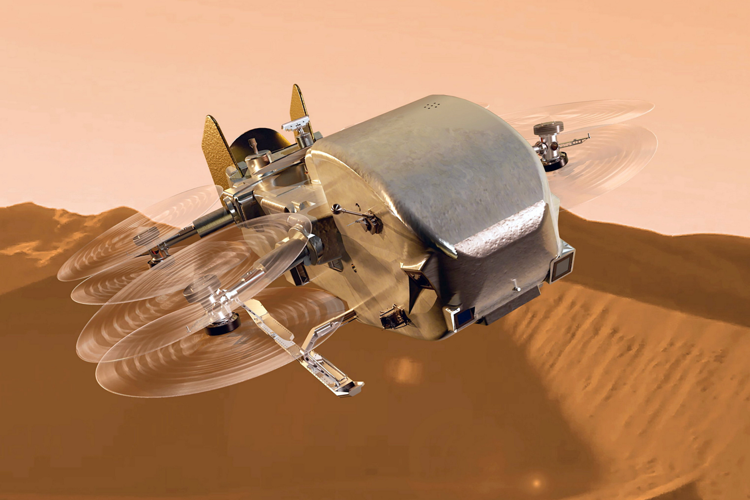
NASA's Dragonfly is a 13-foot-long, nuclear-powered rotorcraft that will fly to Saturn’s moon Titan and investigate its habitability.
The Dragonfly team at the Johns Hopkins Applied Physics Laboratory (APL) in Maryland has delivered the fuselage for the next phase of spacecraft integration ahead of schedule.
NASA Science said: "Dragonfly is starting to look less like a collection of spacecraft parts and more like the rotorcraft that will fly across the surface of Titan, Saturn’s hazy moon."

(NASA Goddard via SWNS)
The rotorcraft, targeted to arrive at Titan in 2034, will fly to dozens of locations on the moon, looking for prebiotic chemical processes common on both Titan and the early Earth before life developed.
NASA says Dragonfly is not a life-detection mission, but one aimed at understanding habitability and the prebiotic conditions that may have existed before life emerged on Earth.
It is being built to endure the rigours of Titan’s environment, including frigid temperatures averaging around minus 290 degrees Fahrenheit (minus 179 degrees Celsius), swirling dust on the surface, and potentially liquid methane rain.

(NASA Goddard via SWNS)
Described as NASA's first flying science laboratory for another world, Dragonfly will begin its exploration near Titan’s equatorial dunes before moving on to other scientifically interesting locations.
Titan, with its thick atmosphere and rich organic chemistry, is regarded as one of the most promising places in the solar system to study the origins of life.
The mission is due to launch no earlier than July 2028 and is expected to arrive at Titan in late 2034.