


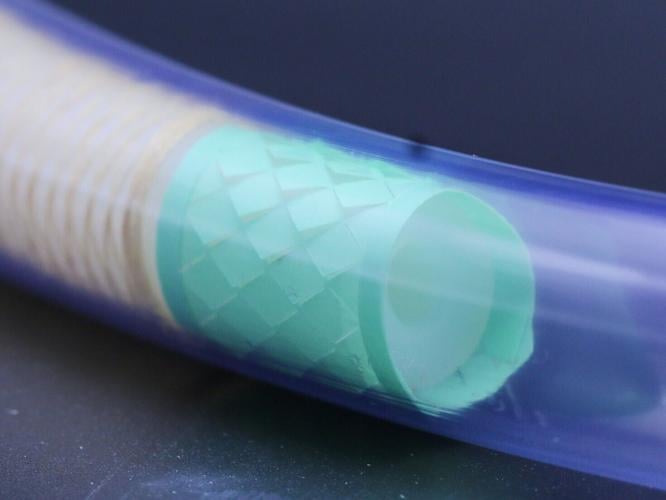
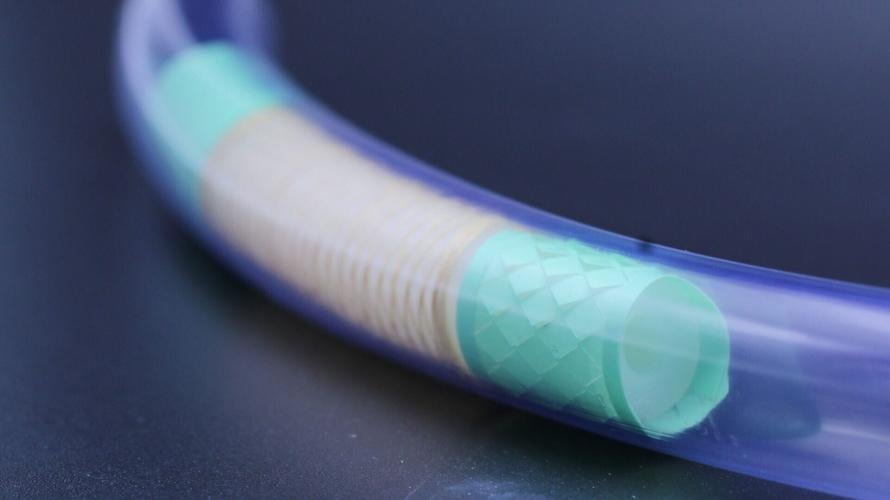
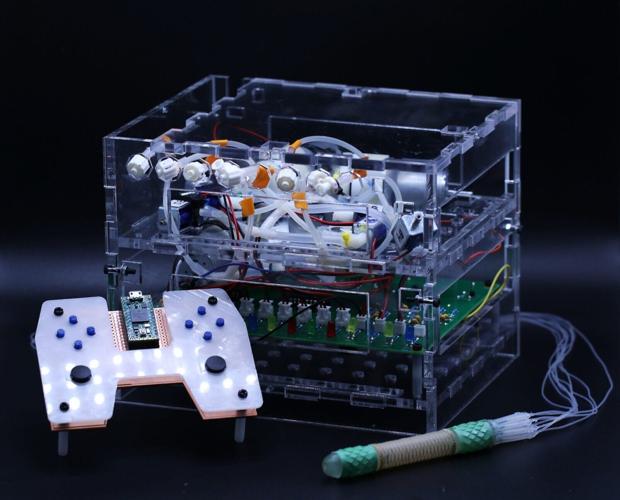


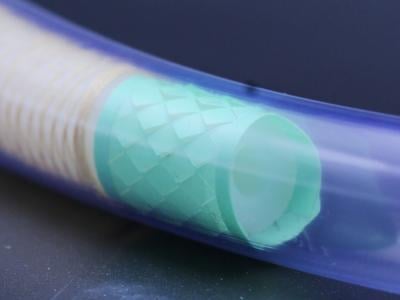

Close up of the bioinspired soft enteroscopic robot. (MIT via SWNS)
By Stephen Beech
A snake-inspired soft robot could help doctors diagnose and treat disorders of the small intestine.
The revolutionary device can inch through the hard-to-reach organ — making biopsies and drug treatment easier, say scientists.
The robotic enteroscope has been developed by engineers at Massachusetts Institute of Technology (MIT).
It can perform imaging, deliver drugs and even remove small polyps or tissue samples for biopsy, according to a study published in the journal Science Robotics.
Disorders of the small intestine are often difficult to diagnose and treat.
At more than 20 feet (6 meters) in length, 1 inch in diameter and located deep within the body, the organ is harder to access than other parts of the digestive tract.
To overcome those challenges, the MIT team designed the robotic enteroscope that can move easily through the narrow passage of the small intestine.
The researchers say they were inspired by the locomotion of snakes, as well as the scaly skin that helps them gain traction on slippery surfaces.
A special textured coating helps the robot remain attached to the mucosal lining of the intestine as it inches its way through the narrow tube.
Similar to an endoscope, the robot contains a range of tools to help detect and treat any abnormalities that it might encounter.

Example of the control box, wireless joystick controller and bioinspired soft enteroscopic robot. (MIT via SWNS)
Study senior author Giovanni Traverso said: “When we evaluate the small intestine, we do it for either diagnosis or treatment.
“If we find a little polyp that needs to be removed, this robot allows us to take a biopsy or remove it.”
Common problems that doctors need to evaluate within the small intestine include bleeding, lesions and blockages.
The only current way to diagnose those intestinal complications is with a procedure known as double-balloon enteroscopy.
During that procedure, an enteroscope advances through the small intestine as a healthcare worker alternately inflates and deflates two balloons that help propel it through the tract.
But the process is slow and laborious, so the MIT team wanted to design an alternative enteroscope that would be easier to control and could move faster through the intestine.
Traverso said: “The fundamental challenge that we’re trying to overcome is how to evaluate that 20-to-25-foot segment of the small intestine in a way that can be more automated.”
The new tube-like robot moves through the narrow small intestine using a locomotion strategy similar to that of the snake.
When slithering along the ground, a snake can steer itself by first contracting muscles on one side of the body, then the other.
To mimic that process, the MIT team designed multifunctional actuators that control the robot’s movement.
Each actuator contains four chambers, which can be inflated in different combinations, prompting the tube to extend or bend in any direction.
Traverso said: “By tuning the amount of air that goes into these chambers, you can tune the direction that the robot is moving in.”
The head and tail segments of the robot contain additional expandable anchoring balloons that take turns inflating and deflating, helping the robot move forward.
Traverso says the head and tail segments are coated with special patterned sleeves inspired by kirigami, a variation of origami that involves cutting paper as well as folding it.

(Photo by MART PRODUCTION via Pexels)
Using that technique, the team created coatings that lie flat until they are stretched by the expansion of the balloon, which causes three-dimensional kirigami needles to pop out.
Similar to the scales of a snake, the needles give the robot more traction within the slippery lining of the intestine.
In previous work, Traverso’s lab has used the approach to create coatings for shoe soles that give them more traction, as well as stents that can temporarily lodge in the esophagus and release drugs.
Paper co-lead author Ahmad Mujtaba Jebran, an MIT graduate student, said: “By using kirigami sleeves to enhance surface friction, the robot can generate localized tissue engagement traction for locomotion without relying on excessive stretching of the delicate small intestinal tissue.”
The system also includes electronics that allow for navigation, with a controller that the person operating the device can use to guide the robot through narrow passages and around tight corners.
The soft robot is tethered to the external controllers by a cable and is designed so that it could enter the body through either the mouth or the rectum.
The robot contains tools including a camera for imaging, a sprayer for drug delivery, and clips that can take tissue biopsies or remove polyps.
In animal studies, the research team showed that the robot could travel around 6.5 feet (2 meters) through the small intestine.
They also successfully demonstrated the drug sprayer, tissue clips and camera.
The MIT team is now working on improving the navigation systems and testing the approach for additional applications in the small intestine.
Traverso added: “We hope we can continue to move it forward to eventually develop systems that can help achieve more automated evaluation of the small intestine.”