


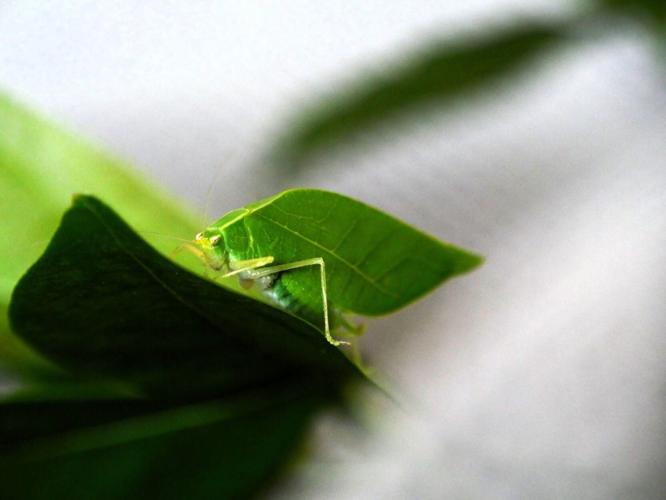
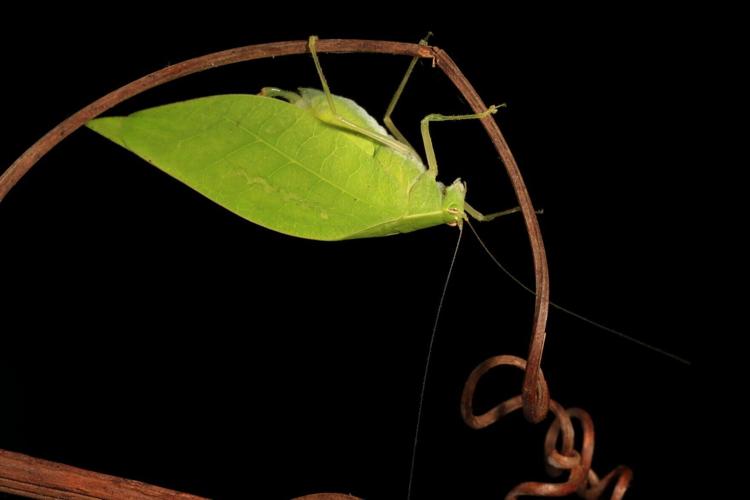

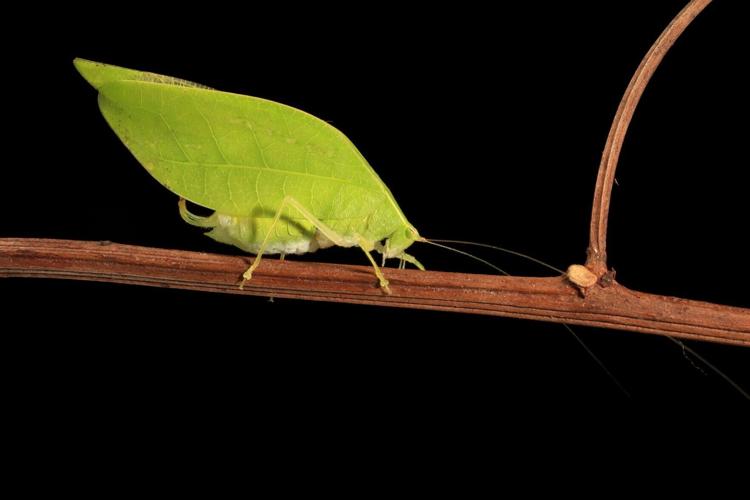
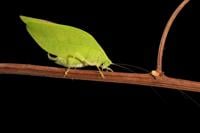

Katydids - often called long-horned grasshoppers - create songs by rubbing specialized structures on their wings together. (University of St Andrews via SWNS)
By Stephen Beech
A male insect uses its leaf mimicry to attract mates, reveals new research.
Male katydids also use their "leafy" disguise to amplify mating calls — making themselves more attractive to the opposite sex, according to the findings.
The study, by scientists from the University of St Andrews in Scotland, is the first demonstration of how impressive leaf mimicry can also be used to enhance the attractiveness of a sexual signal.
Katydids — often called long-horned grasshoppers — create songs by rubbing specialized structures on their wings together.
But in many tropical species, the leaf-mimicking portion makes up the majority of the wing surface.
The St Andrews team's findings, published in the journal Proceedings of the Royal Society B, show that males are able to use the acoustic properties of the structures to their reproductive advantage.

Scientists from the University of St Andrews in Scotland found out how impressive leaf mimicry can also be used to enhance the attractiveness of a sexual signal. (University of St Andrews via SWNS)
It had been previously believed that adaptations for survival and for attracting mates function in conflict, particularly if they are physically connected in some way, as is the case with katydids.
For example, the flashy tail feathers of a peacock make males more attractive to mates — but makes them more detectable to predators, making them less likely to survive.
However, the St Andrews team say their findings are a rare example of how multifunctionality can be achieved.
Bioacoustic, behavioral, and biophysical experiments revealed that the "leafy" structures do more than conceal — they also enhance the attractiveness of male calls to females.
Research leader Dr. Benito Wainwright said: "While the males are the ones that sing, the females indicate their interest by replying with short clicks.
"Despite living in an extremely noisy rainforest, they produce very short, sporadic and infrequent calls.
"Estimates suggest they call for only a total of two seconds in a single night.
"They also call in the ultrasound which makes it difficult for humans to hear them."
The researchers looked at a species of katydid called Viadana brunneri, native to Central America.

A male insect uses its leaf-like camouflage to attract mates, reveals new research. (University of St Andrews via SWNS)
They found that if the "leafy" portions of the male wings were removed, it changed the pitch and loudness of their songs.
When the calls were played to females, lower pitch calls from males with their "leafy" sections intact were preferred.
It was also discovered that the leafy portions of the male katydid wing vibrate so that they amplify the songs males produce, making them more detectable to females.
Wainwright, a research fellow at the University of St Andrews, added: "Our study provides a rare example of natural and sexual selection acting in harmony, producing traits that simultaneously improve survival and mating success.
"We are now extremely excited to start exploring how such an interesting interaction evolved in katydids."