


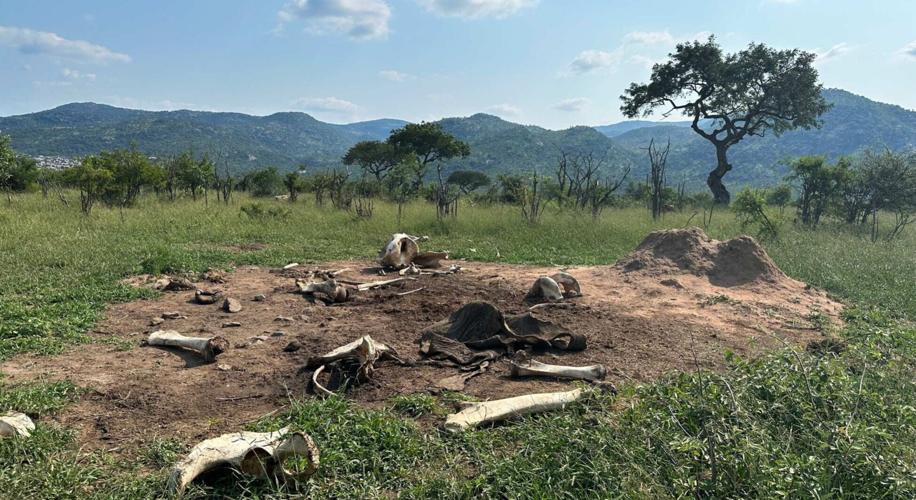
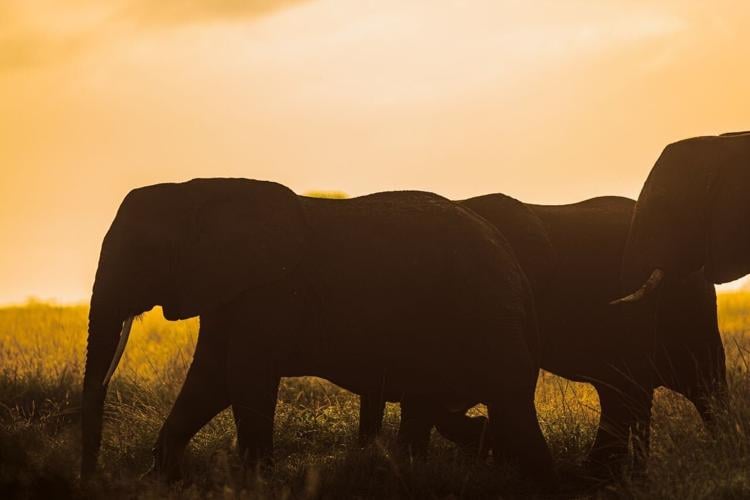
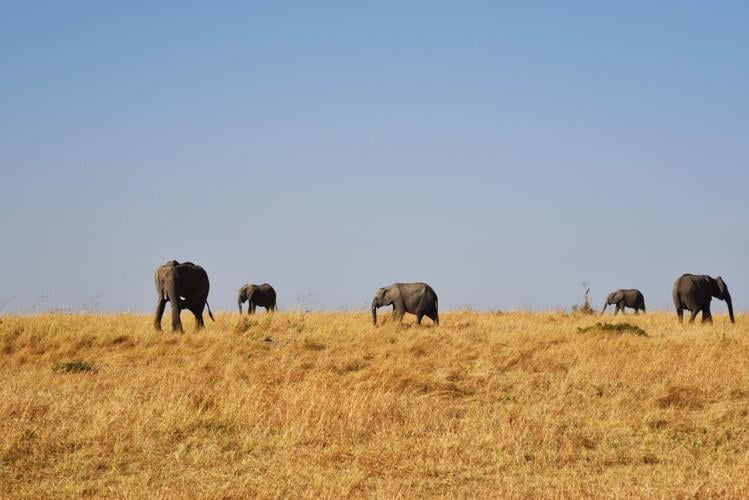
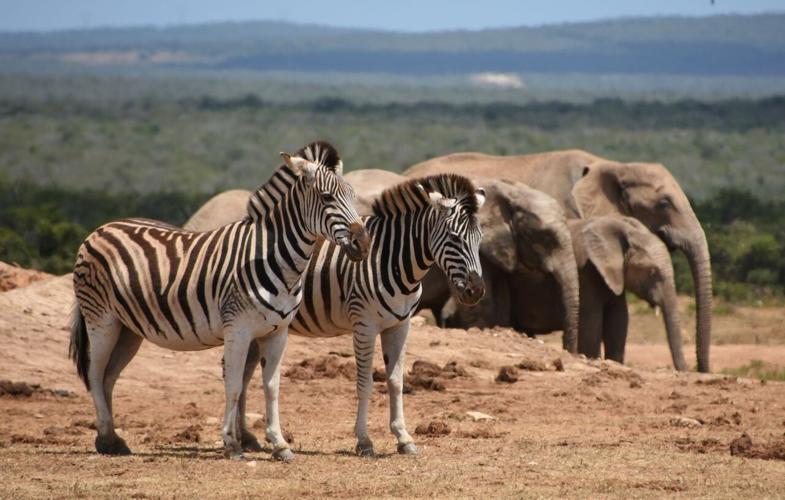
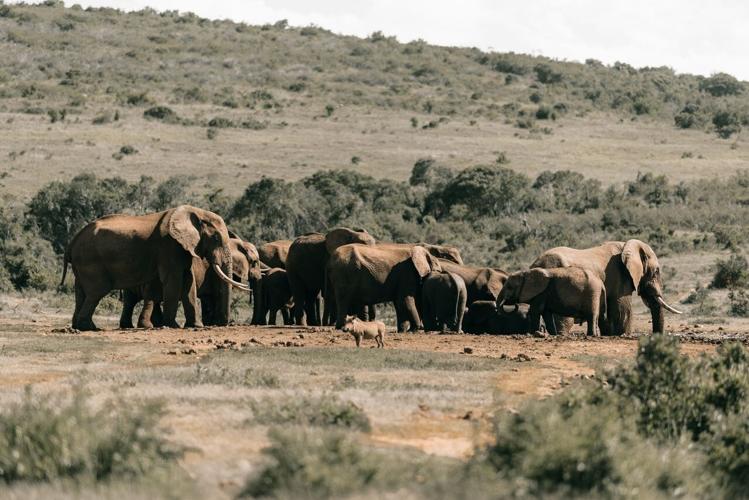

The site of an elephant carcasses in South Africa’s Kruger National Park. (Courtney Reed via SWNS)
By Stephen Beech
Elephants leave a “jaw-dropping” legacy by shaping the grassy plains where they roamed for years after their deaths, reveals new research.
Scientists discovered that the location where one of the iconic mammals dies becomes a “nutrient hot spot.”
And it affects the local ecosystem long after the body is gone and the bones are scattered, according to the findings published in the journal Proceedings of the National Academy of Sciences.
An international team of researchers studied the sites of elephant carcasses in South Africa’s Kruger National Park.
They documented soil chemistry, microbiology, biodiversity and animal grazing around elephant remains.
The team discovered that decomposition creates nutrient hot spots that can persist on the landscape for years, possibly decades.

(Photo by Rino Adamo via Pexels)
The flush of nutrients fuels microbial activity and plants, which attracts herbivores to the site long after the visual signs of the elephant have disappeared.
Study lead author Courtney Reed said: “We know that these really charismatic megafauna have strong impacts on ecosystems while they’re alive, but until now we haven’t really understood how those impacts continue after they die.”
In 2009, one of Kruger National Park’s great tuskers — a large bull elephant called Alexander — died of natural causes.
His body lay just off one of the main roads that study senior author Dave Thompson frequently traveled on for another project.
Thompson, a biodiversity scientist at the South African Environmental Observation Network, said: “Watching the decomposition of that carcass over just a couple of months, got me curious.”
He shared his observations with his colleague, University of California professor Deron Burkepile.
The duo gradually developed ideas and theories about the carcass’s effect on the soil.
They enlisted the help of Kruger’s rangers to find sites and applying for grants to study the phenomenon in earnest.

(Photo by Eric Kamoga via Pexels)
Reed, of Princeton University in the U.S., said: “When a large animal dies, it immediately alters the spot where it falls.
“At first, the elephant carcass just wipes out all the biomass at the center, leaving these huge bare spots.”
She explained that the animal’s immense size flattens vegetation, and the activity from throngs of scavengers scrapes the surrounding ground bare.
Study senior author Burkepile said: “Even for a huge animal like an elephant, the meat and the bones can disappear within a couple of weeks.
“It essentially resets the plant communities to zero.”
Co-author Izak Smit, a senior scientist at South African National Parks, said: “My intuition was that, since the carcass was only physically present for a relatively short period, its effect would also be rather muted and transient.
“However, a very different picture emerged when the lab results came back.”
The findings showed that nutrients from elephant remains percolate into the ground, affecting the soil chemistry and microbial community.

(Photo by Nancy Yu via Pexels)
And the effects rise back above ground to influence plant growth and the animals that graze there.
Reed had suspected that nutrient levels might be higher under a carcass, but she described the magnitude as “jaw-dropping.”
She added: “At really fresh carcass sites, soil nitrogen concentrations can be up to 3,000 times higher.
“That’s just insane.”
Co-author Tercia Midzi, a senior manager in scientific services in Kruger National Park, added: “That amount of ammonium was not on my bingo card.”
However, the spike in nutrients doesn’t initially promote regrowth.
The influx of compounds such as ammonium instead cause nutrient toxicity, initially preventing plants from growing back.
The team saw a biodiversity “cold spot” dominated by just a handful of fast-growing species, a trend that persisted for at least eight years after an elephant’s death.
The plants that are able to colonize the site are especially nutritious, though, based on assays of grass leaves.

(Photo by Tom D'Arby via Pexels)
Burkepile said: “It turns these grasses from watery iceberg lettuce into a juicy romaine.
“Those plants are probably growing faster, but the herbivores are just mowing them down because they want to get at that nutrient-rich forage.”
Grazers continued to revisit carcass sites for years, and their manure further enriched the areas, keeping nutrient levels in the soil high.
The team put up fenced enclosures to keep herbivores at bay so they can investigate regrowth rates at carcass sites.
They hope to publish the results from that experiment in the coming year.
Burkepile believes that savannas may sit in a “Goldilocks zone” where the carcasses have a particularly strong impact.
In more dynamic ecosystems, such as forests or wetlands, the effect may be short-lived as nutrients are leached out of the topsoil and washed away by lots of rain.
Meanwhile, deserts may be too water-limited to see the full effect because microbes and plants need moisture to take advantage of nutrients from the carcass.
The team is seeking collaborators in areas of sub-Saharan Africa to test the theories, and intends to continue surveying the sites in Kruger National Park to build up a time series of data for a future study.

(Photo by Taryn Elliott via Pexels)
Thompson said: “When we got started, we didn’t know how the carcass of a four-tonne elephant would impact its environment.
“Nothing of that magnitude had been studied in a terrestrial system.”
Smit said: “We found that even around eight years after an elephant had died, the ‘signal’ was still present in the soil and vegetation, and herbivores were still preferentially visiting those areas.
“It was such a powerful reminder that what we see in nature is often shaped by legacies from the past, even when the causes of those legacies have long since disappeared from view.”
He added: “We can only speculate on what this may mean for ecosystems where these mega-herbivores are now missing.
“But our Kruger mega-carcass study does make one ask and wonder about those questions more seriously.”