



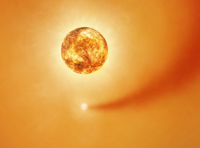


(NASA/ESA/Wheatley/STScI via SWNS)
By Dean Murray
Space scientists have solved the mystery of why one of the brightest stars in the sky acts strangely.
Red supergiant Betelgeuse has been found to have a newly discovered companion star, Siwarha, that caused it to “sneeze” and become unexpectedly faint in 2020.
Located roughly 650 light-years away from Earth in the constellation Orion, Betelgeuse is so large that more than 400 million Suns could fit inside.
For decades, astronomers have tracked changes in its brightness and surface features in hopes of figuring out why the star behaves the way it does.
Using new observations from NASA’s Hubble Space Telescope and ground-based observatories, they tracked the influence of a recently discovered companion star, Siwarha, on the gas around Betelgeuse.
The research, from scientists at the Center for Astrophysics | Harvard & Smithsonian, reveals a trail of dense gas swirling through Betelgeuse’s vast, extended atmosphere, shedding light on why the giant star’s brightness and atmosphere have changed in strange and unusual ways.
As Siwarha speeds through Betelgeuse’s outer atmosphere every 2,100 days, it moves gas aside to form a trailing wake of denser material – just like a boat ploughing through water. This ripple pushes outward, altering light patterns astronomers observe.

(NASA/ESA/Wheatley/STScI via SWNS)
The results of the new study were presented on Monday, Jan. 5 at a news conference at the 247th meeting of the American Astronomical Society in Phoenix and are accepted for publication in The Astrophysical Journal.
This discovery resolves one of the biggest mysteries about the giant star, helping scientists to explain how it behaves and evolves while opening new doors to understanding other massive stars nearing the end of their lives.
“It’s a bit like a boat moving through water. The companion star creates a ripple effect in Betelgeuse’s atmosphere that we can actually see in the data,” said Andrea Dupree, an astronomer at the CfA and the lead study author. “For the first time, we’re seeing direct signs of this wake, or trail of gas, confirming that Betelgeuse really does have a hidden companion shaping its appearance and behavior.”
“The idea that Betelgeuse had an undetected companion has been gaining in popularity for the past several years, but without direct evidence, it was an unproven theory,” said Dupree. “With this new direct evidence, Betelgeuse gives us a front-row seat to watch how a giant star changes over time. Finding the wake from its companion means we can now understand how stars like this evolve, shed material, and eventually explode as supernovae.”
NASA Hubble said: "Betelgeuse, Betelgeuse, Betelgeuse! This red supergiant star is only 650 light-years away, making it large enough and close enough to be a popular source of study for scientists investigating how giant stars age, lose mass, and eventually explode in a supernova."