


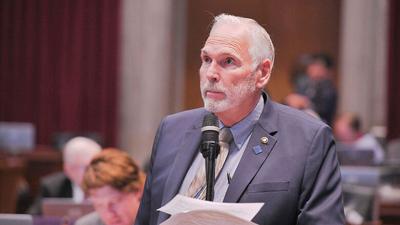

State Rep. Phil Amato has prefiled a bill to define what artificial intelligence software, or AI, cannot be in Missouri.
Amato said he believes the bill, called the AI Non-Sentience and Responsibility Act, may become the foundation for how AI is regulated in the future.
“The bill defines what AI is not,” said Amato, whose District 113 represents the northeast portion of Jefferson County. “It is complex but simple.”
The bill was filed Dec. 1 and sets parameters for what AI cannot do. The state Legislature will convene Jan. 7 and be in session until May 15.
The bill says, “AI systems shall not be granted the status of a person or any form of legal personhood, nor be considered to possess consciousness, self-awareness or similar traits of living beings.”
If passed, AI would not be allowed to get married, be someone’s boss or own property, and the software would not be considered to possess consciousness or self-awareness.
The bill also clarifies who would be held responsible if AI harmed someone or broke a law.
The proposed bill states that AI systems will not be recognized as legal entities. It also says, “any direct or indirect harm caused by an AI system’s operation, output or recommendation, when used as intended or misused, shall be the responsibility of the owner or user who directed or employed the AI.”
The bill further states owners of AI systems must maintain proper oversight and control of their systems and may be held liable if proper safeguards are not in place to avoid foreseeable risks.
It also says an AI system cannot bear “fault or liability” on its own, so owners of systems may not avoid legal ramifications by shifting blame to the system.
“It is so logical,” Amato said. “It is the first brick that we need to set a foundation for the rest of the stuff that will come after.”
Amato said the bill will likely be assigned to the Emerging Issues Committee, and he said he believes it will have plenty of support.
As of Dec. 23, six House legislators have filed bills concerning AI.
“It looks like it will be a top priority this coming session,” he said of AI bills. “The Emerging Issues chairman is Brad Christ, who is from the south St. Louis County, Crestwood area. Brad is anxious to get it.”
Creation
Amato said a chance encounter at a lunch following a funeral led to the creation of his proposed bill.
He said he met a man who was a retired University of North Carolina professor who taught AI and computer science at the Chapel Hill, N.C., university. He said the man retired as a professor to start an AI company in California with one of his former students, and then the former professor started his own AI company.
Amato said both of those companies were sold, and after the former professor sold his own company, he volunteered to create rules to govern AI systems.
“There were so many of us who knew there needed to be guardrails put in, but nobody understood the complexities of AI and how to approach it,” Amato said of his fellow state representatives. “I told him there are a lot of us in the Legislature who did not grow up with computers. Please, dumb it down, so you don’t miss any of us when we get a grasp on it.”
Amato said the former professor initially tried to define what AI could do, but based on Amato’s advice of keeping it simple, the former professor turned his focus on what AI could not do.
“AI can’t get married, be on a board of directors, it can’t be your boss; therefore, there has to be a human being behind the concept who turned on the button,” Amato said. “After going that approach, it basically wrote itself.”
Amato said after the bill was drafted, he sought support from Scott Miller, who represents District 69 in St. Charles County. Miller prefiled a bill identical to Amato’s bill.
“I asked Scott Miller to do it because he is so technical in nature in the computer industry, I figured we would both go to the committee,” Amato said of Miller filing the same proposed bill. “(Miller) has done a lot of consulting work on computer technology.”
Crowded field
Miller also filed a bill that would require AI-generated images to be labeled and allow people to sue for damages if they suffer injury from an image, video or audio, as well as another bill to protect children from using chatbots as companions or for recreational purposes.
Miller and Amato are not the only state representatives to file bills aimed at AI.
Rep. Jeff Franan of Stanberry, who represents District 1, filed a bill to create penalties for the creation of “deep-fakes” – when AI compiles images or sounds using machine learning algorithms and makes it appear the person is saying or doing something that they did not say or do.
Rep. Scott Cupps of Shell Knob, who represents District 15, filed a bill that would make AI-generated visual depictions of minors a violation of the state’s obscenity statutes.
Amato said he is not concerned that the bill he drafted will get lost among the others aimed at AI.
“There are other AI bills doing different things, but everyone is pointing to this bill as the one that needs to be passed,” he said. “It is important. We need to get some guardrails on AI.”
Amato also said he is not too concerned about President Donald Trump wanting to leave oversight of AI technology in the hands of the federal government.
Trump has signed an executive order aimed at stopping states from setting their own guidelines for AI use because it could dampen the technology’s innovation and growth.
“At first, I was concerned about that,” Amato said. “The federal moves should not interfere in it at all.”
Beyond AI
Amato has also prefiled bills aimed at allowing third-class cities, such as Arnold that is inside his district, to establish term limits for mayors and council members.
Term limits were a hot topic in April when Bill Moritz won a five-way race to become Arnold’s mayor. Among those Moritz defeated was Ron Counts, who was seeking a fifth straight four-year term as the city’s mayor.
After winning the mayoral race, Moritz wanted to create mayoral term limits, but he dropped the issue after talking with Stuart Haynes, Missouri Municipal League director of administration and policy, and Arnold City Attorney Bob Sweeney, who both said Missouri statutes do not allow third-class statutory cities to enforce term limits for elected officials.
Amato filed separate bills that would allow third-class cities to limit mayors to two four-year terms and council members to four two-year terms.
The bill says voters may be asked to establish term limits by either the council requesting the question to be placed on a ballot or if 10 percent of those who voted in the latest election request the issue to be placed on the ballot.
“It gives the people a chance to decide on their own destiny,” Amato said. “Everyone talks about transparency in government. What does it mean? Well one part is to let people have their own say in what they want the government to be like. If this thing goes to the ballot, the people will decide if they want term limits.”
Amato said he will recommend the bills go to the Local Government Committee. He is the vice chair of the committee.
“If it goes there, the chance to get (the bill) out of committee in an expeditious manner is pretty high,” he said.