


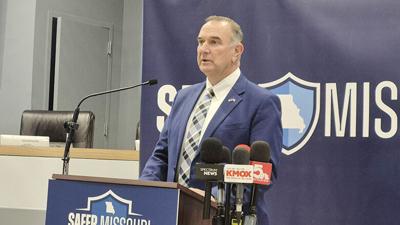

Gov. Mike Kehoe is still hopeful Missouri will receive federal aid to help residents who sustained property damage in the March tornado-producing storm, even though the Federal Emergency Management Agency denied Arkansas’ similar request for assistance.
“We think we have a good application,” Kehoe said on April 24 when he was at Arnold City Hall to recognize the city and Jefferson County as the first two communities to earn Blue Shield status.
“Sometimes these things take a long time, but we feel good about our application,” Kehoe added.
FEMA denied Arkansas’ request for federal disaster relief following deadly storms on March 14 and March 15 that produced 11 tornadoes and killed three people in that state.
Both Arkansas Gov. Sarah Huckabee Sanders, who served as President Donald Trump’s press secretary from 2017 to 2019, and the state’s GOP congressional delegation have sent letters to the White House to appeal the decision to deny assistance.
“Arkansas communities are still recovering from this spring’s tornadoes, as the sheer magnitude of this event resulted in overwhelming amounts of debris, widespread destruction to homes and businesses, the tragic loss of three lives and injuries to many others,” Sanders said in an April 18 written statement announcing the appeal. “To relieve the burden on these counties, cities and towns, I am appealing FEMA’s decision to deny Arkansas’ Major Disaster Declaration request.”
On April 2, Kehoe requested federal assistance for Jefferson County and 27 other Missouri counties to recover from the March 14 storm. The Governor’s Office reported 13 people died during the storm, which also caused damage to homes, businesses and public infrastructures.
As of Monday, FEMA had not made a decision about Kehoe’s request for Missouri counties to qualify for “individual assistance,” which would allow eligible residents to seek federal assistance for temporary housing, housing repairs, replacement of damaged belongings, vehicles and other qualifying expenses.
“Our entire congressional delegation, Republicans and Democrats, also sent a letter to the president and administration,” Kehoe said. “I have met with many congressmen and senators, and they are all pushing the White House to make sure we get a good decision here.”
The National Weather Service’s St. Louis office reported that on March 14 a tornado touched down near Clayton Huskey Road north of Hillsboro and went into Arnold. The tornado traveled 25.3 miles with a maximum wind speed of 115 mph.
The tornado that ripped through Jefferson County was one of 12 that were detected during the late afternoon of March 14 through just after midnight on March 15 in the great St. Louis area, according to the national weather service.
“We are waiting with bated breath to see what the decision from the White House will be on this,” said Warren Robinson, director of Jefferson County Office of Emergency Management. “I do feel like we were able to tell our story well. I feel like we were able to put in some good justifiable numbers for the request that was sent.”
Robinson said local officials, along with FEMA representatives, surveyed the tornado’s path and reported that 24 structures were destroyed, 24 had major damage, 37 had minor damage and two were affected by the tornado.
Arnold Police Chief Brian Carroll reported that officials estimated that it would cost a total of $99,324,055 to repair damaged residential and commercial properties in the city.
He also said city-owned vehicles were damaged by hail, and it would cost about $380,000 to repair those. An insurance adjuster had inspected city-owned buildings, but an estimate to repair that damage was not available as of April 22.
Rock Community Fire Protection Chief Kevin Wingbermuehle said the district had nine vehicles and three trailers damaged in the storm, and it would cost an estimated $50,000 to repair those. As of April 25, Rock Fire did not have an estimate for costs to repair damage to buildings.
Robinson said federal funding would help in the recovery effort.
“We continue to work with all of our typical local non-governmental organizations and volunteer groups to help facilitate disaster recovery as much as we can, as well as our state partners,” he said. “Having additional assistance would definitely be beneficial to the process.”
Kehoe said the State Emergency Management Agency would continue to work with communities to aid recovery with or without FEMA funding.
“Our State Emergency Management Agency is a fantastic group of people who work with local emergency managers throughout the state,” he said. “We are not going to give that up. One way or another, we are going to make sure they are responsible to the citizens of Missouri, and in times of need, we are there for them.”
Robinson said the Office of Emergency Management has continued to receive calls from residents in need of assistance due to storm damage.
“Whether or not we get the federal level declaration, it is not going to change our mission here at the local level to facilitate that disaster recovery,” he said. “The lack of funds would shift priorities and make the process take a little longer.”