





More than half of the Jefferson County school districts saw higher three-year composite and yearly Annual Performance Report scores this year, which the Missouri Department of Education released last month.
Each year, Missouri school districts receive an APR score based on graduation and attendance rates; advanced coursework; career preparation experiences; Missouri Assessment Program (MAP) scores in reading and math; scores on the ACT and other national exams; and the number of graduates entering college, the workforce or military service, according to DESE.
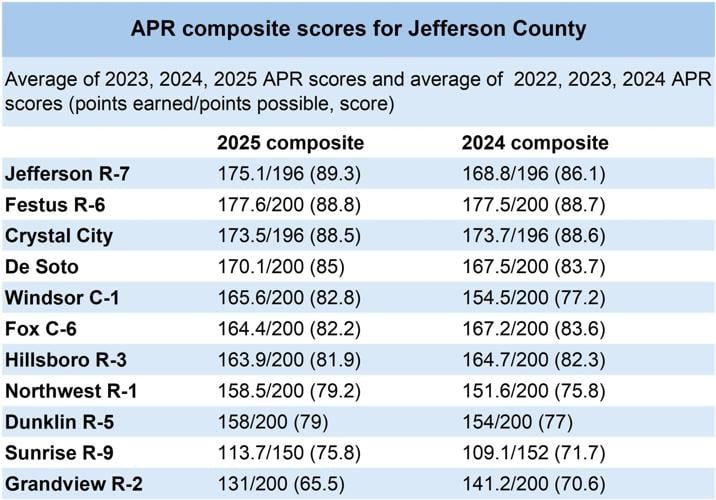
Seven of Jefferson County’s 11 districts’ composite scores improved, with the Jefferson R-7 School District earning the highest percentage at 89.3 when averaging its 2023, 2024 and 2025 APR scores. Last year, Jefferson R-7’s composite score was 86.1 when averaging its 2022, 2023 and 2024 scores.

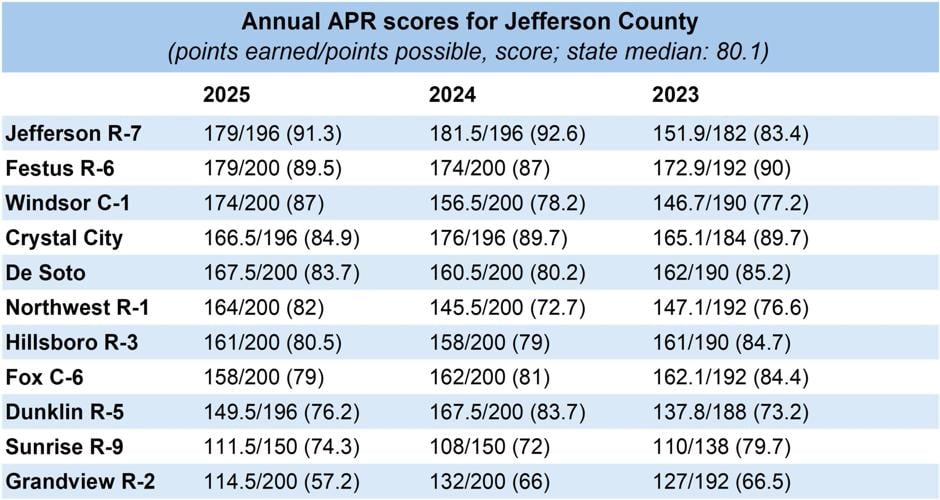
Six of Jefferson County’s 11 districts’ APR scores rose this year compared to last year. Jefferson R-7 also had the highest annual APR score this year, with a 91.3, down slightly from last year’s 92.6.
DESE reported 310 of the state’s 516 school districts’ APR scores improved, and that 92 percent of Missouri’s students met or exceeded state expectations. The state median annual score was 80.1.

“On the broad scope, I think a lot of schools in Missouri are doing great things, especially in our county,” Jefferson R-7 Superintendent David Haug said. “I think our schools are doing a better job communicating and doing what is right for kids in public education. I wouldn’t hesitate to send my own kids to any school in Jefferson County.”
State education officials started using a three-year composite score to evaluate districts last year. Under the system, districts’ accreditation level cannot change until after the 2025-2026 data is calculated, pushing any changes to fall 2027.
If the composite APR scores were being used for accreditation, a district would be accredited if its composite score were between 70 and 94.9. Those scoring at 95 or above would be considered accredited with distinction, those scoring between 50-69 would be provisionally accredited and those below 50 percent would be unaccredited.
If DESE begins using APR scores to accredit districts in 2027, it would be the first time the scores have been used in 12 years to determine districts’ accreditation level. DESE officials have said the scores have not been used for accreditation purposes over the past several years because of new standardized tests and scoring systems, COVID-19 disruptions and the need for “stability of measures.”
“We’re really coming to a point where there is going to be an opportunity for the school districts to show that they have met those expectations,” Commissioner Karla Eslinger told reporters when asked about the delay in using APR to classify schools.
If DESE were to use this year’s composite scores to accredit schools, all but one Jefferson County district would be fully accredited.
The Grandview R-2 School District’s composite score was 65.5, down from last year’s 70.6. If accreditation changes were made based on the scores now, Grandview’s score would result in provisional accreditation, which triggers extra state oversight.
However, Grandview’s scores are skewed because they include scores for students enrolled in the Missouri Virtual Academy (MOVA). Grandview administers this online program for students across the state, receiving funding for those students but also having to include them in the scoring system.
On average, students who attend classes at the Grandview campus score higher than the MOVA students.
“On campus, we have seen great improvement, even though the overall score for the district does not show the great things happening here on campus,” said Don Jeffries, Grandview’s director of curriculum and instruction.
DESE released the latest APR and MAP tests scores for public schools across the state on Nov. 6.
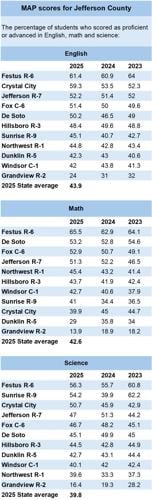
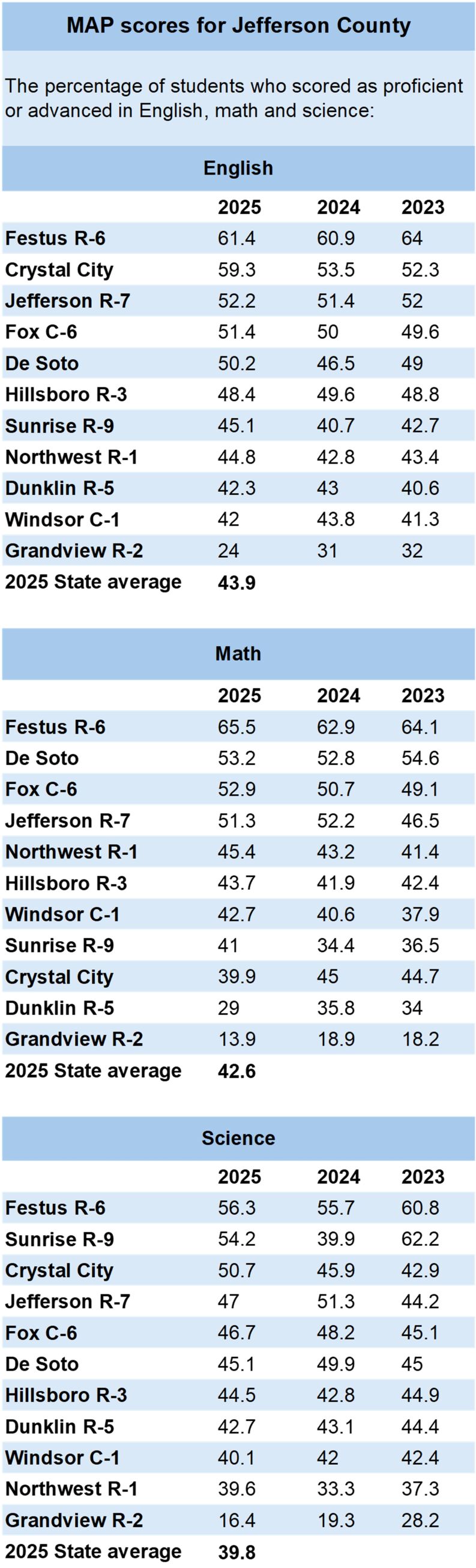
The Festus R-6 School District had the highest percentage of students scoring as proficient or advanced in English language arts (61.4), math (65.5) and science (56.3). The district has had the top MAP performance for at least the past three years.
Students may score as below basic, basic, proficient or advanced. Basic means students’ scores are where they are expected to be based on their grade level.
“Sustainability of high performance is a challenge,” Festus Superintendent Nicki Ruess said. “It takes daily effort. If you do the right things, those scores will naturally follow.”
Eight Jefferson County districts scored above the 43.9 state average in English; seven were above the 42.6 state average for math; and nine were above the 39.8 state average for science.
The following is a closer look at how the area’s districts performed in the APR and MAP.
Crystal City
The Crystal City School District’s APR fell by 4.8 points this year, going from 89.7 to 84.9. Its composite score slipped a tenth of a point, going from 88.6 to 88.5.
“What is great about the composite is it shows over the three years we have been meeting our goals of achieving at a high level,” Superintendent Taylor Massa said. “The dip this year, we dug into the data. It was basically our math scores. We are struggling with math across the district. We have implemented quite a few things, with more data teams and interventions put in place. We are coming up with different ideas for courses to focus on the priority standards that we may not be hitting as well.”
On the MAP tests, students showed strong improvement in English with 59.3 percent scoring at proficient or advanced. Last year, 53.5 percent hit that target. Massa said the improvement came after adding an instructor at the elementary level and focusing on hitting state standards in the curriculum.
She said the district will use that same practice to improve its math performance, where 39.9 percent of students scored as proficient or advanced. Last year, 45 percent were proficient or advanced.
“Our teachers will do what is best for students,” she said. “With us (having) a four-day week, we use Mondays for professional development time at least once a month. We dig deep into the data and what we can do to make a road map for areas of growth.”
Crystal City also showed improvement in science, with 50.7 percent of students testing at proficient or advanced this year after 45.9 percent scored in those categories last year.
“Overall, we are high achieving, but we do see where we need to grow,” Massa said.
De Soto
Both the De Soto School District’s composite APR and yearly APR rose. Its composite score for this year increased to 85 from 83.7 last year, and its yearly score increased to 83.7 from 80.2.
“It continues to look increasingly positive,” said Shawn Brown, assistant superintendent of curriculum. “It is a slow but steady process. We went up nicely in our overall score and a couple of points in our composite. We just want to see that continued progress.”
On the MAP tests, more students scored at proficient or advanced this year, with 50.2 percent landing in those categories compared to 46.5 last year. Brown said the district is revising its English curriculum, and he said De Soto’s English scores will soon compare to its math scores.
De Soto saw 53.2 percent of students score at proficient or advanced in math this year after 52.8 percent scored in those categories last year.
“We are constantly four or five points above in English, but math, it is double digits,” Brown said of how students perform compared to the state averages. “I credit that to people getting good at their craft and how we are challenging students to meet those standards on a daily basis.”
De Soto’s science scores have fluctuated the past three years with 45.1 percent of students scoring at proficient or advanced this year after 49.9 percent hit those marks last year and 45 percent were in those categories in 2023. Students take the science tests in fifth grade and eighth grade and a biology test in high school.
“If one of those areas has a down year, you will see that variance,” Brown said. “We started our science revision of our curriculum. We will break down the standards we have to meet.”
Dunklin
The Dunklin R-5 School District’s composite APR score rose by two points, increasing from 77 to 79. However, its yearly APR dropped by 7.5 points, falling from 83.7 to 76.2.
“APR across the state has a tendency, if you grow too fast or too strong one year, it impacts it the next year,” said Joe Willis, assistant superintendent, referring to Dunklin’s APR last year, when it increased from 73.2 in 2023 to 83.7 last year.
“We had a couple of things that we know existed and knew were going to happen, and they are easily addressed and taken care of. I am not saying I am not concerned, but it is not something we don’t have an answer for.”
Willis said the district anticipated the dip due to its math scores. This year, 29 percent of students scored at proficient or advanced in math, after 35.8 percent landed in those categories last year.
“We know where that concern is at and where we need to focus,” he said. “I anticipate an automatic turnaround in that for next year. I can’t give too much information, but it was an anomaly created by a situation that was out of our control. We are aware of it and know how to address it for the future.”
Willis also said he anticipates improvement in English, where 42.3 percent of students scored at proficient or advanced this year. Last year, that number was 43 percent.
“I look at the reading level because that is the biggest indicator for success,” he said.
Dunklin’s science score remained steady, with 42.7 percent of students scoring at proficient or advanced after 43.1 percent landed in those categories last year. Willis said the district’s students are performing well on the final biology test, which is taken in high school after they are tested in science as fifth graders and eighth graders.
“I look at where our kids are when they graduate and do they have what they need to be successful,” Willis said.
Festus
Ruess said APR scores only provide a snapshot of a district’s performance and districts should be judged beyond those numbers. However, she said the Festus R-6 School District can climb into the accredited with distinction category of 95 or above based on its consistently high scores.
Festus had a composite APR of 88.8 this year compared to 88.7 last year, and its yearly APR was 89.5 this year compared to 87 last year.
“One hundred percent is our goal,” Ruess said. “We owe that to the students. They deserve a quality education that prepares them, so when they leave they are ready to tackle whatever their next steps are.”
Ruess said Festus has performed well on the MAP tests due to its professional learning communities, or PLCs. She said the groups meet every Wednesday, when Festus schools start an hour later than normal, to review data and work to provide additional support to students where needed.
“We are in year 24 of PLCs,” she said. “That is a huge part of our ability to continue to perform at the level that we do. Our teachers are rock stars at it. They have components where they talk about student data, standards and local assessments. That hour on Wednesday is very focused.”
The Festus MAP scores are well above the state average for students scoring at proficient or advanced. In English, 61.4 percent of students score in those categories. The state average is 43.9 percent. In math, 65.54 percent of Festus students fall into those categories, compared to the 42.6 percent for state; in science, 56.3 percent of Festus students are in those categories, compared to 39.8 percent for Missouri students as a whole.
“It is reassuring to see the constant focus,” said Denise Funston, assistant superintendent in charge of teaching and learning. “(Teachers) all have a voice (in the PLCs). I think that is important that everyone is part of the team.”
Fox
The Fox C-6 School District saw slight dips in its composite and yearly APR scores this year. The district’s composite score fell from 83.6 to 82.2, and its yearly score dropped from 81 to 79.
“Our students are performing at a level that is fairly consistent, but we have a lot of work to do to be better than what we are doing currently,” Superintendent Paul Fregeau said. “What we are delving into right now is, if you look at the prior years and this year, where we lost most of our points was in student groups and the area of growth. We lost four points there, and that is basically the difference between this year and last year. We are delving into how we can support students in groups like free and reduced lunch and special education.”
Fox’s English MAP score rose slightly, with 51.4 percent of students scoring at proficient or advanced. Last year, 50 percent were in those categories. Fregeau said it can be difficult to increase those numbers when more students start performing at higher levels.
He also said it is important to celebrate when students move up out of the below basic level category. The basic level means students are scoring at a level expected of their grade level.
“If you get a below basic kid to basic in a year, that is a victory,” he said. “They are growing. Those are the things we are focusing on.”
The district saw more students scoring as proficient or advanced in math this year, with 52.9 percent in those categories, compared to 50.7 in those levels last year.
“Our teachers are doing great work at all levels, but especially at the elementary level where we build a strong base,” Fregeau said. “Math is built on prior learning. If you don’t have the basics, you will struggle as you move through. Having a strong base of knowledge that kids can build on as they move through the district is most important.”
In science, scores dropped, with 46.7 percent of students scoring as proficient or advanced this year, compared to 48.2 percent in those categories last year.
“It is a periodic assessment, and you have to focus on what standards the kids are struggling with at those grade levels,” Fregeau said of the science tests that are taken in fifth and eighth grade and the biology test that is taken in high school. “It is very periodic, so it is more difficult to move in a more organized fashion.”
Grandview
Jeffries said the Grandview R-2 district’s composite and APR scores may improve next year after a change in how MOVA students take their assessment tests is implemented this school year.
He said in the past, MOVA students went to testing centers and had to take all the tests at once. This school year, they will be allowed to take the assessment tests online.
“On campus, we divide the tests up over a period of days and sometimes over multiple weeks,” he said. “An eighth grader takes four (English), two math and two science tests – to do eight sessions in a single sitting would be tough for anyone to do.”
Grandview had the lowest percentage of students score at proficient or advanced in English (24), math (13.9) and science (16.4).
However, the scores for students who attend Grandview schools in person look much better.
At Grandview Elementary, 49.3 percent of students scored at proficient or advanced in English and math. At Grandview Middle, 43.4 percent of students scored at proficient or advanced in English and 45 percent scored in those categories for math.
“On campus, we are very pleased with where we are,” Jeffries said. “There are a lot of positive things going on. We are really excited about some of the things we saw for growth when it came to math. For the most part, we saw gains across the board. We are hoping that will continue in the years to come.”
Jeffries said even though the inclusion of MOVA student scores in Grandview’s APR puts the district in jeopardy of becoming provisionally accredited, which triggers additional state oversite, the online program has many benefits.
“It does a lot for having more funds,” he said. “It helps us offer competitive wages. It allows us to get additional resources for students on campus. It gives us a very good education for students on campus.
“For kids in MOVA, it is the best option for kids in that program. It is highly beneficial. It was good to see last year kids from across the state to come and get a high school diploma. It was a big highlight for the kids and their families to see them walk across the stage.”
Hillsboro
The Hillsboro R-3 School District had a slight uptick in its yearly APR score, rising to 80.5 from 79, but its APR composite score dipped slightly, from 82.3 to 81.9.
“Our district earned a composite APR score of 81.9 percent, reflecting the progress and success of the past three years and placing Hillsboro securely within the accredited range,” said Melissa Hildebrand, assistant superintendent of curriculum and assessments. “We are proud of this accomplishment as it represents the dedication of our staff, the hard work of our students and the ongoing support of our community.”
On the MAP scores, Hillsboro continued to have consistent achievement in English, with 48.4 percent of students scoring at proficient or advanced after 49.6 percent were in those categories last year. In 2023, 43.4 percent scored at proficient or advanced.
“While these percentages show consistency, we are optimistic about seeing continued growth in the future,” Hildebrand said. “We look closely at multiple data points to understand student needs, tailor instruction and support strong literacy development at all levels.”
In math, 43.7 percent of students scored at proficient or advanced this year, compared to 43.2 percent scoring in those categories last year.
“Our educators work diligently to identify learning gaps early, provide targeted supports and offer multiple opportunities for students to deepen their understanding of mathematical concepts,” Hildebrand said. “These strategies have contributed to the gains we are seeing.”
Hillsboro also saw an increase in students scoring at proficient or advanced in science this year, with 44.5 percent landing in those categories this year, compared to 42.8 percent last year.
“These fluctuations fall within the normal range of year to year shifts,” Hildebrand said. “The district remains committed to refining instructional strategies and expanding opportunities for real world science engagement. We analyze trends over time to allow us to make informed decisions that support sustained growth.”
Jefferson
The Jefferson R-7 School District had the highest yearly APR score (91.3) and composite score (89.3) this year. The yearly score was slightly lower than last year’s 92.6, but the composite score was higher than the previous year’s 86.1.
“(Darren Schaffer, executive director of administrative services), our principals, teachers and staff have a commitment to kids,” Haug said. “Dialing into great instruction and practices is really paying off for us.”
Haug said achieving a high APR score is not the biggest priority for the district.
“We believe in creating opportunities for kids,” he said. “Having them being great citizens is our first priority.”
Jefferson R-7 students continued to perform well on the English, math and science MAP tests.
In English, 52.2 percent of the district’s students scored as proficient or advanced this year after 51.4 percent scored in those categories last year.
In math, 51.3 percent scored as proficient or advanced this year, compared to 52.2 percent in those categories last year.
In science, 47 percent scored as proficient or advanced this year after 51.3 percent were in those categories last year.
Northwest
Of Jefferson County’s 11 school districts, the Northwest R-1 School District saw the largest increase in its yearly APR score, moving up to 82 from 72.7. The district’s composite APR score also increased to 79.2 from 75.8.
“It shows our incredible, steady growth and a continued focus on our targeted, strategic plan,” said Doréan Dow, who, along with Grace Green. is serving as the district’s interim superintendent while Jennifer Hecktor is on leave before retiring at the end of this school year.
“We tried to stay really focused on a few big goals. We feel like with this year’s APR, we are starting to see things click. Things are starting to move forward, and we are starting to see results from our many years of our continuous improvement planning.”
Northwest saw a 2 percent growth in students scoring at proficient or advanced in English, with 44.8 hitting those marks after 42.8 were in those categories last year.
“We have continued to try to increase the complexity of the work our students are doing,” Dow said. “We have increased writing instruction in our classroom. Writing is not just production; it is also thought and analysis. Even if they don’t have a performance event on the MAP test, they are going to be building thinking skills that will allow them to handle upper level questions on the MAP tests.”
In math, 45.4 percent of the district’s students scored at proficient or advanced after 43.2 percent were in those categories last year.
Green said the rise in those scoring proficient or advanced are just as important for the teachers as it is for the students.
“Our teachers need to feel just as much success as our students,” she said. “That develops their ethics and wanting to continue the focused and hard work when we see results like this.”
In science, 39.6 percent of students scored at proficient or advanced this year, compared to 33.3 percent in those categories last year.
Green said it is good to be closer to the 39.8 state average of students scoring at proficient or advanced in science, and the district is reviewing its curriculum to improve students’ performances.
“We rewrote our science with new expectations for this current school year,” she said. “Last year, we talked about the realities and how to make time with multiple preps in the elementary world to make sure we are getting the content to our students. That has been powerful and eye-opening for our teachers to understand no matter what grade I am in my work matters. It helps our students be successful.”
Sunrise
The Sunrise R-9 School District, which does not have a high school, saw some success from its recent restructuring. The district’s composite APR score rose from 71.7 to 75.8, and its yearly APR score increased from 72 to 74.3.
Before the 2024-2025 school year, Sunrise made a switch to have one principal oversee students and teachers in kindergarten through third grade and another oversee students in fourth through eighth grades, instead of one principal overseeing all grade levels.
Superintendent Armand Spurgin said he believes Sunrise is in a position to improve its scores even more next year.
“We are happy with a few of the scores, especially our math,” he said. “We have worked really hard the last couple of years on our vertical alignment and with our teaching staff. We have an additional principal this year. We are really trying to work hard so that everything is lined up the way it should be so we don’t have any holes in our instruction.”
Sunrise had a nearly 5 percentage point increase in students scoring as proficient or advanced on the English, math and science MAP tests this year
In English, 45.1 percent of students scored as proficient or advanced this year, compared to 40.7 in those categories last year.
In math, 41 percent of students scored as proficient or advanced this year, which was a 6.6 percent increase from last year’s 34.4 percent.
In science, 54.2 percent of students scored as proficient or advanced this year after 39.9 percent were in those categories last year.
Spurgin said he believes those higher performances will motivate teachers and students to do even better.
“Any time you do something new or change your approach, everyone is a little skeptical,” he said. “Now, they are like, ‘What we are doing is working.’ I feel their buy-in now is 110 percent. Before, they believed but they didn’t see the results. Now that they have seen the results, they are like, ‘OK, this is good.’ I believe that is where they will maximum their efforts more. The kids are seeing the results too. I feel like success pushes people to do even better.”
Windsor
The Windsor C-1 School District had the biggest APR increases among Jefferson County’s school districts. The district’s composite APR score rose by 5.6 points, increasing from 77.2 to 82.8, and its yearly APR score increased by 8.8 points, rising from 78.2 to 87.
“We have moved up every year for the last four years, with a significant jump this year,” said Mike Rickermann, assistant superintendent. “It is a tribute to the work our folks are doing.
“The performance is about our instructional department and teachers putting importance into that. That carries over to your students, and then the students get to shine.”
On the MAP tests, Windsor saw 42.3 percent of its students score as proficient or advanced in English, which is slightly down from last year’s 43 and just below the state average of 43.9.
In math, 42.7 percent of Windsor’s students scored at proficient or advanced, up from last year’s 40.6 and just a tad higher than the state average of 42.6. Rickermann said he believes the district will continue to show improvement in its math scores.
“We had a few inconsistencies several years ago, and we have tied those together,” he said. “It takes time to get back to where you want to be, and we have made a commitment to all be pulling in the same direction. Our students will reap the benefits of that.”
The district saw a dip in its science score, with 40.1 percent of students scoring at proficient or advanced after 43.1 hit that mark last year. The state average for the tests was 39.8.
“We want students exposed to the same material in the same way,” Rickermann said. “When you get that, your performance goes up. Teachers have done an amazing job of expecting that.
“We do believe we are providing a well-rounded education for our students. When you do that the numbers will come.”
Rockwood
Rockwood School District students continue to perform well above state averages, according to the Annual Performance Report (APR) and Missouri Assessment Program (MAP) tests scores released by the Missouri Department of Elementary and Secondary Education (DESE).
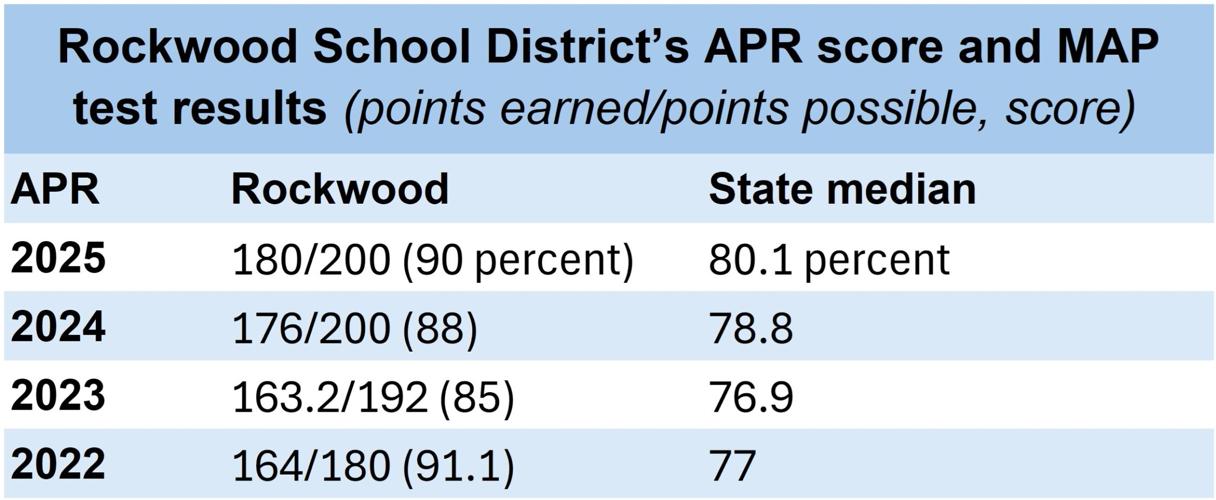
The district captured 180 points out of a possible 200 points (90 percent) in the 2025 APR, which was nearly 10 points better than the state median score of 80.1. Last year, Rockwood’s annual APR score was 88, and the state median score was 78.8.
Rockwood students scoring as proficient or advanced on MAP tests were more than 10 percent higher than state averages.

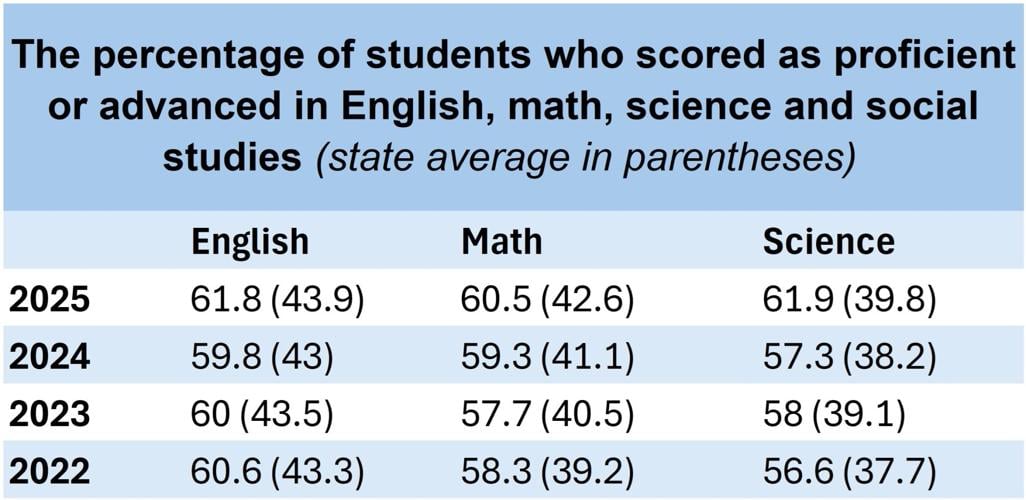
In English, district students scoring as proficient or advanced were 61.8 percent compared to the state average of 43.9. In math, Rockwood students scoring as proficient or advanced were 60.5, and the state average were 42.6. In science, district students scoring as proficient or advanced were 61.9 compared to the state average of 39.8.
“I think it reflects the work that we have been doing intentionally to set goals and make sure we are focused on areas that we know we can grow in,” said Shelly Willott, assistant superintendent of learning and assessment, of the scores.
“We have shown some significant growth this year in several places, and that is due to the work our buildings do on a daily basis.”
Rockwood had an APR composite score of 87.7 after capturing 175.5 out of 200 points.
Rockwood improved its annual APR in part by earning 94.8 percent of possible points in the APR “Academic Achievement Status” categories and achieved perfect scores in the categories of “Success-Ready Students” and graduation rate. Rockwood’s 90 percent ranks first out of the four K-12 districts in the state that include more than 18,000 students, according to the district.
“It is hard to make the movement forward,” said Buddy Sodemann, director of research, evaluation and assessment. “It is challenging to make those leaps. When we show a 2 percent growth, I think that is a testament to what our schools are doing.
“What we are really excited about is the work individual buildings are doing. We are seeing growth in the MPI numbers, which is how students are doing on the MAP assessments. We are seeing significant growth in a lot of our buildings. That is based on the concentrated work that our building principals and teachers are doing every day.”
Rockwood students showed the biggest gains on the MAP’s English and science tests.
The 61.8 percent of students scoring as proficient or advanced in English is a 2 percent increase from last year’s 59.8.
Sodemann said numerous factors contributed to more students scoring at proficient or advanced levels.
“It is the use of the data, our benchmark assessments that we have, the use of our professional learning communities and energy we put into that to troubleshoot every individual student to look at classes and cohorts individually and collectively,” he said. “We use the information we have to improve our instruction. The MAP is the end result of all of the hard work we do on a daily basis. We don’t get into this business to do well on the MAP. It is important, but we are working on student growth and learning. That focus has had a direct result on how well we continue to grow on the MAP assessments.”
In science, the 61.9 percent of students scoring at proficient or advanced is a 4.6 percent increase from last year’s 57.3 percent in those categories.
Willott said the students’ performances on the science tests, which are only given in fifth and eighth grade and for biology in high school, shows how all science teachers in the district work together to prepare students.
“We have to have all the grade levels talking to each other and everybody covering what they need to cover,” she said. “They assess it and intervene when they need to. So, by the time the kids get to fifth and eighth grade, they have had solid instruction along the way.
“The fifth and eighth grade teachers will do a quick review of the other years, but a quick review won’t do if the instruction wasn’t solid during that time. We have to keep our eye on that. It is not just the responsibility of the fifth and eighth grade teachers. It takes all the teachers at all grade levels to get kids to perform well on that test.”
Willott said while Rockwood’s APR and MAP results are impressive, she said the numbers do not show how much the district’s teachers do for students.
She said teachers are constantly getting together to review how students are performing during the school year. She said if a student is struggling, the teachers figure out a way to help the student learn the material, and if a student is doing well, the teachers find ways for that student to learn more about a particular subject or discipline.
“Those are the things people don’t see,” she said. “They think a teacher teaches a lesson, kids test and then it is over. They (the teachers) react to everything going on in the classroom in a timely manner to get kids where they are on those assessments.”
