


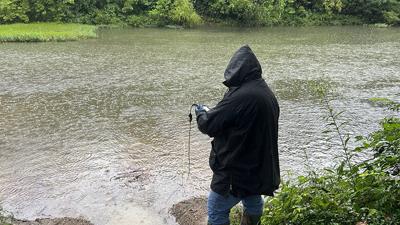
A Missouri Department of Natural Resources (DNR) investigation found a St. Francois County wastewater treatment plant polluted a portion of Big River with sewage, state officials said.
Since July, the facility began experiencing “significant operational issues” and generated numerous public complaints, resulting in the DNR making more than a dozen visits to the plant in Leadwood.
Officials pointed to aging infrastructure and poor maintenance at the facility for the reason behind high levels of E. coli in the river.
DNR officials said ongoing investigations “revealed seriously degraded and ineffective treatment equipment, allowing only partially treated wastewater to be released to the Big River.”
They said samples taken both downstream and upstream of the facility showed high levels of E. coli contamination.
“Further water testing will determine whether other contaminants are being released at levels of health and environmental concern,” the department said in a statement Aug. 5.
Officials said the DNR is following an intensive weekly water sample schedule, including tests for E. coli at upstream and downstream locations along the Big River near Leadwood.
On Aug. 3, the DNR pulled E. coli samples at the plant’s outfall to the Big River and at a point about 300 yards downstream. At that time, the results were more than 2,419 colony forming units per milliliter (CFU/mL), which is the highest the test will read.
On Aug. 14, the department said the facility is beginning to make progress toward repairing its failing treatment system, but E. coli levels were still unsafe.
On Aug. 10, the DNR continued its water sampling schedule in the Big River near Leadwood.
Preliminary results from samples collected at the facility’s outfall show E. coli levels at 1,732.9 CFU/100mL, down from 2,419.6. Sample results from other locations show E. coli at the time was 150.0 CFU/100mL at the Mounts Big River Access, which is approximately 3.9 miles downstream from the Hunt Street Leadwood access, 73.8 CFU/100mL at the Hunt Street Leadwood Access and 80.1 CFU/100mL at the Bone Hole Swimming Basin also known as Owl Creek Park, which is approximately 3.1 miles upstream from the Hunt Street Leadwood access.
At the Missouri Department of Conservation (MDC) access upstream of the Leadwood outfall, E. coli was measured at 866 CFU/mL on Aug. 3.
For comparison, Missouri State Parks officials recommend not swimming at state park beaches with E. coli levels above 190 CFU/mL.
Officials said until the treatment plant’s capacity improves and starts attaining permitted effluent limits, people should heed the public health advisory signs posted at access points on the Big River from the Leadwood Access to Owl Creek Park in St. Francois County. The signs advise people to avoid swimming or wading in the river and to keep pets and livestock away from the water in that section of the Big River.
Solutions
The DNR said they had been negotiating with the city since May to find long-term technical and financial solutions for wastewater treatment in Leadwood.
The department has also been working with Leadwood since May on an administrative order that would provide a framework for addressing longstanding issues with the city’s wastewater treatment plant.
On Aug. 4, the city submitted the signed order to the department and the agreement is now in place, officials said.
In addition to more long-term solutions, the DNR and the city of Leadwood are working to provide temporary fixes to improve the facility and stop current pollution.
■ The city’s engineer has restored some of the plant’s wastewater aeration function.
■ The city of Bismark is on-site helping to clean out a plugged wastewater return line and has agreed to take some of the city’s excess biosolids.
■ The Missouri Rural Water Association is helping with a waste sludge management plan.
■ The city’s engineer is also investigating the availability and viability of special equipment that might help the facility with more consistent wastewater aeration. The department will work with the city to ensure this work stays on schedule, officials said.
■ The DNR’s Financial Assistance Center is also exploring funding options to help the city purchase treatment equipment until a new facility can be designed and built.
“The department continues to work with the city and other partners to find both short-term and long-term solutions to Leadwood’s wastewater treatment challenges,” said Kurt Schaefer, director of the DNR. “We anticipate seeing improvements in the facility’s operations, reflected in better sampling results in the Big River. This issue has developed over time, so it will take time to find and implement lasting solutions.”
What does this mean for Jefferson County?
The Big River begins in Iron County and flows approximately 145 miles through St. Francois, Washington and Jefferson counties until it meets the Meramec River near Eureka.
Brian Quinn, a DNR division information officer, said on Aug. 6 that the department is focused on the section of river between the Leadwood Access and Owl Creek Park in Park Hills.
“If we go any farther up(stream) or downstream, it becomes difficult to differentiate between E. coli coming from the Leadwood facility and naturally occurring sources, such as wildlife and livestock,” he said. “Incidentally, E. coli levels from natural sources virtually always go up in natural water bodies after it rains, because of runoff.”
Quinn said the Jefferson County stretch of the Big River is downstream from Leadwood, and he said he is unaware of DNR investigations into wastewater treatment facilities in Jefferson County.
On Aug. 12, Quinn said the repair work at Leadwood’s wastewater plant will take effect soon, which will lower E. coli levels in the Big River near the plant.
“E. coli is unlikely to ever test ‘negative’ there or in any natural water body. That’s simply because there are too many other natural sources that impact water bodies, such as livestock and wildlife,” he said. “Consequently, E. coli levels almost always go up after it rains. That’s also why people should be careful anytime they play in and around lakes, streams, etc.”
He said the public should follow the Missouri Department of Health and Senior Services’ recommendations by visiting https://health.mo.gov/prevention/environmental-factors/recreational-water-safety.
Byrnes Mill Mayor Rob Kiczenski said on Aug. 12 he was aware of the situation in Leadwood and had spoken with the DNR.
Kiczenski said Byrnes Mill is approximately 50 miles downstream from the Leadwood facility, so he does not believe there is any threat to the city.
He said he will participate in the 59th annual Operation Clean Stream, organized by Open Space STL which is scheduled for Aug. 22. The event, which began in 1967, is part of an effort to preserve the Meramec River and its tributaries.
He also said there is a pre-existing no swimming ordinance in place at Byrnes Mill City Park that was enacted in 2020.
A swimming ban at Rockford Park in House Springs is also in effect through April 30, 2027, which was approved by the Jefferson County Council after several people drowned in the park within the last decade.
Earlier this year, DNR found that a sewage lagoon within the Byrnes Mill Farms mobile home park polluted a tributary of the Big River.
The inspection was performed after several residents complained to the city in January about a foul odor from the lagoon.
Residents said the lagoon’s aerators, which produce oxygen to reduce odor and pollution in wastewater, had not been working for several months.
Josh Willison, the DNR water section manager for the St. Louis regional office, said the aerators have since been replaced.
“We received one concern around May for odors that we went out and investigated again,” he said Aug. 14. “The aerators were functioning; we didn’t observe any odors or smell any odors in the area so it appeared to be transient at the time, which can be common for wastewater treatment plants.”
Willison said the department’s enforcement group is continuing to work with the property managers to address solutions and long-term compliance with water quality regulations.