



Local firefighting agencies are reminding everyone to celebrate safely this holiday season.
The National Fire Protection Agency reports that December is the leading month for house fires in the U.S., with many contributing factors, including dried-out Christmas trees, deep-fried turkeys gone wrong and overturned candles catching tablecloths on fire.
“As we head into this holiday season, we’d like to remind everybody that cooking fires and heating fires definitely start to ramp up,” said Brian Gaudet, Hillsboro Fire Protection District chief. “We caution everybody to be knowledgeable and follow the proper instructions to fry a turkey. Please don’t do it on a wooden porch or a deck – that’s a recipe for a disaster. Make sure you’re doing it outside on concrete.”
Gaudet said his Christmas tree is already up at home, adding that if you have a real tree, make sure to water it regularly and test the lights before they go on the tree.
He also recommends that people who use wood stoves or fireplaces to heat their homes get their chimneys inspected and cleaned to avoid flue fires.
“It’s house fire season, and we ask that everybody do what they need to do to keep their family and their home safe,” Gaudet said.
Live fire training facility
Firefighters take safety seriously and regularly train to make sure they can respond to calls as safely as possible.

De Soto Rural Fire Protection District firefighters brush up on their skills at the shared fire rescue training facility north of De Soto.
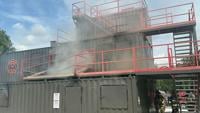
The De Soto Rural Fire Protection District’s two-year-old training facility allows firefighters to practice lifesaving skills in a building that simulates house fires, with mock bedrooms, hallways, stairs and a garage.
De Soto Rural invited Leader reporters Abby Stetina and Goldie Lowe to its facility on Nov. 15 to experience what it’s like to walk through a burning building.
The facility costs are shared between the De Soto Rural and Hillsboro fire protection districts and the De Soto Fire Department. The Valle Ambulance District donated the use of land for the facility.
The 3,000-square-foot facility, which cost $600,000, is made of shipping containers stacked three stories high.
“It’s a very realistic training environment,” said De Soto Rural Fire Chief Tom Fitzgerald. “That was the effort that we tried to put into the design and functionality of it. We wanted to put our crews through 95 percent of what we deal with on a regular basis every year.”
On the Nov. 15 training day, the Hillsboro, Antonia, Mapaville and Saline Valley fire protection districts joined De Soto Rural Fire to observe fire patterns with thermal imaging devices.
“A thermal imager is a firefighting device we can use to see through the smoke where it’s usually pitch black,” Gaudet said. “That way we can help locate any trapped victims or hidden fire within the walls. This (facility) is a prime example of how your fire districts across Jefferson County work together, train together and share the cost of emergency services so one agency doesn’t bear the cost of trying to do everything.”
On the day of the training, Fitzgerald led Stetina and Lowe through the facility, pointing out the exit points they could use during the live burn. Then, they suited up and followed a dozen firefighters inside the ground floor portion of the facility, where a fire was already raging.
You can watch footage of Stetina and Lowe’s experience here:
Two Leader reporters got an up-close experience of how Jefferson County firefighters train and prepare for duty.
The National Fire Protection Agency reports that December is the leading month for house fires in the U.S. Area fire agencies remind everyone to celebrate safely.
For more local stories, visit myleaderpaper.com.
Lowe shares her reactions
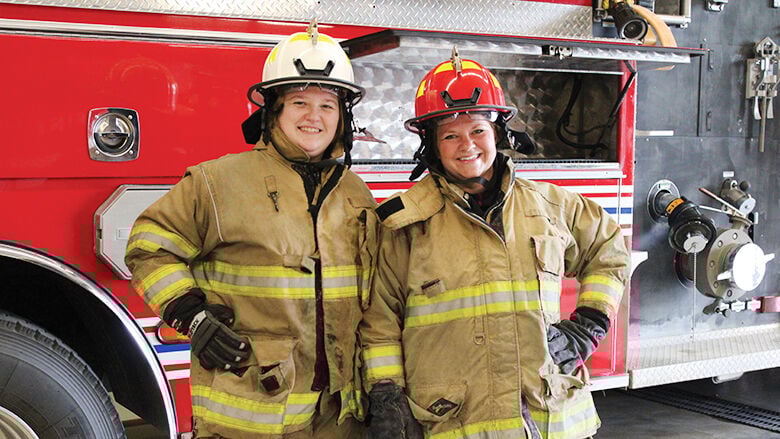
To participate in the training, Abby and I needed to wear the correct protective equipment, so step one was going to the De Soto Rural firehouse on Oct. 30 to get fitted for shoes, pants and a coat.
Firefighters Jeremiah Harmon and Joseph Arnold shared a lot of information about the gear, explaining that the boots are made of thick rubber and have steel toes and shanks and talking about what temperatures personal protective equipment (PPE) can endure. Glass visors can start cracking at about 450 degrees.
They talked about what’s in their breathing tanks (purified breathing air, not oxygen), how long it takes them to get dressed (about 60 seconds), and the toll the high temperatures can take on their bodies (dehydration is a huge concern, and some firefighters even need IV fluids during or after calls).
The firefighters also told us that people with claustrophobia may have a difficult time wearing the equipment before we tried on the self-contained breathing apparatus (SCBA). Even just standing in the firehouse under no stress, I could sense how closed in you could start to feel once your hearing and vision are restricted by the equipment you must wear and the conditions in a burning building.
Then, there was the weight of all the equipment to contend with. Heavy boots; triple-layer pants and jackets; a hood; helmet; facemask; SCBA and thick leather gloves. Altogether, it probably added up to over 50 pounds just in PPE.
I think the part of the training that shocked me the most was how quickly I went from being able to see fine to one minute later not being able to see my hand in front of my face. I knew the smoke would limit my vision, but I didn’t understand the severity.
It struck me how terrifying it would be in a real fire situation where you can’t see anything, your hearing is limited, and you’re trying to get yourself or others out. It seemed impossible that someone would be able to do that, especially in a space they weren’t familiar with. The entire experience was intense.
While I found the training interesting, I certainly will not be quitting my day job to pursue a career in firefighting. As several of the firefighters said during the training, you must have a certain type of personality to see a fire and run toward it instead of away from it. I don’t have that kind of personality, but I’m grateful they do.
I learned some important lessons, especially how vital it is to have working smoke detectors and to close bedroom doors at night. Even if it gives you an extra 30 or 60 seconds, that could be the difference between making it out of a fire or not.
Stetina weighs in
Having a GoPro video camera strapped to my chest while entering a burning building seemed like a bright idea when I was sitting in the Leader’s comfy, climate-controlled newsroom, but my enthusiasm quickly waned when I arrived at the facility to see firefighters stocking the building with plywood and carrying blow torches.
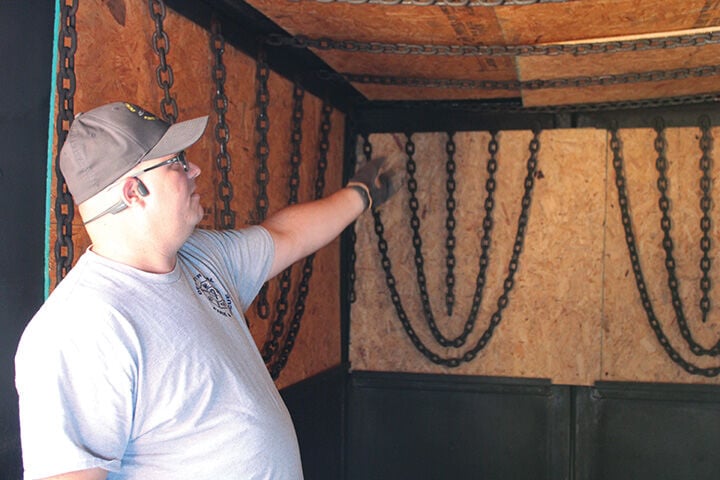
Training Officer Rob Fitzgerald explains how plywood is used during training days.
After we geared up, which took roughly 10 minutes even with the help of at least half a dozen firefighters, it was time to enter the building. Firefighters warned us one last time before going in to never remove our SCBA masks once inside.
“One breath of that air can incapacitate you,” Chief Fitzgerald told us.
De Soto Rural Training Chief Rob Fitzgerald was our guide through the simulation. He led us through the hallway first before taking us to the front room, where a fire was already raging in a designated barrel, spreading up the walls and to the ceiling.
We could see clearly for about 60 seconds while standing before Fitzgerald urged us to kneel to avoid the rising smoke.
The haze was making the room darker by the second, only allowing me to see the glow-in-the-dark patches on Goldie’s uniform and Fitzgerald’s flashlight.
Remarkably, I could barely feel the heat from the blaze, even though I was standing a mere 10 feet away from the barrel.
The protective gear was doing its job, but it also severely limited my senses. I could hardly hear Fitzgerald over the sound of my breathing apparatus (that produced Darth Vader-like noises), and my mask blocked my peripheral vision.
Crouching down and crawling through the hall proved difficult in my bulky pants, and Goldie and I kept banging into each other, thanks to the air tanks on our backs.
The experience was amazing, but one I confidently can say I’ll never do again. I have a newfound respect for every firefighter who willingly goes into a burning building to save another life.
There are so many variables to consider when running into a fire. Where are the victims? Will I safely be able to find them and safely escape? Will my protective gear hold up under this intense heat?
It’s not a job for the faint of heart, that’s for sure.
I would like to give a massive thank you to everyone at De Soto Rural Fire for allowing two reporters to tag along with their training.
And to all our readers, please keep yourself and your loved ones safe this holiday season by following the advice of those in fire service.