



Jefferson County and Eureka fire districts and departments face two main challenges to provide the emergency services we rely on – covering ever-rising costs and recruiting and retaining qualified personnel, according to the chiefs who lead those agencies.
“The biggest challenges now include keeping up with the cost of equipment replacements and staying competitive salary-wise to retain staffing,” Hillsboro Fire Protection District Chief Brian Gaudet said.
Dunklin Fire has funding shortage
Dunklin Fire Protection District Chief Bradley Williams agreed, adding that his district has been hindered by inadequate revenue to fund its operation.
He said Dunklin Fire has asked voters five times to approve a 25-cent tax levy increase that would provide funds to hire more employees, replace equipment and make other improvements and a 5-cent tax that would fund the pension plan for employees, and each time those ballot measures have failed.
Williams said the 25-cent tax increase would generate an estimated $550,000 per year and allow Dunklin Fire to hire three firefighters to bring staff levels up to four per shift and make necessary capital improvements, including building a second fire station.
“With the tax money that we currently receive, we can only maintain the staff we have,” Williams said. “In order to add additional firefighters, we would need additional tax money. We have aging apparatuses and equipment that needs to be replaced. We have property for a House 2 on McNutt School Road but are unable to build because of the lack of funding.”
Lack of qualified candidates to hire
Cedar Hill Fire Protection District Chief Mick Fischer said funding to cover firefighters’ salaries is only part of the problem when it comes to staffing.
He said it is becoming more difficult to find qualified candidates to hire.
“The demand for qualified firefighters continues to grow, often outpacing the supply of candidates,” he said. “We struggle with attracting a diverse pool of applicants who meet the physical and educational requirements. Additionally, the rigorous training and certification processes can deter potential recruits who may seek less demanding career paths.”
William Stamberger, the Eureka Fire Protection District’s deputy chief of support services, said recruiting and retaining firefighters is difficult because nearly every agency is looking to fill its ranks.
“There are several surrounding agencies that have open positions, and the pool of workers who are going into the emergency services field has diminished in the last several years,” he said.
Saline Valley Fire Protection District Chief Bob Dunn said some firefighters work at multiple districts, and salary competition may hinder some districts and departments from being able to hire and retain firefighters.
“Many firefighters work part-time at multiple districts to make ends meet,” he said. “Retention becomes particularly challenging when firefighters can earn up to $30,000 more annually for the same job in St. Louis County.”
Fischer said districts and departments try to find ways to make the job more appealing as the demands placed on firefighters increase.
“We must focus on creating a supportive work environment that prioritizes mental health and work-life balance to keep our personnel engaged and committed,” he said. “Ensuring adequate staffing and addressing burnout through strategic scheduling and hiring practices are essential to manage call volume.”
Volunteerism is down
De Soto Rural Fire Protection District Chief Tom Fitzgerald said a decline in volunteer firefighters also has contributed to staffing shortages.
“Three of our six stations are staffed 24/7; however, they are understaffed with only two personnel being there at any given time,” he said. “When available, volunteers sometimes stay at those stations to supplement the staffing, but volunteerism is on the decline nationwide and we, too, are affected by that.
“Our other three stations do not have 24/7 personnel, and rely on volunteers to respond from home to the station to get the firetruck out, but again as volunteers continue to dwindle, response times are increasing.”
Keeping up with rising costs
Districts and departments also struggle to manage budget concerns as costs rise, according to local fire chiefs.
Rock Community Fire Protection District Chief Kevin Wingbermuehle said one of the biggest cost increases has been the price of firetrucks.
He said his district is currently working to replace a ladder truck and fire engine, and the cost for each has risen dramatically over the past several years.
In 2006, a new ladder truck cost $580,000, and the district paid approximately $1.7 million for a new ladder truck in 2023, he said.
In 2011, a fire engine cost $445,000, but this year, a fire engine costs approximately $997,000, Wingbermuehle said.
“We really work to maintain a conservative budget, but there are certain purchases that we are required to make with firetrucks, rescue tools and protective equipment, and the prices continue to skyrocket,” he said. “That is the part that worries me the most – cost continuing to rise.”
Those higher price tags are not limited to firetrucks. Other essential equipment costs more, too.
“We rely on state-of-the-art equipment to perform our duties safely and effectively,” Fischer said. “However, budget constraints can hinder the regular maintenance and replacement of aging gear, apparatus and technology. This can jeopardize both firefighter safety and the community’s trust in emergency services.”
The need for more equipment rises as communities grow, which is what many area districts and departments are experiencing.
As populations increase, fire districts and departments often have to seek tax increases from the communities they protect.
“As areas grow, you will see agencies going for tax increases,” Eureka Fire Chief Greg Brown said. “It is because they have to add personnel, equipment and stations. Providing that coverage takes that into play as well.”
Equipment advances improve safety in firefighting
By Kevin Carbery

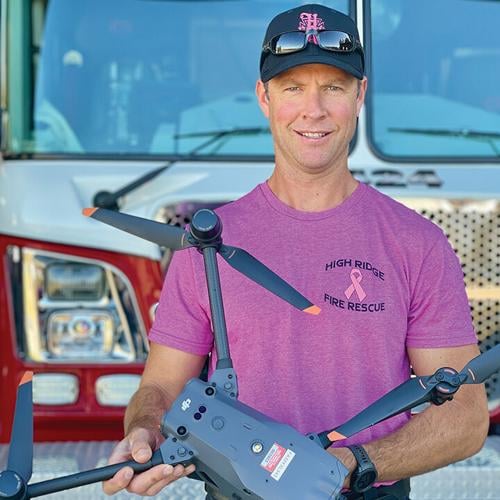
High Ridge Fire Capt. Jake Caplinger with one of the district’s drones.
While nothing can make running into a burning building safe, equipment innovations over the years have made life somewhat less dangerous for firefighters and the people they are called to rescue, according to leaders at the firefighting agencies in Jefferson County and Eureka.
Festus
Festus Chief Jeff Broombaugh said he has seen general improvements in lots of the tools of his trade since he began working in firefighting 41 years ago.
“Everything is advanced,” he said. “The way firetrucks are built, for one. Before, firetrucks were all mechanical. Now, they all have computer devices on them. This provides safety and makes it easy to operate.
“For example, computers regulate the pump pressure so the hose doesn’t over-pressurize and get somebody hurt. Before, if you didn’t properly set the relief valve, it could over-pressurize and cause the hose to get away from the firefighter.”
Broombaugh said the one negative about adding computers to firetrucks are the repair costs.
“In the old days, we sometimes could analyze the problem and fix our own trucks,” he said. “Now, you have to have someone work on the computer.”
Broombaugh said rescue equipment advances have made rescuing people more efficient.
“Added safety measures have made it less difficult to extricate people from cars,” he said. “Some older tools we used were not able to eat through hardened steel. Now, we have equipment that can eat through that.”
He said modern equipment also makes it easier to find people trapped in burning buildings.
“Before, we felt our way looking for victims,” Broombaugh said. “Now, we use thermal imaging technology to locate people. It speeds up the process.”
In addition, the weight a firefighter bears has been greatly reduced through technology advancements, he said.
“On the rescue side, Festus is currently ready to buy battery-operated rescue tools,” he said. “The tools are lighter, easier to carry. You don’t have the limitations of not straying too far from a power source, as we’ve had. That helps speed up the time to get to the rescue.”
Eureka
Eureka Fire Chief Greg Brown has been in firefighting for 43 years.
“There have been some amazing things happen during my time,” he said.
For one, Brown said, just riding to a call has evolved into a much less harrowing experience since his early years in the profession.
“When I started, it was common for firefighters to ride on the tailboards,” he said. “Now, they are seat-belted in the enclosed cabs that have structural cages.”
Brown said innovations in the protective clothing firefighters wear make their jobs safer.
“(Turnout gear) has gone from rubber boots, a long coat and a plastic helmet to a high-tech protective envelope that protects the firefighter from heat and products of combustion,” he said.
Brown said there have been incredible advancements in rescue equipment and other tools used in his profession.
“The use of drones is more and more common,” he said. “Rescue tools became battery-operated with increased power and abilities. The variety of tools and equipment has drastically increased.
“Thermal-imaging cameras (have benefited firefighters). Air mask standards have greatly improved.”
Brown also talked about other important advancements in firefighting tools, such as multi-gas detectors that detect gases in the environment, as well as heart monitors that can transmit directly to a hospital.
“We have to have all types of tools and techniques. Then, the firefighter has to be trained to use the right tool at the right time,” he said.
High Ridge
“I think there have been significant changes in all the different areas,” said High Ridge Fire Chief John Barton, who has been in firefighting for 26 years.
“For one, our trucks have gone from manual valves and analog to electronically controlled,” he said. “For example, with our ladder truck, the ladder controls now are electronic. It’s got safety limitations preprogrammed.
“Another one, thermal imaging has made significant advances. Thermal imaging is what we use to find victims in a building. When we enter a building, very often it’s zero visibility conditions. These cameras used to be very expensive and very bulky. They’re much more affordable and smaller now. Image quality has improved considerably.”
Barton also spoke about the important role drones play now.
“Our drone program started in 2019,” he said. “It’s been a huge help. We have two drones. We get called to assist in outdoor searches both in our district and in other districts in the county. In the past, we would have to get assistance from a helicopter.
“The drones have been of use multiple times. They’ve helped us search for victims along the river banks of the Big River.”
Barton also praised the advancements in firefighting clothing and breathing apparatus.
“It’s lighter weight and more resistant to heat and fire,” he said. “It’s the same with breathing apparatus, lighter weight and electronically controlled. It all improves safety.”
Saline Valley
Chris Harris, assistant chief at the Saline Valley Fire Protection District, said firefighting equipment has become easier to transport and use over the years.
Tools used for extricating victims, as an example, have been adapted to firefighters’ needs, he said.
“You may know these tools as simply ‘Jaws of Life,’” Harris said. “The Jaws of Life is actually a trademarked name from a manufacturer called Hurst.
“When these tools were first developed in the ’60s, they were large and heavy tools powered by an independent hydraulic power unit. These units were loud and required continuous upkeep to ensure a mission-ready state. Many times, the tools, power unit and hydraulic hoses would have to be removed from the apparatus and carried to the location of the incident as we were limited by the length of the hydraulic hose. This required multiple trips back to the trucks or multiple people to carry each component.”
Harris said they are now greatly improved.
“Only in the last 10 to 15 years or so have manufacturers been able to develop tools that are battery powered, more portable and very strong,” he said.
Harris said it has been important for rescue tool manufacturers to make improvements to keep up with changes in vehicle materials.
“Due to changes in the automotive industry, the materials used in modern vehicles were making vehicles safer for occupants, but when extrication was needed, the early tools were having a tough time,” he said. “With the new battery-operated tools, they are tested by the manufacturers to be able to overcome current materials.”
Harris said common firefighting tools include cutters, spreaders, rams and combination tools.
“The cutters are essentially scissors for cutting heavy metal,” he said. “The spreader is for opening or crushing and the ram is for pushing. The (combination) cutter-spreaders are typically smaller than the individual cutter and spreader.”
Harris said Saline Valley’s switch from gas-powered rescue tools to battery-powered rescue tools in 2017 has made a difference for the district’s firefighters.
“The switch has been a blessing,” he said.

Fire districts, departments rely on property tax, sales tax revenue
By Kim Robertson
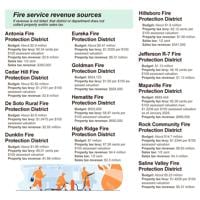
While the 13 fire protection districts and four fire departments that cover Jefferson County and Eureka provide the same kind of firefighting and emergency response services in the communities they serve, fire districts and fire departments are organized and funded differently.
A fire department typically provides services within the boundaries of one city and is a division of the city. It is funded by property tax revenue and other tax revenue the city collects, and a city council or board of alderman oversees the department’s operations and finances.
A fire district, on the other hand, typically covers one or more communities in an unincorporated area and collects property tax revenue from those who live within the district’s boundaries. It also may collect sales tax revenue. A board whose members are elected by district residents oversees the district.
Fire districts and cities also may bring in revenue from fees they charge for building inspections and permits tied to construction projects.
In addition, firefighting agencies may also apply for grants to buy specific equipment or fund particular projects.
Area fire chiefs said the revenue their departments and districts bring in doesn’t always keep up with the cost to operate them.
When fire districts need more revenue, they may ask their voters for permission to increase the property tax rate or to add or increase a sales tax collected in the district, but those campaigns are not always successful.
Districts also may ask voters to approve bond issues to fund particular projects, but again, it can be difficult to get voter approval for those campaigns, especially if a tax increase is involved.
If a bond issue is approved for a district, then the district sells the bonds to investors to raise the revenue and then pays back the investors, with interest, over a period of years using revenue from the property taxes district residents pay.
High Ridge Fire
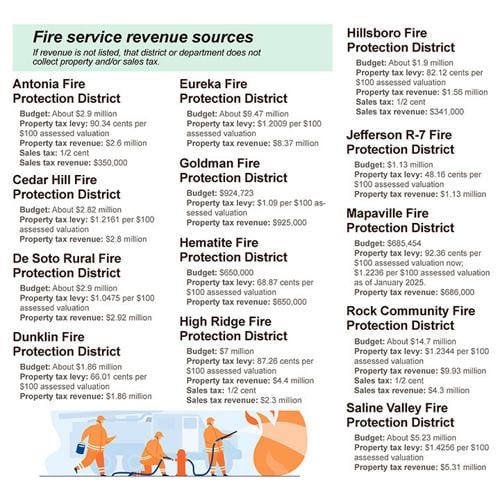
Property tax revenue accounts for the majority of the funding for the High Ridge Fire Protection District, which has an annual budget of about $7 million and brings in about $4.4 million a year from its property tax levy, which is 87.26 cents per $100 assessed valuation.
It also brings in about $2.3 million a year in sales tax revenue from the 1/2-cent sales tax shoppers are charged at retail businesses in the district.
“Right now we’re tapped out on sales tax. By state law, we can only collect a 1/2 cent sales tax (at the most),” High Ridge Fire Chief John Barton said.
He said those two sources of revenue are what the district relies on to cover its expenses.
“We have some permitting fees, but that’s not really revenue-generating. It’s meant to cover the time for doing inspections, but it’s not a large source of revenue,” he said. “That’s pretty much it.”
He said it can be a challenge to keep up with price increases for firefighting equipment and other costs.
“We’ve seen massive price increases in equipment that we need to perform all the jobs expected of us. As an example, the cost of firetrucks has doubled and in some cases more than that in the last five years. So, the increase in costs is outpacing the increase in revenue,” Barton said. “Fortunately right now, even with the increased cost of operating, we’re able to absorb those costs. We try to be frugal with taxpayers’ money, and we live within the budget restraints we have.
“We’re very conservative with our funds, but we make sure firefighters have the appropriate training and best equipment our budget allows to provide the best possible service.”
Rock Community Fire
The Rock Community Fire Protection District’s $14.76 million annual budget is the largest among the fire districts and departments in Jefferson County and Eureka.
Rock Fire brings in about $9.93 million a year through its property tax levy of $1.2344 per $100 assessed valuation.
It also brings in approximately $4.3 million annually from its 1/2-cent sales tax.
“As far as fees for inspections and permits, that’s definitely a negative for us (as far as revenue),” Rock Fire Chief Kevin Wingbermuehle said. “What we bring in (from those fees) doesn’t cover the cost of running the fire marshal’s office (which conducts the inspections),” he said. “When we budget that, we’re very conservative because of that fact. We know it’s not going to fully cover operating that office.”
Rock Fire is still paying off debt from a $10 million bond issue district voters approved in 2013 to buy a firetruck and equipment and to help fund the replacement of House 1 on Jeffco Boulevard in Arnold and House 2 on Main Street in Imperial. Those house replacements were completed years ago.
That bond debt was refinanced in 2019 and is scheduled to be paid off in 2033, Rock Fire finance manager Lisa Eckstein said.
Wingbermuehle said the district also regularly seeks grant funding for various items.
“A big one coming in this year is a FEMA firefighters grant – $196,000 for safety equipment, and we have a 10 percent match on that,” he said.
Wingbermuehle said those grant funds will be used to install exhaust removal systems in the engine bays at the district’s five firehouses.
Currently House 3 on Lonedell Road in the Arnold area and House 4 on Miller Road in the Arnold area are the only houses that have those systems, but those are 20-30 years old and need to be replaced, Wingbermuehle added.
House 5 is on Telegraph Road in Arnold.
Wingbermuehle said the equipment removes exhaust from firetrucks when the trucks are started up and running in the bays, which reduces cancer risks for firefighters.
“If you look at the engine bays in the houses that don’t have them, they are soot-stained,” he said.
Festus Fire
The Festus Fire Department is funded through the city, which collects a total property tax rate of 60.75 cents per $100 assessed valuation. That is projected to bring in about $1,485,400 this fiscal year, which began Oct. 1 and runs through Sept. 30. The fire department’s portion of that is 18.98 cents per $100 assessed valuation, estimated at about $464,000 this fiscal year, according to Michelle Vaughn, the city’s finance director.
In addition, a 9.35 percent sales tax is collected in the city, and of that, the city gets 3 percent, or 3 cents per $1. The remaining portion, or 6.35 cents, is divided among the state, county and other taxing entities in the area.
Of the 3-cent sales tax for the city, 1 cent of it is for public safety to fund the city’s police and fire departments. The 3-cent sales tax will bring in about $10,579,367 this fiscal year for the city, and after $600,000 is taken off the top of the funds generated through the 1-cent Public Safety Tax, the fire department gets 35 percent of that 1 cent public safety tax, totaling about $958,970, Vaughn said.
Plus, the city transfers another $254,470 from its general fund to the fire department each year for operating expenses, she said.
Crystal City
The Crystal City Fire Department is the only all-volunteer department in Jefferson County and has the smallest budget, at about $408,000 a year.
The city funds those expenses, including everything from a payment on a firetruck to insurance to utilities, through its general fund. The general fund is made up of revenue from a variety of different taxes, City Administrator Jason Eisenbeis said.
Revenue from the city’s property taxes, use tax and other taxes, as well as from court fees and other income, make up the general fund, he said.
“Every department’s budget is based on needs vs. wants,” Eisenbeis said. “If we end up with a surplus, wants (i.e., capital improvements like vehicles, backhoes, computers, guns, etc.) are then considered. If taxes are up, there’s more to go around for everything, including raises; if taxes are down, yes, budgets are tighter and/or reduced.”
Read more stories in the fire district series:


Click through to see all six stories related to local fire services.