


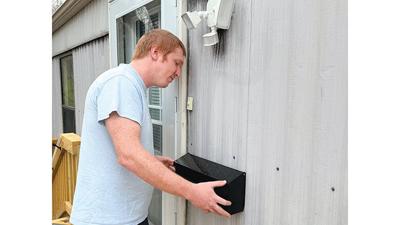
Jefferson Franklin Community Action Corp. (JFCAC) has a new program in place to help seniors remain independent and “age in place” in their own homes.
Andrew Swallow, a certified Aging-in-Place investigator at JFCAC, said the agency received $1.4 million in federal funding in June to start the Older Adult Home Modification Program in Jefferson and Franklin counties for residents 62 and older. The funding is from the Office of Lead Hazard Control and Healthy Homes.
“Aging in Place is the idea of modifying a home where an older adult can live in that home independently and safely,” said Swallow, who began working with JFCAC in 2022 in its Weatherization program.
Swallow, 37, said the home-modification program began in November and so far, one home project has been completed.
“We have eight more houses in the works that I’ve already gone out and done the home visits to,” he said. “We’re income-based. I know just one person can make $62,400 and still qualify. We can do rentals, and we can also do it if they own it. We just need the paperwork to show one or the other.”
Income guidelines for the program fall under low-income limits (80 percent of median family income), which are: $62,400 for one person in family; $71,300 for two; $80,200 for three; $89,100 for four; $96,250 for five; $103,400 for six; $110,500 for seven; and $117,650 for eight.
Modifications vary based on each resident’s needs, abilities and home. For some, it may be adding grab bars in the bathroom, adding high-visibility grip tape on stairs, adding extra lighting, eliminating trip hazards or widening doorways for wheelchairs. Or it could be replacing a bathtub with a walk-in shower.
“It’s such a wide umbrella that there’s not a lot that we don’t mess with,” he said. “We can’t tackle things that are too huge; like I can’t put a new roof on a house. However, we can repair things. We can repair holes in the floor.”
During the first visit, Swallow will walk with the residents through each room to assess the safety of each room based on the abilities of the residents.
“I will have them do mock actions where essentially, I have them step into the bathtub, have them get in and out of it, have them get in and out of bed,” he said. “That way I can kind of see how they’re doing things. A good example is they’re getting up off the couch, and they’re using an end table or a coffee table or something that’s not safe (to help them stand up). We can put in something like a couch assist or something where there’s like a (grab) bar nearby.”
For the second visit, he brings contractors with him to determine the best way to tackle projects.
JFCAC’s first home-modification project was for a Festus couple in their 80s.
“The biggest thing we tackled there was their front deck was like a trampoline,” Swallow said. “I mean you could bounce on (that deck). It was so old and decrepit. It’s a daily activity to walk out your front door to get the mail. If you can’t do that safely, that’s something we need to address. It was at the point their whole deck was rotting to pieces.”
Since the woman had fallen once while getting the mail at the end of the gravel driveway, Swallow filled out a physical hardship form with the U.S. Postal Service to get the mailbox moved to the front door.
He said the man had started a bathroom remodel many months ago. The program finished up the walls and covered the exposed electric wires due to safety reasons. In addition, a comfort height toilet replaced a lower-sitting toilet, grab bars were added near the toilet and shower, and a shower chair was added.
Swallow said the program’s contracted occupational therapist visits the home 30 days after the modifications are made to make sure the modifications are working.
Seniors interested in applying for the program should call 636-789-2686 and press option 2 or email wx@jfcac.org.
Seniors also can learn more about the program by visiting the JFCAC table at the Leader Publications-sponsored Senior Expo on Wednesday, April 15, at the Knights of Columbus Hall in De Soto.
“We’ll be at the senior expos that are around the county real soon to give out flyers and applications,” he said. “I should be there, too, and I’ll gladly answer any questions.”