

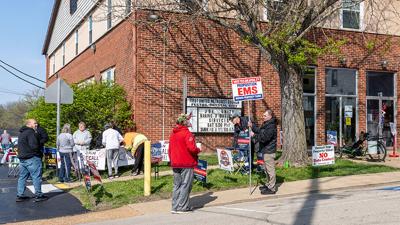
Voters overwhelmingly approved Question 1 on the April 7 ballot, with 13,454 “yes” votes (61.04 percent) to 8,587 “no” votes (38.96 percent).
The approval extends a property tax credit, also called a “freeze,” previously only available to homeowners 62 years old or older to all county homeowners on primary residences.
The taxpayer will receive an annual credit equal to the difference between 2024 and the current tax year. According to officials, the county will begin the tax credit in the 2028 tax year, giving the county time to plan and implement the program.
County Counselor Jalesia Kuenzel could not comment on whether eligible taxpayers would need to apply for the tax credit, like the senior real estate property tax credit, which opened for applications for those 62 years or older in 2025.
“We are in the preliminary stages of this new tax credit,” Kuenzel said. “Therefore, we do not have specifics at this time.”
David Broderson, Missouri County Collectors Association president and the Collector for Benton County, said the property tax freeze was passed by voters in his county as well.
“Since it just passed, I do not know yet how other counties will do this,” he said. “In our county, I believe we plan to have applications for taxpayers to fill out to qualify. This is how we did it for the senior tax credit and renewals, and I think so far it has worked well. We plan to go live in 2027 if it survives the challenges in court.”
Verdict is still out
In a lawsuit filed last September in the Cole County Circuit Court, six school districts, including the Grandview School District, two taxpayers and a fire protection district alleged that Senate Bill 3, which outlines the tax freeze, creates unequal property tax rules based on the arbitrary method legislators used to decide which counties could participate.
Legislators identified 22 counties in SB3, including Jefferson County, where residents can vote to freeze property tax payments at the 2024 rate. In the St. Louis area, Franklin, Warren and Lincoln counties all voted to freeze property taxes at the April election; St. Charles County voters voted down the issue.
In 75 counties identified in SB3, including Ste. Genevieve, St. Francois and Cape Girardeau, residents had the opportunity to vote on a property tax cap of no more than 5 percent or the rate of inflation.
SB3 identified 17 counties where residents cannot vote to freeze or cap property taxes. These counties have large economic hubs, such as St. Louis, Kansas City and Springfield.
Cole County Circuit Judge Christopher Limbaugh on Feb. 3 denied a motion to block the question from appearing on the ballot.
The case will go to trial, and a decision made on SB3 may invalidate the election results.
Jon Isaacson, superintendent of the Hillsboro R-3 School District, said his district is determining what needs to be done now to mitigate the impact of the freeze, closely monitoring any legal rulings on SB3.
“This was passed by the public, and you have to respect and work within that,” he said. “Those are now the new rules, which we must plan for financially. When do you start immediately cutting back? For us, we’d need to start increasing class sizes, even more than they are. Do you stop doing preventative maintenance now? You can’t just kick the can down the road; you must start now. But then you don’t want to get ahead of the game, because the rules could change.”
Fox C-6 School District Superintendent Paul Fregeau said there are many unknowns when it comes to the tax freeze, especially with the legal challenge to SB3. Previously, Fregeau said 58 percent of Fox’s funding comes from local taxpayers.
“We will have to monitor it and make the best decisions that we can with the information that is provided,” he said.
Local impact
Cindy Hayes, director of the Jefferson County Library, said about 90 percent of the library’s operating budget is funded through a library tax on personal property and real estate assessments within the Fox, Northwest and Windsor school districts.
Hayes said options for offsetting lost property tax revenue are limited.
“(Sales tax) is not a preferred option, as it is not a stable or reliable source of funding,” she said. “Revenue can fluctuate significantly from year to year, making long-term planning difficult.”
Hayes said the library lost $46,965.39 in revenue in 2025 when the senior tax credit went into effect.
The library stands to lose approximately $187,825 annually in district-wide revenue with the expanded tax credit program. For 2026, the library’s estimated total revenue from property taxes is $7,432,900.
“We continue to evolve to meet the changing needs of our users while remaining careful stewards of public resources,” she said. “We are committed to using those resources as effectively and efficiently as possible to deliver meaningful value to the communities we serve.”
Local property taxes account for about 46.7 percent of the Hillsboro School District’s operating budget, Isaacson said, meaning the freeze will “significantly” impact school operations. He said the district lost $117,560.13 in 2025 due to the senior tax credit, and estimates losing anywhere from $700,000 to $2 million in operational funds annually due to the expanded freeze.
“For a district already operating within its means, limiting future local revenue growth while also facing reductions in state funding creates real financial pressure that will require us to reassess our long-term plans,” Isaacson said. “A simple way to understand this is through a household analogy. If your income is frozen at what you earned in 2024, but your costs for groceries, utilities, insurance and other essentials continue to rise, you are forced to make adjustments. That is the situation school districts now face.”
North Jefferson County Ambulance District Chief Jamie Guinn said the tax freeze could halt the district’s growth.
“Anybody out there would say they would love to see less taxes,” Guinn said. “I don’t disagree with that. What I do disagree with is saying we are going to freeze things at a certain level without saying, ‘Here is an alternative funding source to keep up with inflation.’”
Valle Ambulance District Chief Jesse Barton said the tax freeze may cause the district to look at what programs need to be cut back. He added that the district is facing rising costs on all goods needed to operate, especially fuel.
“It will affect everything, unfortunately,” he said.
The Joachim-Plattin Ambulance District received $1.5 million in property taxes last year, said Chief Tracy Howell. She said the property tax has rolled back over the years due to the district’s sales tax.
“If (the property tax) were to freeze, we wouldn’t have increased revenue to cover increases in costs that we experience, just like everybody else,” Howell said. “It could be something that plays a factor in our budget.”


Follow races for local and statewide offices as well as ballot measures.