
Jefferson County superintendents are calling for community members to advocate for the state to fully fund public schools.
Legislators opted not to fully fund public education this school year, and the Missouri State Board of Education is not seeking to increase education spending for next school year, instead recommending the same funding level for the 2028 fiscal year.
In a letter addressed to “families, staff and community members of Jefferson County Public Schools,” the Jefferson County Superintendents Association said the county’s 11 school districts are projected to not receive nearly $11 million in state funding this school year because of the shortfall.
The letter urges people throughout Jefferson County to contact members of the state legislature to fully fund public schools. The letter was posted on most Jefferson County school districts’ websites, and it also was circulated on county school districts’ social media platforms.
“The Missouri Legislature has the ability to provide additional funding and fully support public education,” the letter said. “Our governor and/or the Legislature can restore funding for schools in the coming months, but they will only do so if everyone advocates for this together.”
“The letter that was sent was developed collaboratively by all 11 Jefferson County public school districts and released simultaneously to our communities on Oct 22,” Windsor C-1 Superintendent Jason King said. “Our goal is to raise awareness and encourage state leaders to fully fund public education.”
The letter provided estimations for how much less money each Jefferson County school district expects to receive from the state this school year because the school formula is not fully funded.
■ Crystal City: $226,000
■ De Soto: $1,057,000
■ Dunklin R-5: $746,000
■ Festus R-6: $1,353,000
■ Fox C-6: $2,300,000
■ Grandview R-2: $360,000
■ Hillsboro R-3: $1,458,000
■ Jefferson County R-7: $240,000
■ Northwest: $1,951,000
■ Sunrise R-9: $170,000
■ Windsor C-1: $1,230,000
On Sept. 15, the Missouri State Board of Education declined to seek a roughly $300 million increase to fully fund the state’s public school funding formula for next year. The board voted 4-4 on the Department of Elementary and Secondary Education’s proposed budget, which was seeking a funding increase.
The deadlock vote means the state board will request lawmakers allocate the same amount of money that school districts are receiving this fiscal year.
Districts receive a set amount of money from the state that is determined by a formula set in state law. In 2024, lawmakers approved increasing the formula’s cost with the changes being phased in over several years.
Lawmakers have provided about $190 million less than what the formula called for during this fiscal year. An estimated $110 million increase is expected for the 2028 fiscal year, bringing the gap between current funding and the formula’s calculation to about $300 million.
“I hope the Legislature will address the shortfall, but I cannot predict what lawmakers will ultimately decide,” De Soto School District Superintendent Ron Farrow said. “We are asking the state to meet the funding commitment established through its own foundation formula. Our students deserve that investment, and our communities deserve a dependable state partner in supporting public education.”
Funding woes
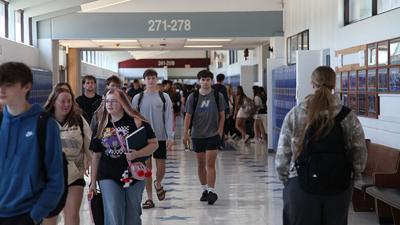
The superintendents’ letter said about 34,800 students attend public school in Jefferson County.
The letter said the reduction in state funding cuts could affect the services and opportunities districts provide students and families. It also said continued reductions in state funding will eventually require districts to make difficult long-term decisions about programs, staffing, services and other priorities.
Hillsboro R-3, which is seeking a $1.39 operating tax levy increase called Proposition H on Nov. 3, said in a statement on Oct. 22 that the district may leave some staff positions unfilled, require families to pay for transportation expenses for athletic, field trips and extracurricular activities, change its rental fees for school facilities and reconsider paying for some community events, such as Boo at the Barn and Christmas at the Farm.
Hillsboro R-3 Superintendent Jon Isaacson said his district expects to receive $13,832,904 in state funding this school year. He said the district will not purchase two new buses, will delay installing playground fencing at its Intermediate School and delay other equipment purchases and facility projects due to receiving less money from the state.
Isaacson said Hillsboro R-3 has not eliminated or reduced any educational programs.
“While we have been able to make reductions without significantly disrupting daily school operations at this point, these are not necessarily permanent savings,” he said. “In many cases, we are postponing expenses that may ultimately cost the district more.”
Patrick Quinn, who is Hillsboro R-3’s communications and strategic engagement director, said his position will not be filled after he leaves the district following the Nov. 3 election.
Quinn, who was hired in August 2025, said he is leaving Hillsboro R-3 for a public information officer position with the Drug Enforcement Agency in St. Louis. He said his decision to leave the district was not because of the reduction in state funding, and he is waiting to leave for the DEA in mid-November because of the upcoming election.
“This community means so much to me, and I wanted to see everything through with Prop H,” he said.
In the statement, Hillsboro R-3 officials said if the operating tax levy increase does not pass and the state funding formula continues to not be fully funded, the district may need to reduce educational programs, student support services, district positions, schedule fewer home games for athletic programs and reduce transportation services for students to and from schools.
“These are not all final decisions and more reductions beyond what is currently proposed will likely be necessary as the state funding reductions are significant,” the statement said.
Dunklin R-5 Superintendent Clint Freeman said his district anticipates receiving $9.6 million in state funding this year. He said Dunklin revised its current technology refresh budget, paused its bus replacement plan, adjusted the number of paraprofessional staff members the district employs and is reviewing instructional programming to see if Dunklin can still offer those opportunities but at a lower cost.
Freeman also said new laws and regulations that school districts are required to follow are creating funding issues, along with the rising costs for items.
“The inflationary pressures every family feels – the escalating costs of fuel, food and electricity – hit our local school districts on a much larger institutional scale,” he said. “Bus fleets require thousands of gallons of fuel, cafeterias serve thousands of meals daily, and expansive facilities must be lit and heated, causing fixed operating expenses to rise sharply.
“We are simply asking that the state be a better, more reliable partner in educating the vast majority of our community’s youth. Investing fully in public education is an investment in the future of Jefferson County.”
Farrow said the De Soto School District did not purchase a bus and reduced its technology and maintenance budgets due to receiving less money from the state this school year. He said the district anticipates receiving $14,116,734 in state funding this school year.
“We are working hard to keep funding challenges from affecting students’ daily experiences,” he said. “At the same time, there are limits to how much a district can absorb through deferred purchases and operational reductions. If the funding gap continues, decisions about staffing, programs and services become increasingly difficult. Protecting opportunities for students will remain our priority throughout that process.”
Fox C-6 School District Superintendent Paul Fregeau said his district is projected to receive $56,698,603 in state funding this school year.
He said the district cut costs in non-instructional areas of custodial, maintenance, technology, transportation and food service to offset receiving less money from the state. He also said building budgets were reduced by 19.97 percent, athletic budgets were dropped by $64,660 and the district has delayed ordering new Chromebooks.
“These state revenue reductions, in addition to inflation and rising costs, have added hardship to operational functions, resulting in increased workloads, longer response times and the potential delay of maintenance projects,” he said.
Grandview R-2 Superintendent Leslie Lause said her district has not cut or reduced education or school programs this school year.
“However, we will be very conservative when planning for the future,” she said.
Jefferson R-7 Superintendent David Haug said his district anticipates receiving $3,470,000 in state funding this school year. He said the district has not cut or reduced education or school programs this school year.
“R-7 relies heavily on local funding at 78 percent annually and 14 percent from state funds,” Haug said. “We budgeted conservatively for 2026-27 based on projections from our advocacy groups who monitor state legislature actions.”
Northwest Superintendent Kyle Gibbs said his district is projected to receive $20.5 million in state funding this school year. He said the district has not cut or reduced education or school programs this school year.
“Northwest approached this year’s budget conservatively, using projected state revenues that did not include the additional $1.95 million referenced in the recent letter,” he said. “Due to these funding challenges, along with our continued decline in student enrollment, we have been strategically reducing staffing through attrition across all levels and departments. This approach has allowed us to adjust expenditures while minimizing the impact on our students and daily operations.”
King said Windsor C-1 will receive about $13,631,265 in state funding this school year. He said the district’s goal is to minimize any impact on students due to receiving less money from the state.
“Our focus has been on managing available resources responsibly while protecting the quality of education and opportunities we provide our students,” he said. “However, if these funding shortfalls stand, we will face increasingly difficult decisions regarding staffing, programs and services.”
In the letter urging people to contact DESE and state representatives, the superintendents said schools and communities depend on each other.
“Our schools are stronger because of the support of our communities, and our communities are stronger because of our schools,” the letter said.