





Clint Freeman, the president of the Jefferson County Superintendents Association, applauds the passage of recent legislation that will raise Missouri teachers’ salaries.
However, the provision that requires yearly raises with no state funding mechanism attached to it has him and other county superintendents worried.
On May 7, Gov. Mike Parson signed Senate Bill 727, a 167-page omnibus education bill that calls for the minimum salary for a teacher with a bachelor’s degree to increase from $38,000 to $40,000 for the 2025-2026 school year. Teachers with a master’s degree will see their minimum salaries raised to $46,000.

Along with implementing the new minimum salary, the bill requires school districts to provide a pay raise up to 3 percent every year after the 2025-2026 school year based on the Consumer Price Index (CPI) for All Urban Consumers of the U.S. as reported by the Bureau of Labor Statistics.
“I want people to be paid. I think that is very important,” said Freeman, superintendent for the Dunklin R-5 School District. “But when you say there is going to be a 3 percent CPI, that starts adding up pretty quickly. That is almost $2,000 (per teacher) a year. Next year, it could go up to $42,000, and it keeps growing exponentially. The issue is that will catch up to us, and how is that going to be funded? That is the issue superintendents have with it. We want teachers to be paid more money, but there are some things we can’t afford.”
While the bill also calls for a $420 million increase in state funding for school districts over the next two years, there is no guarantee the funding formula will be fully funded or that other school state funding, such as money for transportation, will be fully funded.
“I worry about some of the districts that are not financially wealthy,” Grandview R-2 Superintendent Matt Zoph said. “Some of our (Missouri) school districts are at $35,000. Now they have to pay $5,000 more per teacher, and where is that funding going to come from?
“There is some good in the bill. It is not completely a bad bill. It is just another hoop to jump through.”
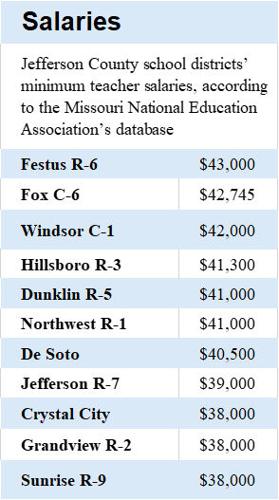
Grandview is among the four county school districts that does not have a $40,000 minimum salary this school year, according to the Missouri National Education Association’s database.
Grandview, Crystal City and Sunrise R-9 each have minimum salaries of $38,000, and Jefferson R-7’s minimum salary is $39,000.
“Teachers don’t get paid enough anyway,” said Sunrise Superintendent Armand Spurgin, adding that the district will raise the minimum salary to $40,000 (by the 2025-2026 deadline), thanks to receiving a baseline district grant. “The part that I don’t agree with is mandating minimum salary adjustments. A lot of school districts may be in a situation where they can’t afford that, and there are guidelines that we have to work in the black. How are those school districts going to cover that?”
School districts are considered “financially stressed” when fund balances drop below 3 percent of their annual operating budgets and are then at risk of losing accreditation and having the state take over the district.
Crystal City Superintendent Crystal Reiter said her district will be able to meet the minimum salary because of the small school grant. However, she said no one knows if those funds will be available every year, and if they’re lost, it could make it difficult to pay teachers at the required salary levels.
“No one will ever argue that teachers’ salaries don’t need to go up, but when you do something like that, you have to have the funding somewhere,” she said. “We will have to figure something out, and there are a lot of options. One of those options is absolutely asking for a tax increase down the road, and that is not popular or anything anyone wants to do.”
The rest of the county’s 11 school districts already have minimum salaries above the $40,000 mark and include De Soto ($40,500), Dunklin ($41,000), Festus ($43,000), Fox ($42,745), Hillsboro ($41,300), Northwest ($41,000) and Windsor ($42,000).
Fox Superintendent Paul Fregeau said it will be important for districts to receive funding to keep up with the state-mandated yearly salary increases.
“Everything with school funding is subject to the state providing funds to do that,” he said. “That will be something we have to be very careful with as we plan moving forward. It may fall onto local funds if the state does not appropriate funds for the bump.”
Northwest Superintendent Jennifer Hecktor said she also is concerned about the salary mandate.
“We are all in support of teachers and all school staff making wages that reflect their professional status and education,” she said. “It is disappointing that the state has shifted the burden of funding from the state to the local entity, which is essentially what has been done through many bills signed and passed this year.”
Hecktor said districts should be helped by another change in Senate Bill 727 that calls for the funding formula to be based on a combination of average daily attendance and enrollment numbers, rather than just average daily attendance as it is now.
In 2026, average daily attendance will account for 90 percent of the formula, and enrollment will account for 10 percent. The districts’ enrollment will account for 10 percent more every year until 2030, when the formula will be a 50-percent split between attendance and enrollment numbers.
“We would support this gradual implementation to 50/50 attendance and enrollment in 2030 moving much more quickly,” she said. “This will help schools and make it more equitable with the way that the state is funding virtual schools.”
Freeman was among a large group of state superintendents to send letters to Parson encouraging the governor to veto Senate Bill 727 because of the bill’s expansion of the voucher tax credit program, establishing charter schools in Boone County and the salary increases with no dedicated funding source.
“My biggest issue is I don’t think the state can afford this,” he said. “No one at Jefferson City who was pushing this through wanted to talk about the fiscal note with it. I don’t understand that part of it.”