
Legislators at the recent Jefferson County Legislative Forum said the last session was a “train wreck.”
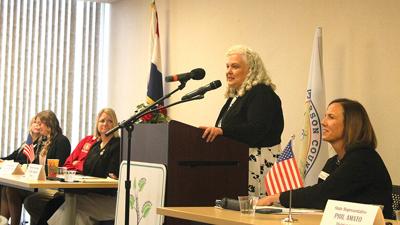
Eight local legislators, including state House and Senate members, along with some federal officials, spoke at the Jefferson County Growth Association’s annual forum, held June 5 at Jefferson College.
The Missouri legislature’s latest session ended on May 17, with the General Assembly approving a near-record low 46 bills.
Gov. Mike Parson has until July 14 to either sign or veto those bills.
Sen. Elaine Gannon (R-De Soto), who is in the final year of her first four-year term and will not seek a second term, said a majority of the proposed legislation was hampered by a small faction of Republican senators called the Freedom Caucus.
“I’m here to tell you everything you’ve read or heard on the TV is true,” said Gannon, who previously served in the House from 2013 to 2020.
“It was a train wreck in the Missouri Senate. Despite all the filibustering that took place in the Senate this session, we did manage to get some bills across the finish line.”
State representatives Renee Reuter (R-Imperial), Phil Amato (R-Arnold) and Gary Bonacker (R-House Springs), all freshmen, and state representative Cyndi Buchheit-Courtway (R-Festus), who is in her second two-year term, all spoke at the forum.
State representatives David Casteel (R-High Ridge) and Ken Waller (R-Herculaneum), and the county’s other state senator, Mary Elizabeth Coleman (R-Arnold), did not attend the forum.
U.S representatives Blaine Luetkemeyer and Jason Smith and U.S. senators Josh Hawley and Eric Schmitt had representatives from their offices speak at the event.
Final votes on the state’s $51.7 billion budget were cast on May 9 within about three hours of the constitutional deadline.
The budget is about $1 billion less than the budget proposed by Parson. It includes a 3.2 percent raise for state employees and $728 million for additional improvements to I-44.
Reuter, who serves on the budget committee, along with about 35 other state representatives, said budget hearings were held for about six weeks, with the committee meetings every day for at least two hours, prior to the vote on the budget.
“It was a lot of fun to sit there and drink it all in and understand all the intricacies and how they work together,” Reuter said. “The paper documents we reviewed – if I stacked all those up it would be as tall as I am.”
Gannon said her decision to leave the Senate was not easy.
“As much as I love serving in the Senate, the bottom line is it’s just time for me to be home,” she said. “We (Gannon and County Executive Dennis Gannon) have four grandkids – two in Dallas, Texas, and two in London, England, and we’re going to try to make as many trips as possible, spend more time with our grandkids.”
Buchheit-Courtway, who declared her candidacy for the state Senate earlier this year, said this session in the state House has been different than most.
“We passed 28 bills, besides budget bills, which is the least amount of bills passed in a very long time,” she said. “Some may argue that less is more, and sometimes I would agree with that. However, in this instance, we left some very good legislation on the floor and in committees.”
Buchheit-Courtway said one of the highlights of the session was the inclusion of $1 million in the state budget for the Amtrak passenger rail stop in De Soto. Amtrak gave the green light for a new stop to be built in the town last August. The city will match the state funding with up to $550,000 to cover the cost of planning, designing and building the project.
Amato sponsored House Bill 2896, also known as the Squatters Bill, which would bring harsher penalties to those found illegally occupying private residential property. The bill was approved by the General Assembly and awaits Parson’s signature.
The squatting bill would elevate the first-degree trespassing offense to a class E felony punishable by up to four years in prison or a fine of up to $10,000.
“Going to Jefferson City, I promised the people in my district two things, one, that I would not be parochial and just look at the town I lived in. I would look at Jefferson County as a whole,” Amato said. “The second thing is I would swing for the fences and hope and pray that I would hit one out.”
Amato said he was proud his bill was approved with bipartisan support.
“I think that was what everybody’s waiting for, finally for people to get along and get together. It’s one of the problems I see up there,” Amato said. “I’m killing everybody with kindness and it’s paying off.”
Bonacker, in the second year of his first term, said he’s still learning how to navigate Jefferson City politics. He did not sponsor any bills this session.
“It was intriguing to watch the drama that was swirling around in both the last session and this session, with the elections coming up,” Bonacker said. “Senator Gannon’s comment on how bad it was out there – well it was even worse than that. Navigating the drama, the personalities, everything that has to happen to get what you wanted done – it doesn’t really fit my M.O. (modus operandi) so much.
“It’s time that we start looking out for the people and not what the elected officials or those lobbyists need to have done.”
What never was
All of the state reps at the forum lamented the fact that many of their bills never made it to the finish line.
Reuter said she plans to reintroduce a bill next legislative session that, if passed, would raise funds to replace the Jefferson County Courthouse. The bill would create a $45 user fee for those filing a civil case in the county’s court.
“It’s a really expensive project (to build a new courthouse), and we’ve got to find the money for it,” she said. “Some people said, ‘Oh, that seems like a lot of money.’ Well, you know, I happen to be a lawyer and whenever we were preparing lawsuits for our clients, typically that could cost $10,000; $45 isn’t going to break somebody and if they’re really determined to file a lawsuit, they’re going to pay it.”
Buchheit-Courtway said one of her proposed bills would have expanded mental health and suicide awareness education in schools. Another bill would have named several Missouri highways and bridges after veterans or police officers.
“Like so many other good bills, they died in the Senate,” Buchheit-Courtway said.
Reuter said she’s looking forward to the next legislative session. Lawmakers will reconvene for a veto session in September before the next session begins in January 2025.
“We have to look at the long game here,” Reuter said. “We’re not running a sprint; we’re running a marathon. I’m sure we can get there.”