

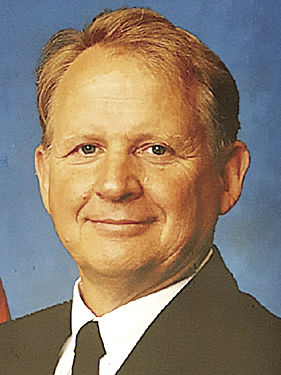

Jefferson County Councilman Brian Haskins wants county residents to vote in April 2020 on whether they want to institute a 3/8 percent sales tax devoted to parks.
Haskins (District 1, High Ridge) said the sales tax would generate an estimated $9 million, and according to his proposal, 27 percent of that revenue would go to cities for their parks and the rest would go to the county to maintain and expand its parks programs.
The sales tax, Haskins said, would complement the current property tax of 2.73 cents per $100 of assessed valuation that funds the county’s Parks and Recreation Department. That property tax funds almost all of the department’s $1 million budget, with some money coming from grants and user fees.
Haskins said the Parks Board, which advises the Parks and Recreation Department, voted unanimously earlier in the evening to endorse the ballot proposal.
However, to get the issue on the ballot, Haskins first needs the votes of at least three more members of the seven-person County Council, and that may be problematic.
Haskins, who campaigned on a pro-parks agenda, spoke at the council’s work sessions on April 1 and May 6 and learned that some of his counterparts don’t share his enthusiasm for the sales tax proposal.
“Are there any plans for this money once it’s passed?” asked Councilman Charles Groeteke (District 4, Barnhart).
Haskins said a parks master plan drawn up in 2013 addresses needs and goals, and those were identified through a series of public meetings and surveys of residents.
“What the master plan talks about is an aquatics center in the northwest part of the county and smaller parks in the north part of the county and larger, regional parks in the south,” Haskins said.
Councilwoman Renee Reuter (District 2, Imperial) said she wanted to see much more information.
“This doesn’t seem to have a lot of substance,” she said of the ballot language Haskins proposed. “I’d like to know exactly how much money is coming in and how they’re going to spend it.”
Groeteke cited a recent report about St. Louis struggling to maintain its parks system.
“I don’t think we want to go down the same road as the city of St. Louis and have more parks than we can maintain,” he said. “I’m looking out for the taxpayers. We have to be responsible with their money.”
Reuter told Haskins that when the Jefferson County Sheriff’s Office asked the County Council to place a property tax devoted to law enforcement improvements on the April 2018 ballot, a group of residents mounted a petition drive.
“This was not just one man coming to us and saying, ‘I want something on the ballot,’” she said. “This was one man saying that there were 2,000 people saying that they wanted it and the sheriff, while he didn’t call it a master plan, knew exactly what that money would go for.”
“About 90 percent of that went to salaries,” Haskins replied. “We don’t need a study. We know that we don’t have any parks. Why would we pay for a study to tell us that?”
Reuter said the situations are different.
“The Sheriff has offices all around the county,” she said. “When you’re talking about buying particular pieces of property that would specifically be used for parks, it’s going to make a difference to me as the council representative from District 2 to know if those parks are going to be in District 2 or in the southern part of the county where people in my district don’t tend to go. Why should my people pay for parks that aren’t accessible to them?
“I would recommend that before you bring this to anyone – including the County Council – that you have details on how this money is going to be spent so you have something to sell to us,” she said.
Parks provide benefits, Haskins says
Haskins provided information at both work sessions indicating that many surrounding communities spend much more per person on their parks than Jefferson County does.
“Farmington spends $189 per person per year on parks. In unincorporated Jefferson County, we spend $4 per person,” he said. “This tax would not move us out of the bottom of this list, but we’d be a little closer to having parks that we can be proud of.”
Haskins said parks provide economic benefits.
“Look at St. Peters (in St. Charles County),” he said. “In 1970, they had 486 people. Now they have 57,000. They spend more on parks than they do on law enforcement, by about $3 million a year.
“St. Louis County has 156 miles of trails. We’re about ready to open our first mile and a half,” referring to a soon-to-open expanded and improved walking trail at the Pleasant Valley Nature Preserve near High Ridge. “St. Louis County has 43 playgrounds; we have two. We compete with St. Louis County for quality families to move here,” he said.
“Studies also find that, in addition to economic benefits, parks provide social and community benefits and mental and physical health benefits. Want to build a smaller jail? Build a bigger park.”
Groeteke asked how many of the communities spending more on parks and building pools and large recreation centers are operating them at a profit.
“How many of these are running in the red?” he asked.
Reuter said Arnold officials have told her that the Arnold Recreation Center, which includes indoor and outdoor swimming areas, does not turn a profit, nor does the Arnold Golf Club, formerly the privately owned Pomme Creek Golf Course.
“It’s unfair to ask parks to make money,” Haskins said. “We don’t ask libraries to make money, or roads. We didn’t pay a toll to drive on the roads to get here tonight. The county parks department has been going along with the same money that it’s been getting for 40 years, and as a result, all we have is basically a mowing crew. What does 2.7 cents get you? Not much.”
Reuter bristled at that suggestion.
“It’s totally unfair to say that we haven’t put any money into parks,” she said. “We have put a half-million dollars into the park in District 7 (the Northwest Sports Complex in House Springs).”
Haskins conceded that the sports complex is the county’s premiere recreation center.
“But it took 14 years to complete it,” he said. “Would we build a new courthouse over 14 years? A jail over 14 years?”
Council members asked Haskins whether officials from cities around the county were onboard with the tax, as they will be sharing money generated by it.
“I don’t know that we need their permission to seek a countywide tax,” he said. “If they don’t want the money (that would be dedicated to parks and recreation improvements in their cities), the county could keep the money. We have plenty of time to go to the municipalities.”
Council members advised Haskins to speak with municipal officials to gauge their interest.
“I would suggest that you speak with the cities sooner rather than later,” Reuter said.
Two residents oppose idea
During a public comment period after Haskins’ presentation on May 6, two people spoke against the tax.
“It’s a losing proposition,” said Alan Leaderbrand of the Fenton area. “We need a jail and a new courthouse. If we go to voters for a parks tax, will we be able to go before them again for a courthouse and jail? Parks are nice, but we need to put this in its proper perspective.”
Susan Davis of High Ridge said she has been told that the Timbers at Eureka recreation center loses money.
“They can’t raise membership fees any higher, or people will drop out. This county is so wide, that if you build it here, people from the other side won’t be going to it. A community center is not going to get the revenue it needs to sustain it.”
In August 2015, the County Council took no action on a request to place a 1/2-cent sales tax for parks on the August 2016 ballot. Haskins, who was then vice president of the private Parks Foundation, which raises money for parks, spoke at that meeting.
Haskins said he is optimistic the result will be different this time around, despite the lack of enthusiasm from other council members.
“Am I disappointed? Yes. Am I giving up? No,” he said. “In the end, I would be very surprised if we didn’t have four people on this council who would say that we should not let the people decide on what kind of parks they want. This isn’t a vote to allow a business to come in or a big zoning question. I don’t know why it’s so scary to let people vote for parks. If they vote no, so be it. Let them decide what kind of parks they want.”
Haskins proposes short-term
fix for college pool
Haskins attended the May 9 Jefferson College Board of Trustees to try to drum up support for his proposal.
He said he spoke with college officials faced with having to close the college’s pool on the Hillsboro campus because of mounting repair costs about a possible way to keep it open for a few years.
“I’ve spoken with officials in the Northwest R-1 School District who said a swim club team is starting in that area,” he said. “They’ll need somewhere to practice.”
Haskins said the club won’t be sponsored by the school district, but instead parents would pay participation fees and the club could contract with the college to use its pool. Then, that money could be used to make short-term repairs to the pool.
“If they know that they can rely on a sum of money coming in, they can use it to fix the pool, which will keep it open for the seniors and the others who want to use it as well,” he said. “It would be a win-win situation for everybody.”
Haskins said college officials told him that they wanted more information before acting on his proposal.
“This could help the college keep their pool going for three or four years,” he said, with hopes that a proposed community center with a pool might be built, possibly in the House Springs area, with proceeds from a proposed sales tax dedicated for parks.
“At that time,” Haskins said, “the college would decide whether they wanted to keep the pool. Everybody would be happy.”