
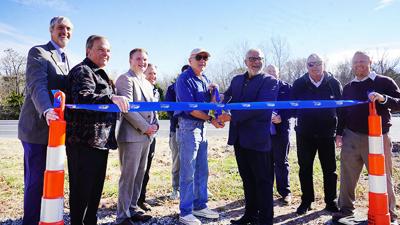
The Missouri Department of Transportation, along with state and Wildwood officials, on Nov. 17 celebrated the completion of a resurfacing and J-turn project along Hwy. 100.
A ribbon cutting ceremony was held at the intersection of Manchester Road and Booness Lane. The project was a partnership with the city of Wildwood and MoDOT.
Work began in April with the crossovers at Hwy. T (St. Albans Road) and at Pond Road, where J-turns were built. Left turns also were added at several intersections, including Woodland Meadows Drive; Hencken Road; Windy Hollow Lane and Hawks Rest Road; and Manchester Road and Booness Lane.
Wildwood Mayor Joe Garritano said the stretch of highway had long been a concern in the community.
“I’ve heard from so many residents over the years who are just trying to get home safely, and today, they can do that with more peace of mind,” he said.
Garritano also highlighted the city’s long-standing relationship with MoDOT.
“This project just continues that tradition,” he said. “Through cost share agreements (and) close coordination, we’ve ensured the improvements that reflect what our city truly needs.”
Other speakers at the event were: Ryan Pearcy, the MoDOT area engineer for southwest St. Louis County; District 7 St. Louis County Councilman Mark Harder; Ben Ridder, a field representative with Sen. Eric Schmitt; and Tom Evers, the MoDOT St. Louis assistant district engineer.
The Hwy. 100 improvements cost more than $14 million, with MoDOT paying more than $12 million and the city paying approximately $2 million for the project.
MoDOT officials said J-turns are a safer alternative to traditional four-way intersections.
“Instead of drivers crossing fast-moving lanes of traffic to get to the opposing lanes, they turn right in the same direction of traffic, merge into the left lanes and then make a U-turn in the direction they intend to travel,” the officials said.
Missouri already has 54 J-turns, and officials anticipate more will be built in the future, MoDOT reported. A MoDOT assessment of 19 existing J-turn intersections in Missouri found the design resulted in a 25 percent reduction in crash frequency of all types, an 88 percent decrease in fatal crashes, a 78 percent decrease in serious injury crashes and the total elimination of a left-turn, right-angle crash.
A recent University of Missouri study showed implementing the J-turn design at intersections of high-speed rural expressways and minor roads results in fewer crashes than those with two-way stops.