


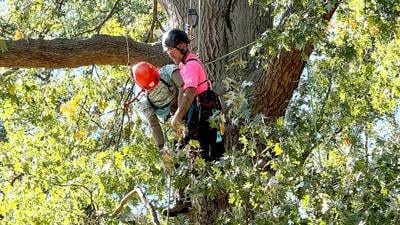
EJ Turner considers participating in the International Tree Climbing Competition in Tower Grove Park earlier this month a “full circle moment.”
Turner, 42, of House Springs is an arborist and co-owner of Turner Tree Specialists, based in Arnold.
He discovered his passion for competitive tree climbing as a spectator at the 2008 ITCC championship, held in St. Louis. Eighteen years later, with five first-place regional championship titles under Turner’s belt, the ITCC returned to St. Louis. Turner was ready to compete this time around, rather than watch.
He’s competed in four international competitions for tree climbing, including in Australia and Canada, but there was something “extra special” about the St. Louis competition, held Oct. 9-11.
“I was feeling a lot of anxiety (before the contests). These are world-class competitors,” Turner said. “A lot of these people spend the whole year training for this competition. The Europeans and Australians dominate; they’ve held the world title for the last several years.”
After three days of competition, with 91 men and women scaling towering trees to rescue dummies and simulate trimming trees with surgical precision, James Kilpatrick from Germany took first place in the men’s category, and Josephine Hedger from the United Kingdom won top spot in the women’s category.
While he didn’t place, Turner said, “I was happy to represent the Midwest and the town that I live and work in.”
Tree training
Turner is a third-generation arborist, with his grandfather and father teaching him the trade. He now operates Turner Trees with his brother, Jason.
How Turner usually trains for competitions is simply by doing his day-to-day job: climbing trees and pruning branches for preservation and removing trees from tight spots. His business services St. Louis City, St. Louis County and Jefferson County.
One of the ITCC events is called “Work Climb,” where competitors are tasked with ringing bells attached to the branches of a tree, signifying making a cut an arborist would make. The event challenges competitors to be fast and precise, Turner said.
“The competition showcases all the skills that we use as an arborist daily on the job,” he said. Turner said his family helps him prepare for these challenges. Turner and his wife, Tia, have five children: Alivia, Adam, Aven, Axton and Azalea.
Tia, a nurse, helps Turner with the “Aerial Rescue” event during competition, providing Turner with useful medical advice like how to apply a tourniquet or what the signs of a heart attack may be.
“They put a life-size dummy approximately 25 feet up in the tree, and they give you a scenario that the dummy is injured,” Turner said. “We have to demonstrate that we can, within five minutes, safely do a risk assessment, ascend the tree, reach the victim and then bring them down to the EMTs safely.”
Turner’s 16-year-old son Aven has taken a special interest in competitive tree climbing. In addition to helping his father run the family business during the summer, Aven acts as a “caddy” for Turner at competitions.
“I’ve been training him how to climb trees,” Turner said. “He goes to all the competitions I go to.”
Future of arboriculture
Similar to Europe’s obsession with soccer, Turner said Europeans tend to take commanding leads in the international tree climbing competitions compared to Americans. It’s just a bigger deal over there, he said.
To become an arborist in Europe, Turner said, you complete an apprenticeship program and pass exams. No such standards are required in the states, he said.
“(Working in arboriculture) is labor-intensive,” Turner said. “There are machines that can take down trees, but to properly prune a tree for preservation, it’s a surgical skill. I hope to see maybe some more licensing and restrictions on who can operate on trees.”
Turner, a 2002 graduate from Northwest High School, began climbing professionally in 2004 and became a certified arborist with the International Society of Arboriculture in 2007.
Competing at an international level has helped boost Turner’s career, he said, showing he’s proficient at maneuvering around a tree but also helping him network with fellow arborists from around the world.
He will compete in his next regional competition in Hawaii in February, a competition he’s participated in for the past 10 years.
“The level of professionalism that goes into these competitions, you know, people recognize that, and a lot of clients want to make sure they’re getting a professional to do the job,” Turner said. “Us arborists, we’re fueled and driven by our passion for proper tree care and preserving trees for future generations to enjoy.”