



A petition filed a year ago concerning former Hematite nuclear fuel site employees’ exposure to cancer risks is being evaluated by the National Institute for Occupational Safety and Health (NIOSH), and the co-petitioners are asking local elected officials for help.
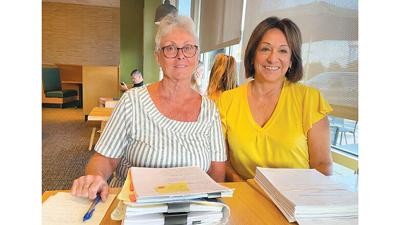
Co-petitioners Brenda Pigg, a former employee, and Debbie Jordan, the widow of a former employee, are sending letters to U.S. Sens. Josh Hawley and Eric Schmitt, Jefferson County Executive Dennis Gannon and the County Council, and District 114 state representative candidates, Ann Moloney and Jessie Shepherd, asking for assistance with any documentation they have available regarding the Hematite facility.
The 228-acre plant operated under several different companies at 3300 Hwy. P in Hematite from 1956 until 2001, when remediation began and is listed by the Department of Natural Resources as a radioactive site. Eight of those acres were used for nuclear reactor uranium fuel production and manufacturing. Uranium was produced for the government for the first two decades.
Pigg’s and Jordan’s Special Exposure Cohort (SEC) Petition 267 essentially asks the U.S. Department of Health and Human Services to provide compensation and medical care to former Hematite facility workers or their survivors for cancers associated with the facility.
According to the CDC, the SEC is a unique category of employees established by the Energy Employees Occupational Illness Compensation Program Act of 2000. Claims compensated under the SEC do not have to go through the dose reconstruction process. Dose reconstruction is the scientific process of estimating a person’s past exposure to radiation or hazardous substances when direct measurement data are missing or incomplete.
Jordan has said any former Hematite site employee filing an individual claim for the Energy Employees Occupational Illness Compensation Program encounters a problem with its mandatory dose reconstruction. Her husband, Gene, was diagnosed with a rare form of pancreatic cancer in 2007 and died in 2013 at the age of 54.
“My husband filed an individual claim in 2007 but was denied because part of doing the claim is they need to do a dose reconstruction,” Jordan said. “So, in order to file that claim, they had to do a dose reconstruction of what they believed his (radioactive) exposure would have been. And in order to be approved, it had to be a certain percentage where they would say more likely than not, your cancer was caused by working here. Well, Gene fell below that. That is the process that most of the employees have had to do.”
To qualify for compensation under the SEC, a covered employee must meet specific requirements and have worked for a specified time period at one of the SEC sites. Classes of employees and work sites can be considered for addition to the SEC through a NIOSH petition process.
According to the CDC, NIOSH is evaluating the Hematite facility petition to see if the proposed class meets the requirements to be added to the SEC. The evaluation is described as a science-based determination of whether it is possible to complete dose reconstructions for the proposed class.
NIOSH will document its findings in a SEC Petition Evaluation Report, which will be presented to the Advisory Board on Radiation and Worker Health in a public meeting that petitioners and other interested parties can attend. Pigg said that could take place in early December.
In June, Pigg and Jordan attended a teleconference meeting with NIOSH and the Centers for Disease Control and Prevention (CDC) in June.
“Written statements from Hematite personnel were presented by myself, Deb Jordan, Randall Jordan (surviving son), and former workers Kyle Brewer and Terri Mouser,” Pigg said. “Those statements were submitted and placed in the record.”
She said it was noted then that the Hematite SEC Petition 267 was approved for review.
“The full (advisory) board intends to complete the review by December of this year, and our workgroup will be created,” she said. “At that point, the formal process will begin for dose reconstruction possibilities.”
The letter to elected officials states, “In view of that upcoming discussion, we would appreciate your attention to the petition and any relevant historical records or questions that your office may be able to help address. We are not asking your office to predetermine the scientific outcome. We ask for an evidence-based evaluation that distinguishes documented facts from assumptions, identifies records that remain unavailable, and gives former workers and their families a meaningful opportunity to contribute relevant information.
“We invite you to become familiar with this issue affecting former workers and families in Jefferson County. We would appreciate your consideration of the importance of historical records preservation, access to relevant public information and a fair federal evaluation of the petition, regardless of the outcome of the election.”
Pigg said there are two time periods addressed in their petition, the operational period from 1958-1965, and the residual period from January 1974 to March 2011, when remediation reportedly wrapped up.
Denise De Garmo, who is acting as the petition representative, said the petition was qualified for evaluation with the dates of 1958-1965 under review. She said the residual period can only be approved if the operational period is approved.
“During the ‘operational’ period, there is evidence and proof that high-enriched radioactive materials were present at the facility,” Pigg said. “During the ‘residual’ period, the high enriched material was not manufactured there, but there is evidence that employees were unknowingly exposed to the residue from the high-enriched days.”
Pigg said there were items found to be highly radioactive during the remediation process of the site which began in 2001, and employees were never informed of their existence.
“During the time that Westinghouse was digging up the burial pits to the east of the plant, there was found 215 Radium-226 contaminated filter press plates in those pits,” she said. “These were discovered and documented by NIOSH. Employees were exposed to the radiation present in those filter plates but were never monitored for exposure to that particular radionuclide.”
Pigg said those press plates are assumed to have been left from the “operational period” of highly enriched radioisotopes before 1974.
“But there has yet to be any origination documentation found,” she said. “Those radium press plates remained on site during the period of 1974-2011 without informing employees of their existence.”
Pigg, who lives near De Soto, worked at the plant for 21 years. Jordan’s husband worked at the plant 20 years.
Pigg said as an employee, she had heard there was high-enriched material there but had been told the property was remediated in between the sale from United Nuclear Corporation to Combustion Engineering in 1974.
Pigg said she has a list of every employee who worked there and she said every fourth or fifth name on the list either had cancer or has died from cancer.
According to the SEC petition, the list of classified projects developed and produced by the facility includes “production of specialized uranium oxides for use in the U.S. Army’s Package Power Reactor; production of highly enriched uranium oxides for a General Atomic gas-cooled reactor; production of highly enriched uranium metal for materials test reactors used by the U.S. Navy; production of uranium-beryllium pellets for use in the SL-1, an experimental military nuclear power reactor that was part of the Army Nuclear Power Program; production of high-enrichment uranium zirconia pellets for a naval reactor; and production of high-enriched oxides for use in General Atomics nuclear rocket projects.”
In summary, the petition alleged radiation exposures and radiation doses were not monitored, and radiation monitoring records have been lost, falsified or destroyed.
Pigg said she has compiled a list of former workers’ contact information. Any former employee who wants to be included in updates can text her at 314-550-4725.
“I will be happy to add them to the contact list and will be happy to forward the agenda and log-in information for any upcoming teleconferences,” she said.
For more information about the petition, visit cdc.gov/niosh/ocas/unc.html.