


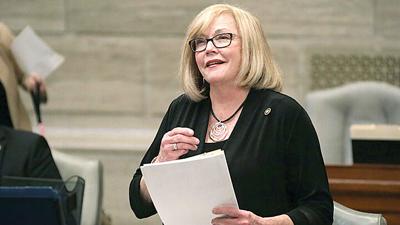
Medical coverage for new mothers with low incomes in Missouri would be extended under legislation state Sen. Elaine Gannon (R-De Soto) has sponsored.
If approved, Gannon’s bill would lengthen the postpartum period that Medicaid would cover from the current 60 days to a full year.
“I’m honored to carry Senate Bill 45,” said Gannon, who sponsored similar legislation last year that didn’t make it to a vote because of infighting among factions in the Senate, including a rancorous debate over U.S. House redistricting. “This bill is about taking care of Missouri’s most vulnerable population, and it’s something I believe everyone should support. I’m looking forward to getting it to the finish line.”
After hearings, the Senate’s Health and Welfare Committee approved the legislation, which now will be considered by the full Senate. If it passes there, it will move on to the House of Representatives.
To become law, the bill must be approved by both chambers by May 12, when the General Assembly’s 2023 session is scheduled to end.
Newborns are covered under a separate state insurance program.
Gannon said extending the period that women qualify for postpartum care is vital.
“In the United States, and Missouri specifically, the rate of postpartum mortality and morbidity is clearly trending upward, and we’re the only First World nation where the rates are going up,” she said. “Missouri is seventh in the nation in mortality rates among new mothers. And 75 percent of pregnancy-related deaths have been determined as being preventable.”
Gannon said the current 60-day Medicaid coverage the state allows new mothers is insufficient.
“The findings are that the greatest number of symptoms related to postpartum mortality occur 43 days to one year after birth,” she said, with mental health issues being the most frequent cause, followed by cardiovascular disease.
“The rate for pregnancy-associated deaths of women on Medicaid is eight times greater than for women on private insurance,” she said. “And it’s greater in rural areas, which allow less access to obstetric services.”
The federal government had extended the 60-day coverage period to a year during the COVID-19 pandemic, but that is set to expire in April.
A provision of the American Rescue Plan Act of 2021 allows states to extend the coverage for at least five years and so far, 26 states and the District of Columbia have done so.
Gannon said the idea behind the legislation is simple.
“If we have healthier moms and healthier babies, that’s a good thing in and of itself, but when you have healthier babies, they get a better start in life,” Gannon said. “Who wouldn’t want those things?”
The idea has bipartisan support.
Gannon’s bill was combined with a similar piece of legislation put forward by first-year Sen. Tracy McCreery (D-St. Louis) and was labeled as a “priority bill” by Senate president pro tem Caleb Rowden (R-Columbia).
It also has been endorsed by both Pro Choice Missouri and Missouri Right to Life.
“Those are two groups that you rarely see on the same page,” Gannon said.
Officials estimated that passage of the bill would extend medical coverage for about 4,600 women each year. It carries an emergency clause that would allow it to take effect immediately after it is signed into law by Gov. Mike Parson.
Parson included $4.3 million in this year’s state budget that was requested by the state Department of Health and Senior Services for a maternal mortality plan. The financial statement attached to the legislation predicted that the Medicaid expansion would cost the state $4.1 million for the fiscal year 2024 (which runs from Sept. 1, 2023, through Aug. 31, 2024) while it also would be funded by $8.1 million in money from the federal government.
In the next two fiscal years, it would cost the state about $10 million to $11 million to fund the extension, with the federal government contributing roughly twice as much.
“Do we want to expand Medicaid to help some of our most vulnerable population and get healthier moms and healthier babies?” Gannon said. “That’s the way people need to look at it. We’re talking about people’s lives here.”