
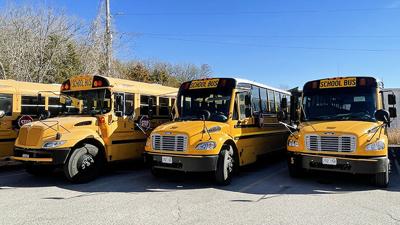
The Fox C-6 School District recently received a federal Emergency Connectivity Fund grant that will allow the district to add Wi-Fi to 97 of its 113 school buses.
JP Prezzavento, chief technology and communication officer, said the district will get 97 routers from RCN Communications, and the cost for the routers, along with installation, setup and configurations, will be $261,581.84.
Not only will the grant cover those costs, but also the cost to provide internet access needed to use the equipment through June 30.
Board of Education members voted unanimously Dec. 12 to enter into an agreement with T-Mobile to provide seven months of 5G internet access for $20,200.25.
Fox will not be billed for any of those costs. Instead, the companies supplying the equipment and internet access will bill the federal government directly, according to school board documents.
Prezzavento said even though the Fox district will not be billed directly, the board needed to vote to approve the contract with T-Mobile because the district has the service agreement with the company. However, the district doesn’t have a service agreement with RCN Communications and the board doesn’t need to take any action related to the routers.
Superintendent Paul Fregeau said he’s excited about getting the Wi-Fi service on buses.
“It will provide better service to our families as far as where our buses are and what they are doing,” he said. “If you have a snow issue, it will be easier to locate where buses are and identify if they are having problems. If there is an accident, we can more quickly identify where they are. It allows us to respond to things more quickly.”
He said he hopes to see the routers installed in buses shortly after the end of winter break, which is scheduled from Dec. 20 through Jan. 2.
Prezzavento said the routers will allow the buses to have internet access where T-Mobile’s 5G network is available. That access will provide the district with bus diagnosis information and allow it to accurately track where a bus is located.
“It is something our transportation department has been looking at,” he said. “We will test it to see if it is the right thing to move forward with.”
Prezzavento said the routers will have to remain on the buses until June 30. However, after the grant funding for the internet service concludes in June, Fox could use the routers anywhere in the district, including buildings and other facilities where internet access could be needed.
“The great thing is we will get the infrastructure with the powerful routers that will last us years and years,” Prezzavento said. “We can use this to supplement the wireless service in our buildings. An example would be ACT testing in a gym. If we want to test 400 kids in a gym, we need internet service to do that. Right now, we don’t have that infrastructure in our gyms. This would allow us to provide that to our students and staff.
“If there is an outage in a building or a wing of a building, we can in a pinch grab these, plug them in and provide Wi-Fi. It is a really versatile opportunity for us.”
Prezzavento said if district officials decided to use the routers in buildings, they would be connected to the internet service offered there, so T-Mobile’s 5G network would not be needed. He also said district officials determine T-Mobile’s network access is something they want to keep, the cost would be $29.75 per month for each router.
However, Prezzavento said the district would only have to pay half of the monthly fee per router because the federal government refunds school districts half the cost of mobile internet access.
“We are really lucky that we are coming into this as a pilot situation,” he said. “If we find it does not fit our needs, we don’t have to move forward with it. We can pivot after June 30. We have a great opportunity to get some much-needed infrastructure.”
Prezzavento said district officials have not decided if internet access will be made available to students while they are riding Fox buses.
“Kids having Wi-Fi on the bus has been secondary,” he said. “We will have conversations about what that ought to look like. We will work with the assistant superintendents, building principals and transportation department to figure out what that can or should look like.”