


After a public hearing and meeting that lasted more than four hours, the Festus City Council voted unanimously Nov. 24 to approve rezoning requests tied to the proposed construction of a data center in Festus.
The requests, which involved 370 acres north of Hwy. 67 and west of Hwy. CC, would rezone parts of the land from R-1 (single-family residential) and other parts from N-1 (non-urban) to I-1 (industrial) so a data center could be built and operated there.
While the request was for the entire 370-acre parcel, only about 250 acres of the land would be used for the data center, said Chris McKee, president of CRG, which is requesting the zoning change.
CRG is the St. Louis-based data center development arm for Clayco. McKee has said CRG would develop the property, and then a data center company would operate it, although no operator has yet been identified.
Clayco is the same company that in August withdrew its plans to develop a 440-acre data center in St. Charles following a public outcry against it.
Many of those opposed to the Festus data center project have raised concerns about how much electricity and water the potential data center would use, as well as noise and light pollution it might generate. Some also said they worried about how the proposed data center would affect their property values.
Those in favor of the data center – many either government officials or union representatives – have said a data center would boost the area’s economy and provide hundreds of jobs.
The data center project has been the subject of several recent city meetings.
On Oct. 27, the Festus City Council approved adding regulations governing data centers to its ordinances.
The council then agreed on Nov. 10 to annex 240 acres of the 370 acres. The other 130 acres were already located inside the city and did not need to be annexed.
On Nov. 19, the Festus Planning and Zoning Commission voted 5-4 to recommend approval of the rezoning requests and advanced the request to the council.
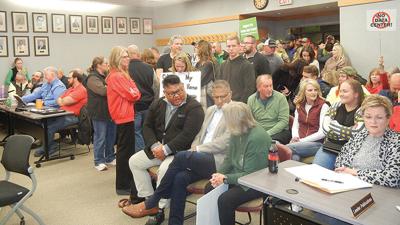
On Nov. 24, about 80 residents came to the council chambers to listen and speak on the rezoning request; the crowd spilled into the lobby and outside the front doors, which were left open so those outside the building might hear the proceedings.
Fourteen residents commented during a public hearing held before the council meeting. Of the 14 who spoke, 13 said they opposed the request.
During the hearing, Erica Carter of Festus said city officials had not been transparent in presenting the potential data center project to the public. She also said the entire process was being rushed. A number of other later speakers agreed the process was moving too fast.
“I’m just furious that I had no say in the matter,” Carter said.
The speakers during the public comment section of the regular council meeting were nearly evenly split, with 20 opposing the rezoning and 19 supporting it.
Matt Drinen of Festus said he is bothered by the speed the project apparently is moving.
“It’s the definition of ready, fire, aim,” he said. “In under 30 days, Festus is being asked to rewrite a law, annex farmland and rezone hundreds of acres with no studies, no disclosures and no public understanding of impacts.”
Jessie Shepherd said she now lives in Festus but was a resident of the Providence subdivision in Herculaneum when a Love’s truck stop was allowed to be built near where she lived. Like the Love’s truck stop, she said, there will be no turning back if the data center project receives its required zoning.
“We pleaded with our (Herculaneum) Board of Aldermen to stop the project from happening,” she said. “But the project went on. The reason why was because the parcel had already been rezoned long before Love’s showed any interest in the property. If the city had tried to stop the project, they would have been sued on the grounds that they had no legal justification to stop the development, even though the community did not want it. Their hands were tied.
“If the city of Festus rezones this property as industrial now, there’s no turning back.”
Cindy Buchheit-Courtway of Festus, executive director of Jefferson County Port Authority, spoke in favor of the data center project.
“I am here to ask you to please stay focused on the task at hand,” Buchheit-Courtway told the council. “You are considering a zoning request this evening, which is just an initial step in a long process. Allowing this type of use could stimulate and attract development that would create good-paying, sustainable jobs, increase the local tax base, provide many community partnerships and much more.”
Another speaker in favor of the project, Alisyn Beffa of Festus, the CEO of Mercy Hospital Jefferson, pointed to medical advances through technology.
“These partnerships and advances in medicine are dependent on a strong digital infrastructure,” she said. “From a hospital standpoint, we do not believe the proposed location will have a material impact on the hospital and, thus we do not object to the rezonings.”
At the end of the evening, Mayor Sam Richards said the council members did a good job deciding on the rezoning requests, understanding that a data center will ultimately benefit the city.
“I’m just glad (all council members) voted for it,” he said. “It shows we’re all on the same page in getting this going. I think it’s going to be a big boon for the city.”
Festus City Administrator Greg Camp said he could see a data center operator identified by CRG sometime in the first half of 2026.
“We could get a proposal as soon as spring,” Camp said.
McKee issued a statement the day after the meeting, thanking those supporting the project.
“We appreciate the support we received from the community and the unanimous support from the council on this important step in a lengthy process, and we look forward to continuing to engage with city leadership and the public with openness and transparency,” McKee said.
PSC reaches customer protection agreement
On Nov. 24, the Missouri Public Service Commission announced a settlement agreement with Ameren Missouri to protect regular customers from rate hikes due to “large load power” users. The plan affects electric customers using 75 megawatts or more of monthly peak power demand.
Among its provisions are:
■ Companies affected must sign a contract term of 12 years, with an option of five years.
■ Companies affected must provide collateral equal to two years of minimum monthly bills.
■ It ensures that all costs incurred to serve large load rate plan customers are fully recovered.
■ It provides that a percentage of excess revenues from large load customers be returned to regular customers, with half of such revenues dedicated to low-income customers.