


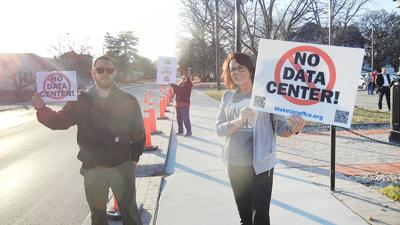

A petition drive to change the form of government of the city of Festus is imminent, those behind the effort said after Monday’s City Council meeting.
Citizens against the proposed data center project of CRG said they are starting a petition to put a measure on the August ballot, seeking to change the city’s form of government, which would then allow citizens to place items on the ballot through petition drives, as well as make other changes to the municipal government system.
Among other results, the change in government would replace the city administrator position with a city manager position.
CRG of St. Louis announced in late 2025 it plans to develop a data center on property north of Hwy. 67 and west of Hwy. CC in Festus.
CRG President Chris McKee has said CRG, which is the data center development arm for Clayco, would develop the property, and then a data center company would operate it, although no operator has yet been identified. Clayco is the same company that in August 2025 withdrew its plans to develop a 440-acre data center in St. Charles following a public outcry against it.
As those proposed data center plans in Festus became public, opposition soon arose.
Opponents of a potential Festus data center development project presented a petition with more than 1,400 signatures along with a letter Feb. 9 to the City Council, demanding the council enact an ordinance calling for a special election for a public vote on a ballot measure to ban such projects for 10 years.
Brian Malone, the city attorney, responded to that petition, saying the city could not put such a referendum on the ballot with its form of government under state statutes.
Sherman Doyle, a vocal opponent of the data center project, told city officials during Monday’s council meeting that data center opponents intend to try to change the city’s form of government.
“We are preparing to mobilize the 1,400 voters who signed that petition to force a new ballot measure this August to transition the city of Festus to Chapter 78 manager form of government,” Doyle said. “We are not doing this to change your job titles. We are doing this because under Chapter 78 of the Missouri Revised Statutes, the citizens are explicitly granted the legal power of initiative and referendum.”
Curtis Higgs, who lives outside of the city but near the proposed data center, said the petition drive will soon begin.
“It will give the power back to the people,” Higgs said. “We’ll pursue (the petition drive) as quickly as we can.”
If voters were to approve the change in Festus government, Malone said, it would mean more than moving from a city administrator to city manager and allowing citizen ballot measures.
“If approved by the voters, this would require a major restructuring of city government that would go far beyond the ability to propose ordinances by initiative,” he said in a written statement. “For example, instead of an eight-member council from four wards, five residents would be elected at large to serve on the council.
“Once the city is reorganized, another initiative petition could be proposed by 25 percent of the registered voters of the city. If an initiative petition for an ordinance affecting data centers were submitted to the City Council, there would be another election on whether that ordinance should be adopted.”
Stuart Haynes, Missouri Municipal League deputy director, said he has been following the data center situation in Festus. He said state statutes would allow for a change in government such as Doyle and Higgs are proposing, but it does not necessarily mean an initiative, such as to stop the data center, would be the end of the project.
“The citizens could put an initiative on the ballot (to change the form of government),” Haynes said. “But, it’s not just as simple as the citizens could determine an issue. There could be legal considerations involved.”
In addition, such a change in government could potentially give a city manager more authority than that of a city administrator, he said.
“A city administrator answers to the mayor,” Haynes said. “A city manager is the chief executive officer of the city and does not answer to an elected official.”
For a second time, attendees at a City Council gathering were required to go through a checkpoint as they entered the premises Monday night at City Hall.
At a March 2 council work session about potential data center incentives, a checkpoint was set up at Four O Six, a city-owned rental space next to the Festus Public Library. Festus Police used metal detector wands on those entering the space.
After the March 2 work session, Mayor Sam Richards said he ordered the use of the wands and they will continue to be used at city meetings or work sessions if there continue to be threats to city officials and staff.