

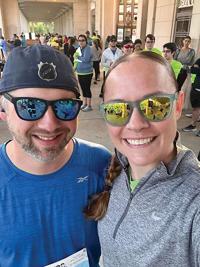

Cassandra Siegfried-Willard finally made the cut to run in the Boston Marathon after five years of writing essays, devising fundraising strategies and sitting through interviews.
A self-proclaimed slow runner, Siegfried-Willard said she couldn’t qualify with her race time, so the only way she could be approved to run would be by supporting a charity. The Dana-Farber Cancer Institute in Boston selected her to raise money for cancer research and run the marathon as part of the Dana-Farber Marathon Challenge (DFMC).
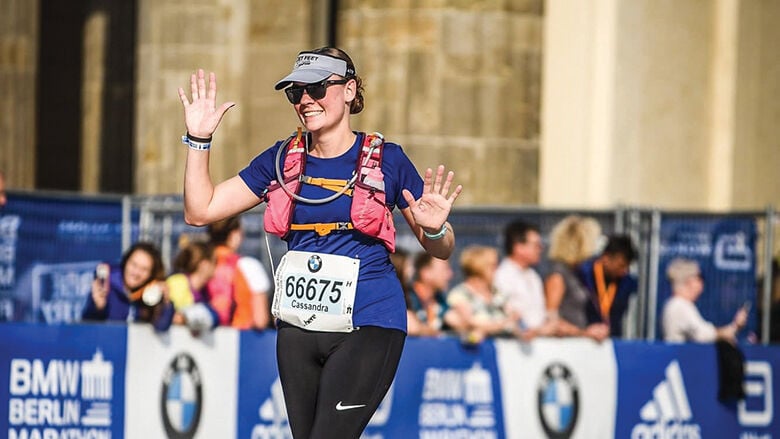
Siegfried-Willard, 38, of Eureka has made it her mission to run all six of the world’s major marathons: London, Berlin, New York City, Chicago, Boston and Tokyo. The 129th annual Boston Marathon on April 21 will be her fifth.
“(The Boston Marathon) is the hardest to get into,” Siegfried-Willard said. “They have around 35,000 people who run it each year and the qualifying times get higher and higher. I’ve been rejected by all the charitable organizations until this year. It’s been quite a process.”
Siegfried-Willard must raise a minimum of $10,000 by the end of May for the cancer institute. In return, DFMC guarantees her race entry and provides training apparel and a race singlet, Boston-area training programs and pre- and post-race amenities.
DFMC is the largest charitable group in the marathon and aims to raise $8.5 million for cancer research this year, said Kelly Wicks, associate director at the Dana-Farber Cancer Institute. Since it was founded in 1990, the group has raised more than $132 million.
More than 500 DFMC runners will participate in this year’s marathon in support of the Claudia Adams Barr Program in Innovative Basic Cancer Research, said Wicks. The program is funded entirely by the runners, allowing more than 300 scientists to pursue research studies since it was established in 1987.
“(The program supports) research in its earliest stages that can provide researchers with critical resources to test their ideas and kind of get cross-cutting research that could provide novel clinical insights as well as the results to seek additional federal funding,” Wicks said. “It’s a great start for some of our early career scientists as well as more experienced scientists.”
Siegfried-Willard paid the $375 marathon registration fee, and she paid an additional $250 charity program fee and an $85 team fee.
“The Dana-Farber Cancer Institute is one of the biggest cancer institutes in the country,” she said. “I chose them because, unfortunately, everybody has a connection with (cancer); everybody knows a family member, a friend who has had it. When I was in my 20s, I went through a little bout of cancer. I always want to race for a charity that I have some connection with because it makes (the run) worthwhile.”
Wicks said runners from 20 states and seven countries are representing Dana-Farber in this year’s Boston Marathon. Without the annual fundraiser, crucial cancer research may go underfunded, she said.
“It’s absolutely amazing that 500 runners are able to raise $8.5 million in a year,” Wicks said. “That’s just such a helpful, wonderful boost to our program. It really makes this research possible.”
Journey to Boston
Siegfried-Willard began running more than 10 years ago following her mother’s death. She said the exercise allowed her to process emotions, get away from stress and have some “me time.” Following the encouragement of her colleagues and running buddies, she signed up for her first marathon in 2013.
“When you run one, you always say you’ll never run another,” she said. “Then you sign up for another. It becomes an obsession.”
Siegfried-Willard said she realized running marathons could open the door to traveling around the world. Since 2013, she has run in the London, Berlin, New York City and Chicago marathons. She plans to run in the Tokyo Marathon soon.
Born and raised in New Jersey, Siegfried-Willard earned her bachelor’s degree in geochemistry from Bridgewater State University in Bridgewater, Mass., in 2008. She worked for environmental and pharmaceutical companies in Rhode Island and Florida before moving to St. Louis in 2015, where she met her husband, Steve Willard.
She earned her master’s degree in environmental health and safety from the University of Wisconsin-Whitewater in 2018.
Siegfried-Willard now works as an environmental, health and safety manager for Richardson International, a Canadian agricultural company. She has also worked part time in the evenings at the Timbers of Eureka Recreation Center, 1 Coffey Park Lane, for the past year and a half.
Training
Siegfried-Willard said the Boston Marathon is more challenging than other races due to its hilly route and six-hour time limit. Runners will be bused to the starting line outside of the city and run 26.2 miles to downtown. For those who can’t make it to the finish line in six hours, Siegfried-Willard said runners who do not complete the race in six hours are driven to the finish line in a bus.

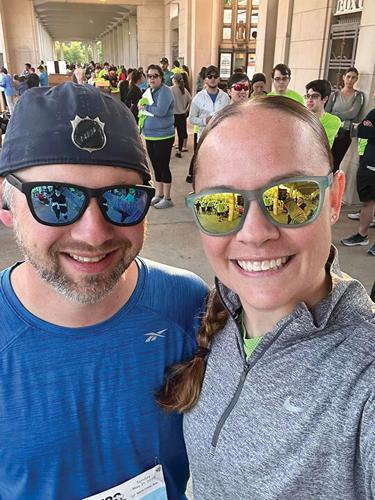
Cassandra Siegfried-Willard with her husband, Steve Willard.
Siegfried-Willard usually runs a 12.5-minute mile during marathons. On good days, she can finish a marathon in 5 1/2 hours, in poor conditions like snowy weather or extreme temperatures, she may finish in 6 1/2 hours.
“It won’t be easy, but hopefully with the crowd’s support I’ll get through it,” she said. “You could be the best-prepared runner, but you never know what happens. It could rain. It could snow. It could be cold. It could be hot. Whatever happens, happens.”
Marathons are mentally taxing, Siegfried-Willard said. She listens to music while she runs to keep her mind distracted from the physical effects of the race. Past the halfway point, she has to start mentally pushing herself.
“Your legs start getting tired and you start wondering, ‘Why the hell am I doing this?’” she said. “Usually, at the 19- or 20-mile mark, that’s where the mental part takes over. You could be in great shape, but once you let your brain take over, you’re done.”
Siegfried-Willard said it’s because of her husband, stepchildren Kyle and Makenna and running friends that she’s able to keep going during a race.
“It means a lot to have the support of my friends and family,” she said.
Once she finishes the Boston Marathon in April and eventually the Tokyo Marathon, Siegfried-Willard said she’ll begin a new challenge: running a marathon in each of the 50 states.
“When people ask me why I do it, I say, ‘Because I can,’” she said. “If there’s something out there you want to do that you don’t think you can, you could totally do it. Give it a try, you never know what could happen.”
To support her fundraising campaign for the Dana-Farber Cancer Institute, visit RunDFMC.org, click on the “Donate Now” button and search for “Cassandra Siegfried-Willard.” Those interested in donating may also call the DFMC office at 617-632-1970.
As of Tuesday, Siegfried-Willard had raised $6,996.75.