


Flooding in Old Town Eureka should be a thing of the past, thanks to a new earthen floodwall, officials say.
Engineers on Nov. 6 tested the wall, spanning from Hwy. 109 to west of Bald Hill Road along Flat Creek, for leaks or flaws.
Jon Derner, a structural engineer with Horner & Shifrin, said the flood-protection system will be mostly complete once a few small tweaks are made. The system includes not only the earthen wall, but a new pump station visible from South Central Avenue, four removable gates spanning Bald Hill Road and Central Avenue and a lagoon berm surrounding the Missouri American Water wastewater treatment plant, which is east of Hwy. 109 on Labarque Way Road.
“From my perspective, most of the work is done,” Derner said Nov. 6. “We tested the gate to make sure it was able to fit in the slot. Then we did a water test to make sure it was watertight. We’ll make corrections as needed. There will be a tweak or two. They’re easy fixes – nothing to be alarmed by. If water started coming up tomorrow, it would function as intended, but we want to make sure that it’s perfect.”
The project began in December 2024 after Eureka Board of Aldermen members voted unanimously to approve a $7.3 million contract with Keeley Construction Group Inc. of St. Louis to construct the earthen wall.
The city funded the project with a $4 million Missouri Department of Natural Resources grant and funds from the Proposition E ½-cent sales tax. Voters approved Prop E in 2018 for city capital improvements, including the construction of a new police station, replacing the Allenton Bridge and for flood-mitigation measures.
Mayor Sean Flower said the floodwall project began about six years ago to prevent major flood events in Old Town. Two floods in 2015 and 2017 caused approximately $10.7 million in damage to public facilities, businesses and homes in the Old Town area, according to a 2020 flood-protection plan from the city.
Flower began working on flood-mitigation efforts before he was elected mayor in 2019 and said he’s proud of the community for making the wall possible.
“When you think about the Eureka community, it’s a pretty crazy thing to get done,” he said. “It started with a bunch of people sitting down, drawing lines on a blank piece of paper. There aren’t a lot of other cities, counties and communities that can get this kind of solution done: raise the money, get the grants, create the thing. It’s a very unique situation for our city, our size.
“2015 and 2017, that will just never happen again.”
How it works
Derner said the Old Town floodwall is visible 4½ feet above ground, and it extends 3½ feet below the ground.
Project engineer Michael Mills said about 15,000 cubic yards of compacted, water-resistant clay dirt was used for the wall. To get compacted dirt, about 21,000 cubic yards were excavated. Most of the dirt used for the earthen wall came from the site of the future ALDI grocery store on West Fifth Street, Flower said.
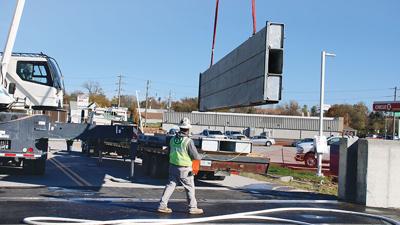
Four heavy gates, called stop logs, were installed. One was at South Central Avenue, just south of the Circle K gas station, 100 Old Towne Drive, and the other was at Bald Hill Road, near the Edward Jones office, 304 Bald Hill Road. The stop log at Central Avenue weighs 13,000 pounds, Derner said.
Engineers designed two smaller stop logs to go over the existing sidewalks on Bald Hill Road.
The stop logs connect each portion of the wall across the two roads.
“When the water reaches a certain level, (city employees) will install the stop log to prevent water from the creek from going into (Old Town),” Derner said. “Whenever the water reaches certain levels, the plan is to put it in place. They’ll exercise it two times a year to make sure they put the gate in correctly and it still works, just so their crews are familiar with it.”
Flower said the stop logs are so heavy that Big Boys Towing & Recovery must use their crane to install them.
“In a flood situation, if we knew it was coming, we’d have these big gates that we pull out of our work yard, and we’ll take them down and insert them into those concrete barricades on Central and Bald Hill,” he said.
Mills said city officials have a big decision to make when determining if the stop logs should be installed. When the gates are closed, no traffic can pass through until the crane removes the logs.
“You’ve got a pretty big judgment call when it comes to closing down South Central Avenue and Bald Hill Road,” Mills said. “When I do that, I’m going to disrupt traffic and any economic opportunities. As a result, you want to make sure that when you close these gates, you get the call right, and as close to the actual event as possible.”
Mills said the earthen wall was moved slightly north of the original design to preserve the existing Flat Creek Trail. A section of the trail was redone to go over the floodwall. He said a handrail will soon be installed to help walkers manage the wall’s steep grade.
“We wanted to make sure that we tie in smoothly; we don’t want to disrupt anybody who wants to enjoy the trail over here, so we brought the path under the bridge as it was before, and we took the same path that it followed previously up and over (the wall),” Mills said.
A pump station built between South Virginia Avenue and South Central Avenue will be used in the event of heavy rain. It should ensure stormwater that collects on the Old Town side of the floodwall is retained and then properly drained, Derner said. Metal bars on the intake area of the station are spaced about 4 inches apart, ensuring that any curious child won’t be able to slip through, he said.
The wastewater treatment wall is a different flood-mitigation system from the Old Town wall, Mills said. He said the wall is built to where the top of the bank is only about 2 feet above the 100-year flood event. About 108,000 cubic yards of dirt were compacted to 93,000 cubic yards at the wastewater treatment plant berm, he said.
“On this system (near Old Town), I care a lot about these businesses and homes, and I don’t want them to flood,” Mills said. “On the wastewater treatment plant, I’m not protecting any homeowners. I’m not protecting any businesses.
“You’re not dealing with the water under normal conditions going over the top (wastewater treatment wall), and you’re not dealing with the sanitary waters on the inside, comingling with what’s going on the outside, but I don’t need the same degree of protection (as the Old Town wall).”