

The Eureka Fire Protection District is celebrating its 80th anniversary this year.
Eureka Fire began as an all-volunteer force in 1944. The district now has 52 full-time employees, which includes 44 firefighters who are also trained paramedics, four chief officers and four administrative staff members.
Chief Greg Brown has been with the district for 43 years, beginning as a junior firefighter at 16 years old.
“When I started as a junior firefighter, we had one firehouse which was downtown across from Joe Boccardi’s (on South Central Avenue),” Brown said. “Since then, we’ve gotten three fire stations and a training center. The area continues to grow – that comes with more and more people and more and more challenges – and our district wants to be a part of that.”
House 1, 4849 Hwy. 109, was completed in 1988 and replaced the original house located on South Central Avenue. It is home to the administration office.
Engine House 2, 1815 W. Fifth St., was completed in 1987. It’s located near the Six Flags St. Louis amusement park.
House 3, 3570 Riverbend Road, in Hoene Springs was completed in 1998.
Deputy Chief William Stamberger said Houses 1 and 2 have full four-person crews and House 3 has a three-person crew that operates whichever equipment is required in an emergency, whether it’s a firetruck or an ambulance. He said the starting salary for a firefighter is $65,800.
Eureka Fire covers 82 square miles in St. Louis and Jefferson counties.
Becoming a district
Harriett Vaucher said she has volunteered or worked for Eureka Fire since the 1960s. She was married to the district’s first chief, George Manetzke Jr., and has been employed by the district since 1971.

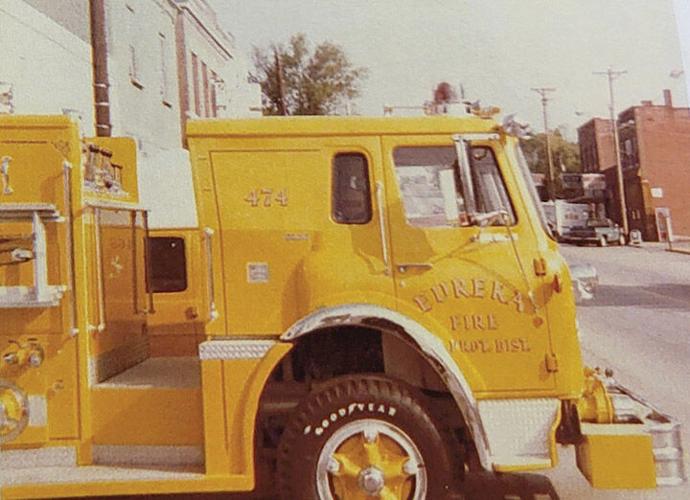
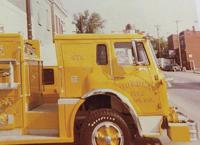
In 1972, Chief George Manetzke Jr. ordered and purchased the first midship firetruck west of the Mississippi in bright yellow. Over the years, Harriett Vaucher said the district would transition to red.
Vaucher’s contribution started when Manetzke was a volunteer firefighter. She said she has organized a ladies auxiliary for the district, volunteered as an EMT and firefighter and worked as an office manager for Eureka Fire, all while raising five children.
“I started getting active when (the volunteer firefighters) would be out on a call and I’d go somewhere, get some bread and bologna and fix some sandwiches and take it out to the fire scene and see that they had something to eat while they were doing their due diligence,” said Vaucher, who works as an administrative assistant for the district now. “They needed something to keep them going.”
A referendum was placed on the ballot in 1970 asking voters to approve a tax-supported fire district. Vaucher said the measure was approved with overwhelming support from area residents.
On Jan. 1, 1971, Manetzke became the district’s first full-time, paid fire chief.
Manetzke died while working to put out a truck fire on Nov. 11, 1971. Vaucher said she began working for the district as an office manager on Dec. 1, 1971. She said her duties quickly extended past the 8 a.m. to 4:30 p.m. workday.
“The next fire chief that we got in, he wouldn’t let me join the volunteers, but as soon as he left then I joined the volunteers on fire and ambulance calls,” she said.
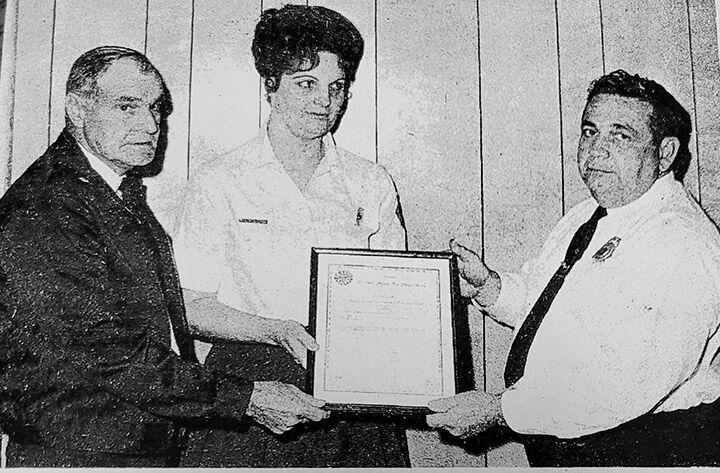
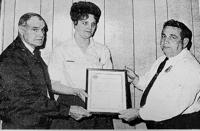
Harriett Vaucher, center, accepted the Certificate of Merit from Robert Watts of the St. Louis County Fire Chiefs Association on behalf of her late husband George H. Manetzke Jr., who died while fighting a fire on Nov. 11, 1971. At left is George Manetzke Sr.
Vaucher said she received her emergency medical technician training from the Big River Ambulance District. She would be on-call on nights and weekends for Eureka Fire, should an emergency arise.
The district purchased its first ambulance in 1972, but Vaucher said having only one proved to be a challenge at times.
“At one point in time, we had a fire chief’s car, which was basically like your (Chevrolet) Equinox or Traverse that we have these days, and we put a stretcher in the back of it as a backup ambulance,” she said. “If you tell the people you’re going to provide ambulance service and that ambulance is out on another call, you’ve got to use that backup ambulance, which was really just the fire chief’s car.”
When Eureka Fire transitioned to a tax-supported district, Vaucher said the district employed a fire chief, fire marshal and one or two firefighters.
The original firehouse had two firetrucks and an ambulance crammed inside, Vaucher said. She said it was tricky to get the vehicles out of the house to answer calls for service.
“I can remember more than once, I was standing in the middle of the street stopping traffic so that the firetrucks could get out,” she said. “(In the engine house) you had three vehicles across and you had two apparatus doors. You had just about enough room to walk in between them.”
Notable calls
Brown said certain community features make responding to emergency calls sometimes unique and interesting. He noted that I-44 and two railroads cut through the district, and the Six Flags amusement park and large areas of protected wildland bring thousands of people into the area on any given day.
The medium security Missouri Eastern Correctional Center in Pacific and the Times Beach hazardous waste site are not everyday challenges for fire districts either, he said.
“We get a little bit of everything, and it’s really interesting and challenging at the same time,” Brown said.
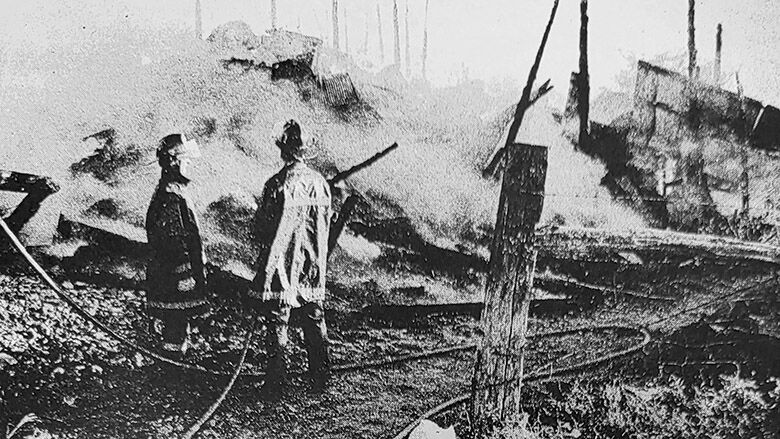
Brown said fire crews worked to put out four major brush fires at separate parts of the district on the same day – March 27, 1991. He said it was a day of 75-mph winds.
“It was unbelievable,” he said. “There was fire equipment from all over the place helping. I was a captain at (House 2) by Six Flags, and the first fire I went to was actually out in Pacific. We got done with that and then we came back and started fighting more fires that were popping up here in Eureka.”
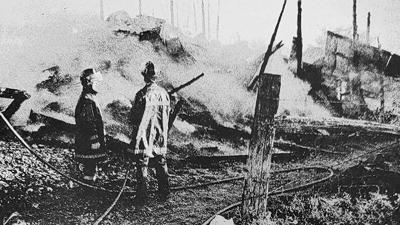
Brown recalled responding to a fire at the abandoned Times Beach City Hall, a few years after the small town was evacuated for dioxin contamination in 1983. He said the building was destroyed.
“They had 35-gallon drums of pesticides to try and keep the mosquito population down, and I can remember those rocketing off (during the fire),” he said. “They literally rocketed up in the air and exploded. It was quite a deal.”
Brown said the fire district had to be flexible and prepared for Eureka’s historic floods in 1982, 2015 and 2017. He said the three firehouses often are cut off from one another during flooding, making a unified response to emergencies difficult.
“Firefighters from other agencies that live in our community will help us out because, literally, boats are the only way to get into those areas,” he said. “We’ve got to have a dynamic response that addresses those days when they happen.”
Future of firefighting
Brown said it has become increasingly difficult to hire and retain firefighters.
“From time to time, we have issues trying to grow the staff,” Brown said. “We are very lucky that we continue to draw good quality people, but certainly the number of applicants has decreased. We used to get 40 or 50 applicants for a position, and now if we get 20 we consider that to be good.”
While applicants are down, Brown said the quality of firefighters as far as preparedness and technical training has increased. He said more people with advanced education are interested in fire service.
“We are very blessed that we have great people who apply here and great people who work here,” Brown said. “Fire service is a great profession to be in, and I think people are realizing that.”
Vaucher said firefighting equipment has improved greatly since she first volunteered with the district. She said Eureka Fire has benefited a lot from the continued support of the community, noting that voters have approved every bond issue the district has brought to them.
Vaucher transitioned from a full-time to part-time role in 2007. She works on Mondays and Tuesdays at House 1.
“It’s very rewarding that the people in the area support you,” Vaucher said. “We’re here to serve the people and do the best we can.”