
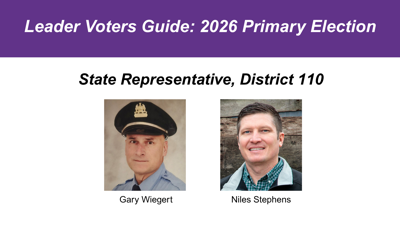
Republicans Gary Wiegert and Niles Stephens will face off in the Aug. 4 primary election for the state House District 110 seat.
Democratic candidate Claire Heinrich has no challengers in the primary. The winners of the Aug. 4 election will face off against each other in the November election.
District 110 encompasses parts of western St. Louis County, covering portions of Wildwood and Eureka.
The District 110 seat is currently vacant, after Republican Justin Sparks left office on Nov. 5, 2025, to accept a position with the U.S. Department of Homeland Security.
House representatives are paid an annual salary of $41,770 and serve two-year terms.
Wiegert, 69, of Wildwood is a retired sergeant with the St. Louis Police Department, having served from 1980-2015. He earned a bachelor’s degree in law enforcement from Southeast Missouri State University in Cape Girardeau and a master’s degree in business administration from Lindenwood University in St. Charles. He was the president of the St. Louis Police Officers Association from 1999-2003 and from 2007-2009. He was a St. Louis Police Pension Board trustee from 2019-2021, and a Republican committeeman for St. Louis City Ward 7 from 2016-2020. Since 2024, he has served as the Republican committeeman for Chesterfield Township. He is married to Maureen and has one child and two grandchildren.
Stephens, 47, of Wildwood is a general manager. He served as a Wildwood city councilman from 2018-2020, was an elected delegate for the Republican National Convention in 2024, and is the current Republican committeeman for Wildhorse Township. Since 2024, he has served as managing director of MO Tax Relief Now. He is married to Michelle and has three children.
Why should voters elect you and what are your goals?
Wiegert: A veteran of protecting citizens in both the Ferguson and City of St. Louis protests. We must prepare for future riots. The Michael Brown verdict led to one night in the city of St. Louis with numerous arsons, burglaries, four police officers shot and David Dorn murdered. I have a plan to prepare for future protests so that our police may properly protect us and at the same time equip and train our officers to use reasonable force to prevent harm. Here is my three-step plan: 1. Training cadets: Train all cadets in police academies for riot control.
2. Police officer preparedness: veteran officers mandate continuous training hours in the technique of riot control.
3. Enforce the law: enforce minor crimes during potential riot situations before it escalates into looting and burning.
In conclusion, regarding criminal illegal aliens, mandate ICE, Homeland Security and local police departments work in cooperation.
Stephens: I’m asking for your vote to continue my commitment to serving our neighbors. I am the only candidate who raised a family in Wildwood, volunteered in our schools, and organized community events. I’m the only candidate with experience serving as an elected official in West St. Louis County. As managing director of MO Tax Relief Now, our organization has helped save Missouri seniors millions of dollars through the senior property tax freeze. We led efforts to stop a local tax increase in 2025. I’ll bring that same commitment to protecting taxpayers to the Missouri Capitol. I’ll focus on constituent priorities that residents have asked me to support, including protecting independent pharmacies, increasing transparency for special-needs students and their families, and codifying the Slayer Rule. I’ll build great relationships within the Republican caucus and work with House leadership, committee chairs and other stakeholders in Jefferson City to build support for residents.
As federal COVID-19 funding runs dry, the Legislature will be facing tighter budgets. What should Missouri’s funding priorities be and where should cuts be made?
Wiegert: Major police departments in Missouri have been systematically defunded. The Legislature should mandate set percentages for local government to be spent on public safety. Protection of the public should be our number one priority. Missouri does not face a tax-collection problem but a spending problem. We should no longer give tax credits for sports teams or stadiums when corporate owners extort fan loyalty to enrich themselves at our expense. Tax credits need to be gradually reduced to zero dependency on government money. The market should determine the viability of investment, not the government. School districts receiving state funding must account for every dollar with the bulk going toward teacher salaries. School districts need to limit bloated administrations and non-teacher spending. Students dropped off by a taxi or Uber shows our budget priorities are out of line. Protect the children with an armed guard at every school.
Stephens: The temporary federal COVID funding was just that — temporary. Missouri families don’t get to spend money they don’t have, and the state government should follow the same principle. Missouri’s commitment to a balanced budget is responsible government, and I am confident we can continue providing essential services within current revenue forecasts. Some spending is required and must continue, such as matching federal funds for healthcare. Other spending provides a strong return on investment and makes economic sense for the state. Beyond that, we should carefully consider all other spending to ensure taxpayers are receiving value for every dollar spent. Missouri must continue funding core responsibilities such as public safety, infrastructure and education. The alternative is higher taxes, and I don’t support raising taxes. We need to make Missouri a low-tax, low-regulation, pro-business state. Economic growth, population growth and private-sector investment will provide the resources needed to fund government services over the long term.
Missourians will have the opportunity to vote on whether to eliminate the state income tax and allow the Legislature to increase sales taxes to make up for the lost revenue. Do you believe increasing sales tax would be preferable to keeping state income taxes? Why or why not?
Wiegert: I am against eliminating the state income tax for the following reasons:
■ Missouri income tax raises $8-9 billion a year – three-fifths of the state budget
■ The Missouri Constitution prohibits tax on services, and the Hancock Amendment protects taxpayers. Currently, the Hancock Amendment requires that a tax increase must be voted on by citizens.
■ The Missouri Legislature wants to change the constitution and prohibit voters for five years from voting on taxes replacing the $8-9 billion loss.
■ To compensate for loss of revenue, the Missouri Legislature must triple the sales tax or tax services such as lawn care, car repair, medical providers, Realtors, lawyers, etc.
■ Retiree constituents on a fixed pension or Social Security know this is a transfer of tax burden on the elderly. Citizens know better what taxes to increase than the Legislature.
Stephens: Amendment 5 continues Missouri’s current path of reducing the income tax through economic growth and revenue triggers. Over the last decade, Missouri has lowered the income tax rate from 6 percent to 4.7 percent, and Amendment 5 would lower the floor rate to 0 percent. Government revenue growth is capped, and additional revenue is returned to taxpayers through lower income tax rates. To speed up the revenue triggers and eliminate the income tax in years instead of decades, we can modernize the tax code for today’s online economy and expand the sales tax base. The amendment does not raise overall taxes because it is revenue-neutral and requires local taxes to be reduced. For House District 110, a yes vote could keep tens of millions of dollars in our local economy, helping families save and businesses grow. This would be a major economic boost for St. Louis County.


Follow races for local and statewide offices as well as ballot measures.