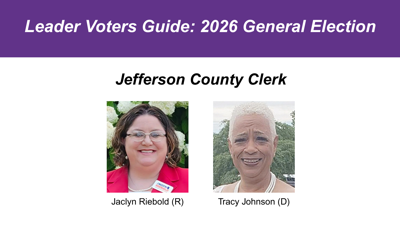
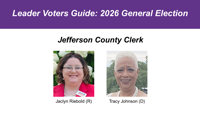
Republican Jaclyn Riebold and Democrat Tracy Johnson will face off for the county clerk seat in the Nov. 3 election.
Republican Jeannie Goff, who served mainly as the second-in-command in the office for 35 years under five county clerks, opted not to run again after being elected as county clerk in 2022.
Johnson ran unopposed in the Aug. 4 primary election, and Riebold narrowly won the Republican Party ticket in a three-way race against Steve Wyatt Earp and Brent Myers.
The county clerk is the county’s election authority as well as the keeper of county records. The office also issues liquor and solid waste licenses and administers notary public commissions.
The office pays a salary of approximately $86,000.
Riebold, 44, of Cedar Hill works in healthcare provider credentialing and insurance contracting, ensuring compliance and regulations for approximately 600 healthcare providers across the country to be in-network providers with various health plans. Since 2002, she has volunteered with Faith Community Church. She was a team manager for various traveling soccer club teams from 2010-2020. From 2017-2021, she served as a Sunday School teacher at Summit Church. She was an assistant troop leader with the Girl Scouts of Eastern Missouri from 2017-2022. She served as board treasurer for the Jeffco Patriots from 2021-2025. She has worked as an election judge since April 2022, joining the verification board judge panel in April 2024. She is married to Victor and has three children.
Johnson, 67, of Herculaneum retired in 2024 after working for 14 years in the Jefferson County Clerk’s Office. Her duties in the office included preparing for countywide elections, attending annual conferences and keeping up to date on new laws and procedures. She graduated from De Soto High School in 1977. He has volunteered for voter registration drives, COMTREA events, Mary’s House of Hope, the Howard Wagner Golf Tournament, Shop with a Cop and Jefferson County Foster Children’s Christmas. She is a member of Giving Something Back to the Community, the Twin City Area Optimist Club and the Quad City Juneteenth Committee, and is treasurer of Amvets Post 42 in Herculaneum. She has one son and two grandchildren.
Why should voters elect you, and what are your goals if elected?
Riebold: With over 20 years of administrative experience, I have developed the ability to work accurately, efficiently and professionally in fast-paced, constantly changing environments. The county clerk’s office requires an open-minded, unbiased approach, and my background in compliance, credentialing and public-facing administrative work has prepared me to meet those expectations consistently. This office is far more than elections; it is a hub for essential county records, processes and services that affect residents every day. If elected to serve, my goals are to strengthen transparency, improve efficiency, support staff through clear procedures and ensure every citizen receives respectful, timely assistance. I am committed to maintaining accuracy, adapting to new requirements and upholding the integrity of all administrative functions (including all election activity) that the office is responsible for.
Johnson: Voters should elect me because I bring 14 years of firsthand experience working in the county clerk’s office and an understanding of the responsibility that comes with serving the public. That experience has taught me the importance of accuracy, accountability, confidentiality and treating every person with respect. If elected, my goals are to provide dependable customer service, make information and services easier to access, support staff through continued training and manage taxpayer resources responsibly. I will also prioritize secure, accessible and transparent elections. Every resident deserves a clerk’s office that is professional, responsive and fair.
What is the biggest challenge facing the county clerk’s office?
Riebold: The county clerk’s office faces several ongoing challenges that directly affect daily operations. Limited budgets make it difficult to replace aging voting systems, expand storage capacity and fulfill transportation needs on election day. Aging equipment can slow workflow, increase maintenance needs and create risks for record accuracy and long-term preservation. The office also struggles with limited storage space, especially as records accumulate and retention requirements grow. These constraints require careful planning, efficient processes and consistent evaluation of what can be digitized or reorganized. Another major challenge is public engagement. Turnout in local elections is very low, and many residents are unaware of the full range of services the clerk provides. Increasing participation requires clear communication, accessible information and outreach that helps citizens understand how county records, licensing and administrative functions affect their daily lives. Together, these issues shape the operational and strategic priorities of the office.
Johnson: I believe the biggest challenge is maintaining public trust while meeting growing expectations for efficient service, secure records and reliable elections – all within the resources available. Meeting that challenge takes clear communication, well-trained employees and consistent procedures. I would listen to residents and staff, identify where delays or confusion occur and prioritize practical improvements. Trust is earned through the everyday work of the office: answering questions, keeping accurate records, addressing mistakes and following through on commitments.
As clerk, what would you do to improve participation in elections, as well as voter registration?
Riebold: Improving voter registration and participation requires a mix of accessibility, communication and community engagement. Expanding online registration awareness, offering clear step-by-step guides and simplifying forms can help residents feel more confident navigating the process. Hosting registration opportunities at public events, libraries, schools and community centers increases visibility and convenience. Clear communication about deadlines, polling locations and identification requirements — through social media, county websites and partnerships with local organizations — helps reduce confusion that often discourages participation. Providing sample ballots and explaining local issues in plain language can make elections feel more approachable. Engaging churches, civic groups and youth organizations encourages broader outreach, especially in areas with historically low turnout. Finally, evaluating barriers such as transportation, work schedules or limited awareness allows the office to tailor outreach efforts that make voting easier and more relevant to residents’ daily lives.
Johnson: I would make voter information easier to find, understand and use. Residents should know how to register, check their registration, update their information, and understand their voting options and deadlines. My priorities would include clear website information, timely reminders and nonpartisan outreach. I would also work to address barriers affecting first-time voters, older adults, residents with disabilities and people with limited internet access. The clerk’s role is to serve all eligible voters equally. My goal would be for every eligible resident to have the information and opportunity to participate confidently.
Both of you have said election integrity is a priority. How would you define it as a concept, assess its current state and strive to improve it?
Riebold: Election integrity means ensuring that every eligible voter can participate, every ballot is handled accurately, and every process follows the law without bias or influence. It includes transparency, secure procedures, clear communication and consistent application of rules. Assessing the current state of election integrity involves reviewing compliance with state statutes, evaluating equipment performance, monitoring chain of custody practices and analyzing post-election audits for accuracy. It also requires listening to public concerns and identifying gaps in understanding or access. Improving integrity in local elections can include strengthening verification processes, updating procedures when laws or technology change, expanding training for election workers and increasing public education about how elections function. Clear documentation, open communication and proactive outreach help build trust and ensure that voters understand the safeguards already in place.
Johnson: To me, election integrity means every eligible voter has a fair opportunity to vote, every legally cast ballot is counted accurately and the process follows the law consistently. It also means protecting ballots and voter information. My priorities would include consistent training, secure handling of ballots and records, appropriate safeguards for election systems and verification procedures required or permitted by state law. My commitment is to administer elections fairly for every voter, regardless of party or candidate preference.