


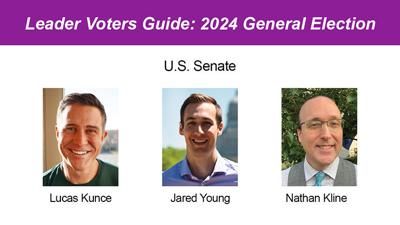
U.S Sen. Josh Hawley, a Republican, is facing four challengers in the Nov. 5 general election – Democrat Lucas Kunce, Libertarian W.C. Young, Better Party candidate Jared Young and Green Party candidate Nathan Kline.
Senators are paid $174,000. The term is for six years.
Hawley and W.C. Young did not return Leader surveys.
Kunce, 42, of Independence is a lieutenant colonel in the U.S. Marine Corps Reserve. He received a bachelor’s degree from Yale University, a juris doctor (law) degree from the University of Missouri and a master of law degree from Columbia University.
Jared Young, 38, of Webb City previously was an attorney in Washington D.C., and a CEO at Employer Advantage in Joplin. He has a bachelor’s degree in Middle East studies and Arabic from Brigham Young University and a law degree from Harvard. He is married to Christin and has six children.
Kline, 56, of Kansas City is the executive assistant to the director of the Kansas City Planning and Development Department. He has a bachelor’s degree of fine arts from Kansas City Art Institute. He attended the University of Missouri-Kansas City and has completed various other college coursework.
What experience do you have (elected office, civic organization membership, volunteer work, etc.) that might serve you well in this position?
Kunce: I grew up like most Missouri families, living paycheck-to-paycheck. When medical bills bankrupted my family, we got by because people in our neighborhood helped us. I joined the Marines to pay them back and served 13 years. I trained with the Border Patrol Tactical Unit in Yuma, Ariz., deployed to Iraq and led a police training team, deployed twice to Afghanistan on Special Operations Task Forces, and served on the Joint Staff at the Pentagon.
Young: I have done internships in every branch of government, giving me firsthand insights into how government really operates. I lived in Europe and the Middle East, giving me a love for diverse cultures and increased appreciation for our country. I have volunteered in the community, including serving on the Boys and Girls Club board and in positions at my church, giving me a firsthand perspective on the challenges associated with generational poverty in Missouri.
Kline: I have a varied background in both the public and private sector, management and administration. With 25 years of hospitality management experience, I brought his skill set to the public sector in 2013 to work for Kansas City. I have been a Green Party member since 1996 and a party officer since 2016, working to provide the only corporate-free option on the ballot in 2024.
What specific needs exist in your district, and how would you address them?
Kunce: A senator’s most important job is to bring money and resources back to their state. Missouri used to be represented by Roy Blunt, a Republican senator who brought back hundreds of millions of dollars in federal funding to Missouri projects each year. But Josh Hawley hasn’t brought back a single dollar of congressionally directed spending to Missouri. Not one. When I am elected to the U.S. Senate, I’ll ensure that Missouri receives its fair share of federal resources so we can reinvest in our state and rebuild our communities.
Young: Our country needs leaders who will prioritize progress on key issues rather than furthering the agenda of their party. We need leaders who reject these “us against them” tactics and instead seek to unite us to work together to tackle our country’s complex problems. That is why more American voters now identify as independents than as members of either major party. The path to real substantive change is electing capable, qualified independent candidates. Independent politicians inherently have more voting power and bring people together to have a large enough coalition to drive solutions for the people they represent.
Kline: Priority 1: Exposing the corruption in D.C. in a way that none of the other elected officials will do because they are all on the take equally. Everything changes with a Clean Green in Washington. The people will finally have a champion in the Senate who will create a beachhead in the chamber to begin our reclamation of American Democracy. The two parties that built the pay-to-play political system will not do anything to change it now. Neither party does very much in office because the corporate consensus rules with either of them in charge.
What steps should the U.S. government take to address concerns about immigration and border security?
Kunce: Before deploying to Iraq, I trained with the Border Patrol Tactical Unit at our southern border. Americans agree there is a border crisis, and I’ve seen it firsthand. Unfortunately, politicians from both sides of the aisle have failed to adequately address the issue. As U.S. senator, I will prioritize securing our border. We need to fully fund and equip the Border Patrol and stop the flow of fentanyl. We need to fund more immigration judges to process the large backlog of cases. And we need to stop employers from taking advantage of both American and non-American workers.
Young: I believe we need a secure border and more legal immigrants. The current state of the border, where millions of people are coming into the country without us knowing who they are, is unacceptable. We must secure our border. At the same time, legal immigrants are vital to both our culture and our national economy. I support measures that will make legal immigration easier for qualified workers. My heart breaks when I hear politicians demonizing immigrants. Most immigrants are people like us who are simply trying to find a path to a better life, just like our ancestors.
Kline: The immigration crisis is driven by the climate crisis. As subsidence farmers are forced off the land in South America and Central America due to increasing droughts, hurricanes and high temperatures, they are piling up on our border. This will only get worse. The U.S. has always been the most welcoming country in the world to immigrants. It is the root of our success. Immigrants are less violent than U.S. born citizens in our country and they work hard for less pay. We need to increase the resources needed to efficiently process immigrant applications, for their benefit and ours.
What steps should the government take to address concerns about the economy?
Kunce: We need to build an economy that puts American workers in charge, not giant corporations and foreign oligarchs, an economy that invests in putting America first in the next generation of energy, semiconductors and supply chain independence. We need to focus on reshoring our jobs and ensuring that investment and opportunity stop being shipped overseas. We need to invest in Missouri and create a Marshall Plan for the Midwest – a historic investment in our workers and communities to rebuild our forgotten towns and cities, and to finally start making stuff in America again.
Young: Decades of irresponsible spending and poor decision-making by both major parties have left our country on the brink of fiscal disaster. Both parties inflate budgets (and deficits) to buy voter support. Our national debt has exploded over two decades. The federal government now spends $400 billion a year just on interest payments. But we still have time to act before disaster strikes. If we elect leaders with real political courage – people who put the country’s future over their own political careers – we can implement a plan to stabilize America’s finances, save Social Security and begin reducing our crippling national debt.
Kline: The necessity to rapidly transition from a fossil fuel powered economy to a sustainable way of life so our children and grandchildren can continue to live on the Earth must drive all of our economic decisions going forward. The free market has proven unable to respond appropriately to this necessity because it is a growth-only economic system. We can’t continue to grow our resource extraction endlessly on this finite planet. We have reached the point where our economy will shrink to a sustainable level either purposefully and carefully, or we will drive off an ecological cliff leaving few survivors.
Why should voters elect you to this position? List your goals, if elected.
Kunce: I take no money from corporate PACs, no money from federal lobbyists and no money from Big Pharma executives because the only people I ever want to owe as U.S. Senator are everyday Missourians like the ones from my old neighborhood who took care of my family when I was growing up. As a senator, I will work across the aisle with anyone who is ready to do right by hard-working Americans. I will work with any president and any member of Congress, from any party, to pass legislation that puts Americans first.
Young: My combination of international experience, legal knowledge, business acumen and empathy for the downtrodden will make me a knowledgeable and compassionate senator who can tackle the challenges this country faces. These experiences have prepared me for public service as a U.S. senator. About 43 percent of Missourians don’t affiliate with either of the two major parties. Elections today feel like you’re voting against the politician you dislike the most rather than a candidate you trust. That’s because candidates have to appease the most extremes on each side, leaving the exhausted majority in the middle unhappy. Uniquely qualified, high integrity, independent.
Kline: I am the only Senate candidate this year qualified to represent the citizens of Missouri because I am the only candidate who has no wealthy donors backing my campaign. The other candidates don’t serve for the working people of Missouri, like myself, because they have been selected by the current pay-to-play election system they have crafted to serve only multinational corporations and the super-rich. My goals are to get money out of politics so the current corporate status quo can be replaced by a system that serves the needs of regular working Americans and future generations.


Follow races for local and statewide offices as well as ballot measures.