


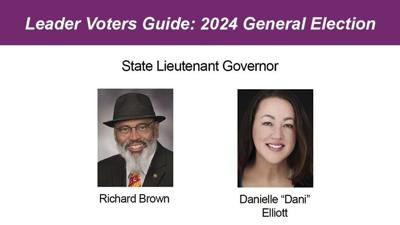
Republican Dave Wasinger, Democrat Richard Brown, Libertarian Ken Iverson and Green Party candidate Danielle “Dani” Elliott are running in the Nov. 5 general election for Missouri lieutenant governor.
Current Lt. Gov. Mike Kehoe, a Republican, is running for governor.
The term is for four years, and the annual pay for lieutenant governor is $88,646.
Wasinger and Iverson did not return a Leader survey.
Brown, 61, of Kansas City is the state representative for District 27. He has a master’s degree in teaching English as a second language from Webster University and a master’s degree in communications and a bachelor’s degree in broadcast and film from Central Missouri State University. He is married to Terese.
Elliott, 47, of Crystal City is a certified medical coder for a multi-state health care system. She has associate degrees in liberal arts and health information management from Jefferson College. She has one daughter.
What experience do you have (elected office, civic organization membership, volunteer work, etc.) that might serve you well in this position?
Brown: Served eight years in the Missouri House of Representatives, from 2017-present, and held the following leadership roles – assistant minority floor leader; vice chair of Ethics Committee; vice chair of Radiological Task Force; treasurer for Missouri Legislative Black Caucus; executive board member for Missouri Legislative Black Caucus; tourism commissioner; ranking member of Tourism Committee, Pensions Committee and Professional Registration Committee; and member of Joint Committee on Public Employee Retirement.
Elliott: I have been a part of numerous committees and organizations and served in leadership roles. I would have no problem with leading the Missouri Senate and the committees the lieutenant governor serves.
What specific needs exist in the state that you think need addressed, and how would you address them?
Brown: Lack of affordable housing statewide is a problem. The state needs to work to increase the number of affordable units. One solution could be to give housing assistance through public/private partnership for new teachers and newly hired police officers, jobs every community needs to fill. This works as an incentive to bring these professionals into communities and to get them to remain. This assistance could be in the form of rent assistance or a form of property tax exemption.
Elliott: Mental health advocacy is needed. There are gaps in care and coverage for those with mental health needs. We need to address the mental health coverage requirements insurance companies have and offer incentives for students to go into the mental health care field. This is the step needed to reduce abuse, crime, drug abuse and homelessness and improve our overall well-being.
We need to reinvest in our people: I’d like to offer learn and earn programs that teach people skills that can help them obtain good-paying careers and break cycles of unemployment.
Why should voters elect you to this position? List your goals, if elected.
Brown: It is a job that requires experience, responsibility and accountability. I have demonstrated all three. I am a retired public school teacher, and I have served eight years in the Missouri House. I serve as the assistant minority leader and ex-officio of all House committees. I work to bridge gaps and foster unity across the aisle. I stand for fairness, trust and transparency in my role as vice chair of the House Ethics Committee. I serve as a Missouri tourism commissioner. My leadership does not stop at titles. It is about action, integrity, common sense – real Missouri values.
Elliott: You can trust me to put people first, do the work and not rely on a political party to make my decisions. My goals include improving communication, as well as looking for programs that offer assistance to reduce taxes and free home improvements for our elderly and those in need. These programs are available but often go unused. We need a platform that can direct people to the programs, which will help them and help reduce scams. I also would like to figure out a way to reduce the number of foreign corporations that own our farmlands.