


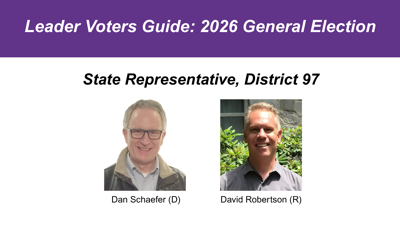
Residents of the Missouri House District 97 will elect a new state representative in November. David Robertson of High Ridge is running as a Republican, and Dan Schaefer of Fenton is running as a Democrat.
District 97 covers a portion of northwest Jefferson County, including High Ridge, Murphy and Fenton.
David Casteel of High Ridge currently is the state representative. He was first elected to the seat in 2022 and was reelected in 2024. He was defeated in the August primary by Robertson.
House representatives are paid an annual salary of $41,770 and serve two-year terms.
Schaefer, 67, of Fenton is a retired electrical engineer. He served on his homeowners’ association board from 1998-2000 and from 2014-2018. He’s a member of the American Civil Liberties Union and served as Alliance Party state chairman from 2019-2021. He produced approximately 100 episodes for the Alliance Party podcast from 2019-2022 and produced approximately 100 episodes for the Democracy on the Move podcast from 2022-2024. His spouse is Ellen Koster, and he has one son, two stepsons and two step-grandchildren.
Robertson, 52, of High Ridge is a retired physics and mathematics professor. He earned a bachelor of arts degree from Lawrence University in Appleton, Wis., in 1996 and a master of science degree from Stanford University in 1998. Robertson organized the St. Louis Medical Freedom March in 2022, created and managed the “We the People of Missouri/STL Patriots Events” e-mail distribution list from 2022-2025.
Why should voters elect you, and what are your goals if elected?
Schaefer: I believe our government should work for ordinary people, not the wealthy, the powerful, or the politically connected. We can only succeed when we all succeed, and that means strong public schools, affordable healthcare and ensuring every Missourian knows his or her voice matters. My approach is simple: spend public money carefully, demand transparency and accountability, reduce the influence of big money in politics and make our tax system fairer. I accept no PAC money from wealthy or corporate interests because I believe representatives should answer to the people they represent. Representatives are hired by the people. When Missourians speak, Jefferson City must listen. My goal is honest, practical government that puts people ahead of ideology and special interests.
Robertson: Founding Father John Adams stated, “Our Constitution was made only for a moral and religious people.” Voters should elect me because I love and understand the structure of our constitutional republic, because I am a moral, God-fearing individual who will place the interests of my constituents above checks from lobbyists and PACs, and because of my experience as a leader in Missouri’s conservative grassroots movement for more than 10 years. My goals, if elected, are to restore the Founding Fathers’ vision of limited government to Missouri, government whose sole purpose is to protect and preserve the inalienable rights of the people, which come from God and return government to serving the interests of the citizens, not special interests and lobbyists. Ninety-five percent of my donations come from everyday citizens, not PACs and special interests.
In light of recent elections, many voters contend Missouri’s state legislators are following their own political agendas, rather than listening to the will of the people, citing Amendments 4 and 5 as the most recent examples of a seeming disconnect between legislators and residents. Do you agree or disagree with that assessment?
Schaefer: I agree. Our representative government only works when elected officials remember the people they represent. Lawmakers will sometimes disagree with their constituents, but it undermines public trust when they overturn the will of the voters. Amendments 4 and 5 are good examples. Our elected representatives placed them on the ballot, and Missouri voters overwhelmingly rejected them. That disconnect should cause every lawmaker to ask whether Jefferson City is listening to the people. Representatives are hired by the people, and they must explain their positions, listen to those who disagree and ultimately respect the decisions their constituents make. I may not personally agree with every decision Missourians make at the ballot box (sports betting, for example), but respecting the people’s right to make those decisions is the most important element of representative government.
Robertson: I do agree there is a disconnect between the desires of the people and Missouri legislators. I believe this is due, in large part, to the fact that many legislators accept significant amounts of special interest, lobbyist and PAC money. That money isn’t given without expectations, meaning many of your representatives are controlled by the interests of their donors in Jefferson City, not the interests of the citizens. Amendment 5, for example, was written in such a way that it was not clear whether it was really a net tax decrease or a bait-and-switch that would raise the overall tax burden and make certain special interests money. I believe the situation can be improved dramatically if the influence of special interests, lobbyists and PAC money is diminished, if not eliminated. Additionally, the people have the privilege of voting out legislators who do not represent their interests or running for office themselves.
A common topic of legislative reform concerns tightening the requirements for citizen-led initiative petitions. Would you support reforming IP? What sort of reforms would you support?
Schaefer: I support IP reform, but it should protect the initiative process, not make it harder for citizens to use it. If outside or hidden money is the problem, address the money, but don’t punish the people by reducing their rights. I would also require greater transparency about who finances and sponsors IP campaigns, so voters know who is behind them. In short, shine a light on “dark money.” Further, I would explore making participation easier through technology, including online petitioning. I agree that amending our Constitution should require broader consensus than a simple majority. I would consider raising the threshold for constitutional amendments, but never above 60 percent of the statewide votes cast on the measure.
Robertson: The initiative petition process needs to be reformed. Initiative petitions are often written with deceptive or confusing ballot language and include multiple parts. Require all initiative petitions to be single subject and written in straightforward, comprehensible language. Currently, a 50 percent plus one majority can amend the state constitution, while amendments to the federal constitution require 2/3 of both houses and ratification by 75 percent of the states. I believe the bar for amending our state constitution should be raised somewhat to be more in line with the process for amending the federal constitution, such as a 60 percent bar, which is what Florida has, or five out of eight congressional districts. That said, the people should have a means for amending the state constitution. Amendment 4 would have raised the bar too high (eight out of eight congressional districts), making it virtually impossible to amend the constitution.