


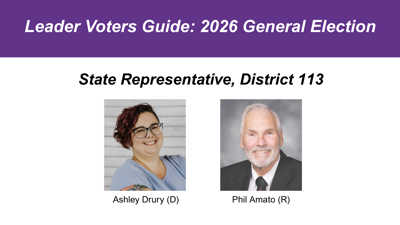
Incumbent Republican Phil Amato will face Democrat Ashley Drury for state House District 113 in the Nov. 3 election.
District 113 includes the northeastern part of Jefferson County including Arnold.
House representatives are paid an annual salary of $41,770 and serve two-year terms.
Drury, 38, of Arnold is a substitute teacher in the Fox C-6 School District and a mental health trainer with the CHADS Coalition. She is the secretary for the Jefferson County Democratic Central Committee and vice president of records for the MO Women’s Political Caucus. She was the secretary for her homeowner’s association from 2023-2026 and the Women Dems Legislative Committee chairwoman from 2025-2026. She graduated from the LeadMO staff cohort program in spring 2025. She holds a master’s degree in human resource management from Lindenwood University. She and her spouse, Alex, have two sons.
Amato, 72, of Arnold is a retired manufacturer’s representative. He is finishing his second term as state representative of District 113, having held the seat since 2023. He serves as vice chairman of the local government committee and is a member of the economic development, transportation and intergovernmental affairs committees. He served on the Arnold City Council for a total of 16 years, serving as mayor pro tem eight separate times. He chaired a committee to raise money for Arnold’s tornado sirens in 1985, and in 1987, he chaired the committee to establish the Arnold and Windsor branches of the Jefferson County Library. He chaired the committee for the Arnold Recreation Center in 1982, 1996 and 2002, and chaired Arnold’s Stormwater Task Force to mitigate stormwater runoff in 1998. He served on the Jefferson County Library board for 31 years, from 1991-2022, serving as president and vice president numerous times. He served on Jefferson County’s Charter Commission for 14 years, which was responsible for writing the county’s charter in 2008. He served as board president of the Arnold Food Pantry from 2016-2023. He was a member of the Mercy Jefferson Hospital Foundation Board from 2017-2023, serving as vice chairman from 2021-2023. He was a member of the Jefferson College Foundation Board around 1999. He served as Arnold Jaycee’s president in 1977 and 1984. He has a sales and business degree from St. Louis Community College at Meramec. His wife is Deb.
Why should voters elect you, and what are your goals if elected?
Drury: I want to bring a new, community-focused voice to Jefferson County. One that listens, works hard and puts people before politics. As a lifelong Missourian, a working mother and substitute teacher, I understand the challenges working families face because I live them, too. If elected, I will work to fully fund our public schools and support the students, teachers and staff who make them strong. I will fight to lower the cost of everyday needs like groceries, utilities, healthcare and childcare. I will push for fair wages, good jobs and better access to mental health care. I am committed to protecting the rights and freedoms of Missourians while making sure our government is transparent, ethical and accountable. I will not go to Jefferson City to tell you what you need. I will go there to listen, to stand up for you and to make sure your voice is heard.
Amato: I have a proven record of leadership and problem-solving skills, from leading the effort to get the Windsor and Arnold libraries started, raising money for the first tornado warning sirens installed in Jefferson County, and leading the effort to get the Arnold Recreation Center built. I have taken that same skill set to the state capital. I introduced squatters legislation, acknowledged as the second most important bill of only 11 passed, that protected property rights. This past session, I introduced legislation to keep crooks from stealing your house. It passed out of the House with overwhelming bipartisan support but stalled in the Senate. If reelected, I will reintroduce that piece of legislation along with the adoption bill, child abuse legislation as well as reauthorizing the food pantry tax credit. All my pieces of legislation garnered massive bipartisan support, passing the Missouri House last year before stalling in the Senate.
In light of recent elections, many voters contend Missouri’s state legislators are following their own political agendas, rather than listening to the will of the people, citing Amendments 4 and 5 as the most recent examples of a seeming disconnect between legislators and residents. Do you agree or disagree with that assessment?
Drury: I agree there is a disconnect between legislators and the people they serve. Voters should be able to trust elected officials to listen to their concerns, understand their needs and be their voice. I appreciate that Missouri’s initiative petition process lets voters take part directly in state government, but it shouldn’t replace good representation. Lawmakers need to learn about the issues, listen to the people they serve, make decisions and vote to represent those who elected them, instead of just “sending the issue to the voters” as some chose to do with Amendments 4 and 5. I am proud to be the first Missourian certified by The Politician’s Creed, a nonpartisan organization that evaluates candidates and elected officials on their commitment to honesty, integrity and transparency. This is just one way I plan to stay accountable to the people of HD113 and help rebuild trust between residents and their representatives.
Amato: Being a republic rather than a direct democracy, we elect representatives to vote on our behalf. I believe it is my sacred constitutional duty to vote, placing ballot measures before voters so they can have their voices heard. I believe disconnects arise when the legislature overturns voters’ decisions without putting the issue before voters again for clarification. After voters approved a new minimum wage and family leave referendum, the legislature moved to reverse those measures without seeking a second vote to clear up any unintended consequences. I voted no, telling colleagues I would never vote to overturn the will of the people. Now that the voters have voted down Amendments 4 and 5, it proves the system works. There would now be a disconnect if the legislature ignores the voters, but I have faith the majority will respect the results, not making the same mistake as the minimum wage referendum.
A common topic of legislative reform concerns tightening the requirements for citizen-led initiative petitions. Would you support reforming IP? What sort of reforms would you support?
Drury: I support the upcoming Amendment 6 because it gives citizens the right to start initiative and referendum petitions and also declares this process as a fundamental right. I believe Missourians deserve a real voice in their state government, especially when elected officials do not act in their best interests. Ideally, voters should be able to trust their representatives to listen, act honestly and put the needs of their constituents first. Sadly, many Missourians have not felt heard for far too long. Keeping the initiative petition process strong gives people a way to hold the government accountable. I also believe ballot language should be clear, simple and easy to understand. Voters should never have to guess what confusing words mean or wonder if a “yes” or “no” vote means what it says.
Amato: There are two ways of changing the direction of our state through the initiative “citizen-led” petition process. Voters can change state law or the Missouri Constitution through an amendment, with both requiring simple majorities. Both ways basically accomplish the same thing, but a constitutional amendment alters a sacred 200-year-old document that cannot be changed once passed. In my experience, there are no perfect laws -- there is always something someone forgot to add or an unintended consequence not intended by someone seeking change. Last session, I introduced a House/joint resolution needing voter approval, hoping to encourage petitioners not to use constitutional amendments over simply using a petition to change state law. I view the “citizen-led” petition as a democratic safety net and would not change the process. If voters would approve HJR 118, it might encourage petitioners to seek state law changes over changing the sacred, 200-year-old Missouri Constitution.