
With the last of the COVID-19 pandemic relief funds either allocated or spent, many elected officials who spoke at the Jefferson County Growth Association (JCGA) Legislative Forum on June 4 cautioned local leaders that the state budget will likely be even smaller next year.
The Legislature approved the state’s $50.7 billion operating budget for the 2026-2027 fiscal year, which begins on July 1.
The budget was sent to Gov. Mike Kehoe on May 6, and he has until June 30 to approve the budget as sent or to veto all or portions of the budget.
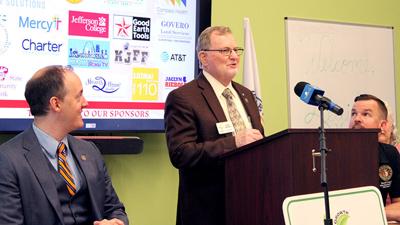
“This is one of the leanest budgets in Missouri’s recent history, and most budget followers expect next year’s budget to be more challenging,” said Jefferson College President Dena McCaffrey, who kicked off the forum with an overview of the latest state legislative session. “Weakening revenue growth and the end of the pandemic-era federal relief programs will require cuts to state programs when lawmakers begin writing next year’s budget.”
Seven of the 11 state and federal legislators representing portions of Jefferson County, or their chosen representatives, spoke at the JCGA event at the Compass Health Network Festus-Truman Center.
JCGA Executive Director Sharon Floyd said 85 community leaders attended.
The most recent state legislative session began Jan. 7 and adjourned May 15. More than 3,000 bills were filed during the session, and 81 bills were passed and sent to the Governor’s Office. Kehoe has until July 14 to either sign or veto the bills.
A near-record low of 46 bills passed in 2024, and 67 crossed the finish line last year.
“Many view this session as one of the most productive Missouri has had in years,” McCaffrey said. “While individuals certainly disagreed on issues, they did it in a professional and courteous fashion, without disrupting the entire legislative process. The Senate made it to the final day and hour (of the session) without imploding for the first time in several years.”
State Sen. Mike Henderson (R-Desloge), along with state Reps. David Casteel (R-High Ridge), from District 97, Cecelie Williams (R-Dittmer), from District 111 and Renee Reuter (R-Imperial), from District 112 spoke at the forum.
Jeremy Lloyd, director of community initiatives, spoke for U.S. Sen. Josh Hawley and district director Madison Baker spoke for U.S. Rep. Jason Smith.
All state legislators representing Jefferson County voted to put an amendment on the Aug. 4 ballot, that, if passed, would eliminate the state’s income tax.
Henderson said if Missouri voters approve the amendment, legislators will be challenged with implementing the plan. Henderson is finishing his second year in the Senate. Before that, he was elected as a House representative for eight years.
“If that (the elimination of the income tax) passes at the ballot, that’s going to make next session maybe the most interesting session since I’ve been up there,” Henderson said.
McCaffrey said about 65 percent of the state’s general revenue is income tax, meaning if it’s eliminated without any replacement revenue, the overall state budget would be significantly cut.
Casteel, who has served four years in the House, said eliminating the income tax could provide more uniformity and clarity for businesses looking to establish services in the state.
While he voted in favor of the bill, Casteel said he would not vote “yes” to eliminate income tax if it makes his constituents’ quality of life harder to achieve.
“There are a lot of assumptions being made (about the bill),” he said. “It’s too thick of an onion with too many layers to have any accurate data right now, so the purpose of the bill is to allow the Legislature a period of time to hear the concerns of the residents, the industries and the stakeholders.”
Henderson said it was a productive session but there weren’t a lot of “earth-shattering” bills passed. Rather, many of the bills he focused on would help business owners in small but meaningful ways, he said. Four of his bills passed this session.
He highlighted one of his bills, called the Critical Infrastructure Protection Act, which will increase penalties for those damaging or tampering with materials from communication and utility systems.
“Thieves don’t necessarily have to be smart, so they’re out there stealing copper; sometimes they’re cutting fiber optics while they’re doing it, thinking they’re going to get copper,” Henderson said. “They’re interrupting services. If I hadn’t mentioned it, it probably wouldn’t have hit your radar. But a lot of bills like that can become very important to your everyday life.”
Reuter, in her final year as a state representative, sponsored a bill that will put lessons in cursive writing back in public schools. Reuter has filed as a Republican for the associate circuit judge Division 12 seat in the Aug. 4 primaries.
She said many of the United States’ founding documents are written in cursive, and it’s important for students to be able to read and comprehend them.
“Historically, people who don’t know their rights and can’t read are at risk of losing those rights,” she said. “There’s a reason women weren’t taught to read before we could vote; there’s a reason why it was illegal to teach a slave how to read, once upon a time. We have a whole generation of people who don’t know how to read in cursive. Some teachers will have to go and learn it before they can teach it. It’ll be really great to have that back in our schools, so that we can read the original documents in the original way they were written, and our citizenry will continue to understand what that means.”