



Near the end of the summer, parents begin compiling a mental checklist of things that must be done before the new school year starts.
There’s back-to-school shopping. Haircuts. Eye doctor visits. Physicals. Vaccinations.
Oftentimes, parents don’t think about making sure their children under the age of 7 have their blood checked for elevated lead levels.
But in this area, known as the former Lead Belt, maybe they should, Health Department officials say.
Jefferson County, Missouri, has a long history with lead, with half of the county previously part of the former Lead Belt. There are areas throughout the county contaminated by processes in lead production, such as lead smelting and tailings removal. The lead contamination has spread from its original sources due to natural events such as floods and manmade activities such as the transportation and use of fill dirt.
But it’s not just the soil you should worry about.
Private drinking water wells in Jefferson County have been found with elevated levels of lead due to mining activities. According to the Health Department, an estimated 20 percent of Jefferson County gets water from private wells. Nearly 1,800 private wells have been tested. Of those tested, approximately one out of 12 wells have elevated lead levels.
Lead can also be found in children’s toys or things children may play with such as car keys, pre-1978 paint, cosmetics, pottery, spices or tracked in on your carpet from your shoes.
Statewide, of the 61,007 children less than 6 years old tested in 2022, 1,688 children had elevated blood lead levels, which means the level was above 3.5 micrograms per deciliter. A level above 10 is considered lead poisoning.
Brianne Zwiener, the Health Department’s public information officer, said from January through May, the Health Department provided 118 blood lead level tests with six coming back as elevated.
According to the Centers for Disease Control and Prevention (CDC), six Jefferson County children had elevated blood lead levels in 2021 and 28 had elevated levels in 2022. No data was immediately available for 2023-2025.
Health concerns and testing
According to the Health Department, lead exposure is a significant health concern for children under the age of 7 who are most sensitive to the adverse effects of lead.
Lead poisoning in children causes lower IQ, behavioral problems, learning disabilities, nervous system function damage, hearing loss, bone and muscle deterioration, slowed growth, anemia, and abnormal kidney function and damage.
Rachel Cooper, a state-licensed lead risk assessor and health inspector, said lead exposure is more dangerous whenever kids are growing because lead is a lot easier for their developing bodies to absorb.
“Early detection really matters when it comes to lead exposure,” said Ashley Proffitt, nursing supervisor at the Jefferson County Health Department. “It can affect a child’s health in serious ways, but what’s especially concerning is that many children don’t show any clear signs or symptoms. That’s why regular testing is so important; it’s the only way to truly know your child is safe.”
Most of the time, when parents of children under 7 come to the Health Department for vaccinations, staff will recommend a lead test. Julia Plaster, who is also a state-licensed lead risk assessor and health inspector, said the test is easy. To get your child tested at the Health Department, call 636-797-3737.
“It’s a finger stick,” she said. “We just need a drop of blood. We’ll have results in five minutes.
Proffitt said Jefferson County is part of the Lead Belt, which means there is a higher chance of lead being present in the environment.
“Because of that, we really encourage parents to have their children (under age 7) tested once a year,” she said.
Zwiener said the department bills insurance.
“Most of the time it is covered, especially for children under age 6,” she said. “We also sometimes have grant funding to help cover patient costs. We utilize funding through the Children’s Health Insurance Program (CHIP H.S.I.) to help cover the cost of lead screenings and case management.”
Next step: home assessment
“Families are contacted and offered a free home assessment if a child’s blood level is 3.5 micrograms per deciliter or higher,” she said. “Missouri requires investigations at 10 micrograms per deciliter, but Jefferson County intervenes earlier to prevent further exposure.”
Zwiener said the in-home lead investigation is provided at no cost to families and takes about two to three hours. In 2025, the Health Department conducted eight home lead assessments, she said. Only one has been conducted so far this year.
Plaster said first they contact the parents by phone and ask several questions.
“We want to know where (the kids) spend the majority of their time,” she said. “Where do you go, like to parks or rivers? What are the (parents’) occupations? What are your hobbies? What is their diet like? How do you store your food? Do you use a little bowl you made in ceramics that could have lead glaze? Things like that and that can give us a clue.”
The parents are asked if they want their soil or well water (if they are on a private well) tested by the EPA.
“If it comes back high – the soil or well water for lead, the EPA does offer free remediation for that as well,” Cooper said. “They’ll come in, they’ll scoop out the contaminated dirt (if it is above 400 parts per million of lead) and they’ll replace it with clean fill and then they’ll put sod over it.”
“And then if the private well water comes back contaminated, they’ll install a filter in a faucet you use the most for drinking water and you will get free (water filters) at least for five years,” added Dan Kane, environmental supervisor at the Health Department.
Contact the Health Department at 636-797-3737 about getting your private well tested.
A new lead testing machine
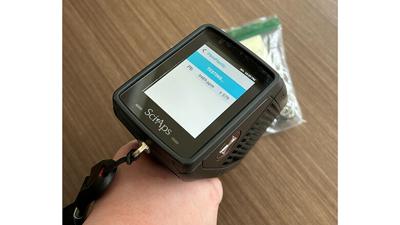
Earlier this year, the Health Department purchased an XRF (X-ray fluorescent) lead analyzer for $29,675 using Jefferson Foundation grant funding. The machine is only used for home assessments where a child has an elevated blood lead level.
The new machine allows staff to quickly test multiple surfaces and items inside homes, including toys, bowls, jewelry, soil, walls and spices, to identify a source of lead exposure.
“Previously, we weren’t able to test toys accurately,” Cooper said. “Our old machine could tell if there was lead, but we didn’t know if it was a significant amount or not. This new one can very accurately tell us if it’s a hazard.”
They can use the machine to test bare soil in gardens and play area.
“Part of the process is questioning the parents to see where’s the child playing,” Kane said. “Finding out where they are (in) the soil and possibly putting it in their mouth.”
“Or even if they’re playing in the dirt and then come inside to eat lunch but they don’t wash their hands,” Plaster said. “That’s why it’s so important to wash hands. The only way you are going to be lead poisoned is if you inhale or ingest it.”
The machine also can test the family’s spices to make sure those are lead free.
“It’s usually turmeric, cinnamon and cumin, and those are imported from like India, Nepal, Bangladesh,” Plaster said, adding the lead can be caused environmentally or intentionally. “One reason is just that it’s an industrial area where the soil there could have lead in it. Also, in the manufacturing process, there could be lead in the air from pollution that’s settling on top of surfaces where they’re manufacturing the spices. Also, people can add lead chromate to the spices to weigh it down and make more money off it.”
Before the machine, they had to bag the spices and send it off to a lab and wait a few weeks for results.
“(With the new machine,) it’s a lot quicker intervention, and the quicker that we can intervene for lead poisoned children, the better off we are,” Cooper said.
There also can be lead in paint.
According to the Missouri Department of Health and Senior Services, 21 percent of Missouri housing was built before 1950, a time when lead-based paint was widely used. Approximately 65 percent of homes were built before 1978 and may contain some lead-based paint.
“The thing is, lead can be in just such a variety of things,” Cooper said. “It’s hard to pinpoint it.”
Plaster said most cases take months to resolve.
Nutrition
Plaster said a diet high in iron, vitamin C and calcium can prevent lead from absorbing in their bodies.
“A lot of the kids (with elevated blood lead levels) are anemic,” she said. “A lot of kids get put on an iron supplement. If the iron is there, the lead won’t bind as readily and then calcium and vitamin C, just all of them kind of do their own thing to help push the lead from lingering in the body and being absorbed.”
Potential sources of lead
- Lead-based paint
- Soil
- Private well water
- Household dust
- Spices
- Pottery
- Toys
- Cosmetics
- Certain jobs and hobbies
Visit www.myleaderpaper.com/news/health for more health coverage from the Leader.