

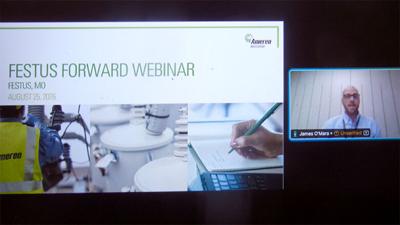

A required power-use study will play an important role in the potential development of a Festus data center, a spokesman for Ameren Missouri said Aug. 25 during the second Festus Forward community webinar.
The study, among other things, determines if enough electrical power would be available for a large load customer at a particular site, James O’Mara, Ameren’s senior manager of economic development, said at the webinar presented by CRG, the data center development company.
In late 2025, CRG announced its plan to develop a hyperscale data center on 361 acres north of Hwy. 67 and west of Hwy. CC. CRG, which is the St. Louis-based data center development arm for Clayco, has estimated the cost of developing the facility at $6 billion. In the Festus project, CRG would develop the property, and then a data center company would operate it, although no operator has yet been identified.
“So many times, a customer will come to us or a developer or a prospective end user, and they may have a site in mind. And before they do due diligence, we are the first to contact,” O’Mara said at the webinar. “Many times, we are the gating mechanism or the eliminating factor in many projects because if electric capacity is not available, then in most sites, if it’s not available it would not work. So, we’re engaged very early on in the process.”
O’Mara said power studies are essential prior to a large project.
“No project can proceed until that study is completed, and I think that’s a really important detail, is that these studies are the first requirement before a project can even move to any agreements and move forward in any level of the process,” he said. “Typically, those studies take anywhere from 120 to 150 days. But depending on the complexity they have, there are some times where they are taking longer. But that’s a typical timeline.
“So right there, just in the study process alone, you know you’re looking at roughly a four- to five-, six-month time frame to complete those studies because it is an exhaustive process to ensure that that load, if it were to connect, it can connect and we maintain reliability for our existing customers.”
A preliminary review by Ameren’s internal engineers is the first step of the study, he said.
It gives the utility and the customer a “high-level” sense if there is potential capacity, he said.
“If there is potential capability, we relay that information to the customer and at that time, if they want to proceed forward, we require that customer to submit a formal interconnection study request,” he said. “That interconnection study request outlines … the specific specifications of that load, where that point of interconnection is, a point of connection for that customer, what’s the rough timing on the project that they believe is the timing of the project, and then that really allows us to do the formal study.”
For the interconnection study, the customer pays a $200,000 deposit and then Ameren engineering teams begin reviews.
The status of an Ameren study on the CRG data center project – such as had it started or was it nearing an end – was not made clear during the webinar. During the webinar, O’Mara said he could not give out information about a study for an individual customer.
After the webinar, Ameren officials also declined to release information about the status of the CRG study.
CRG did not respond to subsequent attempts to learn if the Ameren study could affect CRG President Chris McKee’s announced target of beginning work on the project in November.
During the webinar, O’Mara was asked how a large load user could affect electricity costs of other customers.
“Large energy users, even data centers, dating back have historically provided benefit to existing customers,” O’Mara said. “We’ve seen this nationally. Even today we’re seeing this nationally in other states where the large energy users are helping put downward pressure on rates.”
O’Mara was asked if a closed-loop water system proposed for the data center could put an additional power strain on the system.
“At the end of the day, we control the maximum electric usage and contract capacity that they have with us based upon that electric service agreement, and would not allow them to exceed that,” O’Mara said. “If for some reason the technology they implement requires more energy usage, they would have to adjust to stay within those contract limits.”
He was asked if there will be a need for infrastructure improvements because of a potential data center.
“We have construction agreements and mechanisms in place to ensure that if there are upgrades, those costs are 100 percent on the customer to pay for before we complete any of those upgrades,” he said.
On Aug. 26, McKee in a written statement said he thought the webinar went well.
“We were pleased with the engagement,” he said. “Just over 50 attendees joined us, and the session let us walk through some of the questions we’ve heard most often from the community around electricity and the grid. We were glad to have Ameren Missouri present directly, since they’re best positioned to explain the state’s large-load customer protections and how the cost of serving a project like this is handled. This was the second webinar in our series, and we remain committed to maintaining an open, ongoing conversation with Festus.”
He said more webinars are planned, although the date of the next one is to be determined.
The Aug. 25 webinar, which lasted a little less than an hour, is available for viewing on the Festus Forward website, festusforward.com.
The first webinar, which was held July 22, may be accessed at the website.