


Jefferson County Executive Dennis Gannon issued an executive order on Dec. 2 directing the County Services Department to research data centers and draft proposed regulations for the development of them. The proposed regulations will be presented to the Jefferson County Council to consider within the next few months.
County Services Director Mitch Bair said at the Dec. 3 Economic Development Objectives Committee meeting that the executive order directs his staff to research best practices and regulatory models for new data centers; assess local constraints and needs; draft a regulatory framework and findings; and submit the results to Gannon and the County Council for possible adoption.
The Economic Development Objectives Committee met Dec. 3 to discuss possible regulations regarding data centers. The committee invited guest speakers from Olsson, an engineering and design firm based in Chesterfield that works with data center developers, to speak about possible light, noise and water ordinances the county could enact.
Six of the seven council members were present at the meeting, with Councilman Brian Haskins (District 1, High Ridge) absent. Also sitting on the committee, as consultants, were Chris Howard, a Cedar Hill resident seeking the Republican nomination for Jefferson County executive in 2026; Clint McBride, government affairs director for LiUNA Local 110; and Bobby Kaye, a Festus resident and president of the Lorenzen Candle Corp.
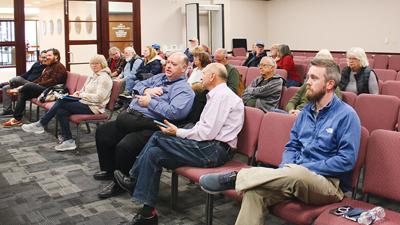
About 30 community members attended the meeting, and four spoke during the public comment portion. Most of the speakers opposed data center development within the county or said they were worried a data center development could negatively affect their health and property value.
A data center is a building or group of buildings that houses equipment necessary for computing, such as routers, servers, switches, firewalls and storage systems.
These centers can be large, like the 970,000-square-foot, hyperscale QTS Data Center in Atlanta that sits on a 99-acre campus and has electric substations on-site, along with direct fiber internet access, according to the company’s website.
A hyperscale data center uses thousands of servers and advanced networking to process enormous amounts of data. The system relies on high-speed networks, a powerful cooling system to manage heat output and automated software to continually run the system, according to Fortinet, a global cybersecurity company.
The Missouri Public Service Commission on Nov. 24 announced a settlement agreement with Ameren Missouri to protect regular customers from rate hikes due to “large load power” users, which could include data centers. The plan affects electric customers using 75 megawatts or more of monthly peak power demand.
Recent proposed data centers in St. Charles and St. Louis were met with public opposition, with some concerned the developments may lead to energy rate hikes, extensive water usage and pollution.
The Festus City Council on Nov. 24 voted unanimously to approve rezoning requests tied to the proposed construction of a data center in the city. The requests involved 370 acres north of Hwy. 67 and west of Hwy. CC.
Bair said his staff has tentatively laid out a schedule for the preparation and approval of data center development regulations. The Economic Development Objectives Committee was expected to meet again on Dec. 10, after the Leader deadline, to discuss the appearance and design of the centers; potential site plan issues; wastewater and stormwater.
He said staff will draft recommended language “in a timely manner,” with the goal of presenting the legislation at the March 12 Planning and Zoning Commission meeting, held at 6:30 p.m. at the Ken Waller Memorial Building, formerly the Jefferson County Administration Center. The meeting will include a public hearing.
“The County Council would consider draft legislation, tentatively, at their April 13 and April 27 meetings,” Bair said.
The County Council meets regularly at 6:30 p.m. on the second and fourth Mondays of every month at the Ken Waller Memorial Building.
“As we move forward, all of (the committee’s comments) will be synthesized and put into draft regulatory language,” Bair said. “The whole point of the county executive’s executive order is to remove any confusion as to who does what and provide a substantial commitment to a ‘we’-based system on how we put this together for the county.”
Councilman Bob Tullock (District 7, House Springs) serves as chairman of the committee and said the county is trying to be as transparent as possible with drafting the legislation. He said he anticipates the committee meeting several more times in the coming months to discuss data center legislation.
“We don’t even have any kind of proposal being brought to unincorporated Jefferson County right now, but we are taking the appropriate steps to make sure that we address potential problems,” he said.
Zoning requirements
Under the county’s current zoning requirements, a data center development would be allowed in a non-planned industrial district, planned industrial district and a planned-mixed district, Bair said. Any development would require zoning and development plan approval from the county.
Bair said data centers should be allowed under a planned approach, where the county could establish conditions and limitations on the developer and hold them accountable.
“We should regulate data centers as an independent, specific land use,” he said. “We should also regulate both as a primary and accessory use, because (data centers) can be an accessory use to a larger office building or other operations. Should we go down that road, we will be prepared for that.”
Bair said his staff recommends adding language to the legislation that clearly states data centers are not allowed within floodplains or environmentally sensitive areas.
If data centers did not comply with the county’s adopted codes, he said, penalties would be enforced. The penalties for noncompliance could be a hefty fine or temporarily shutting down the center until compliance is met.
“I think it has to be something beyond just financial penalties because some people might just accept that and just pay the fine,” said Councilman Tim Brown (District 6, De Soto). “Can you actually shut down the facility operations? I don’t know what it would be, but just consider what we can do.”
Lights, noise, water
Bair said the county would use a common regulatory approach to limit excessive light pollution from data centers. All lights must be limited to a certain height and are required to be fully shielded downward, toward the ground.
In terms of noise regulations, the county could limit the amount of noise produced by data centers and heard at the property line of the development, measured in decibels, Bair said.
Noise levels could be capped at 55-65 decibels during the daytime, recorded at the property line, Bair suggested, and limited to 45-55 decibels at night. The 55-65 decibel range is compared to a conversation held at a normal speaking level, he said.
The county could also limit the hours of operation for the centers and how often back-up generators are tested, which can be noisy, Bair said.
Will Calderon, an environmental engineer with Olsson, provides noise modeling for data center developers. He said that, because data centers use relatively new technology, the industry is still developing best practices for acceptable noise levels. Decibel levels can vary depending on the manufacturer of the data center, where the center is located on the property, and the topography of the property and surrounding area, he added.
Nancy Withinton, a Festus resident, said her main concern, if a data center were built next to her property, would be for her health, as well as the health of her family and neighbors.
“I feel that a data center is going to dash all of our hopes for our children and future generations,” she said. “The constant sound and light, along with the air and water pollution, will affect our minds as well as our bodies. Is the almighty dollar more important than the health of your fellow man?”
“The purpose of (noise regulations) is to prevent excessive noise from data center operations that may adversely impact public health, safety and the peaceful enjoyment of nearby properties,” Bair said.
In terms of water usage, Bair said the county’s main goal is to ensure a data center does not adversely impact the public’s water supply, groundwater sustainability or the availability of water for residential and commercial users.
Many older data center models use water to keep their processing servers cool, Olsson mechanical engineer Brad Hutchins said; however, newer centers are moving away from water to an air-cooling system. Using air cooling, though, may result in higher energy usage, he added.
“(Data center developers) are very conscious about taking water away from people,” Hutchins said. “They’re worried about that news story or that neighbor who complains. We’ll do a site due diligence (for clients), looking at how much water is available so it would not disrupt surrounding areas.”
Dale Weese of Festus said he’s a retired data center employee. He urged the committee to be mindful of where data centers should be developed within the county.
“Much of our county is on well water,” Weese said. “I ask that you please pass an ordinance forbidding the use of well water for cooling. An aquifer is a finite resource.”