


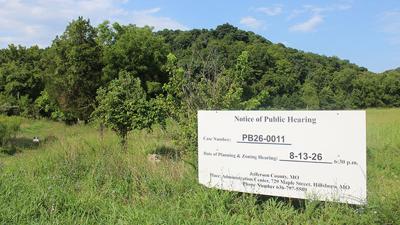
The Jefferson County Council has postponed approving a 200-home subdivision development in Imperial, with some council members calling for a procedural change to how developments are reviewed by county staff.
On Monday, Councilman Charles Groeteke (District 4, Barnhart) moved to table the final vote to approve the Lionstone subdivision development. He said the council had questions and concerns regarding the petitioner’s submitted traffic impact study and wanted Public Works Director Jason Jonas to look at it.
As Public Works director, Jonas oversees maintaining and improving the county’s roads and bridges. Groeteke said Jonas’ analysis and comments on the subdivision’s potential impact on local traffic are important to the council’s decision to approve or deny the development.
As part of a report sent to the Planning and Zoning Commission and County Council, County Services staff reviewed the traffic impact study conducted by CBB, stating that “all recommendations from the traffic impact study” shall be required as a condition for approval of Lionstone.
CBB’s traffic study found that no auxiliary turn lanes are warranted on Lions Den Road at the proposed subdivision but recommended the developers clear vegetation along the west side of Lions Den Road to ensure adequate sight distance for Lionstone residents.
The study highlights motorists traveling northbound on Lions Den Road approaching Old Hwy. 21, stating that there may be more traffic congestion at the intersection during evening rush hour because of the subdivision.
However, the study said “based on video review,” Lions Den Road is “often utilized as two lanes” at the intersection, and assuming most motorists use that approach, the traffic congestion should be eased.
“There were some things in the traffic analysis that didn’t look right,” Groeteke said.
Councilman Billy Crow (District 2, Arnold) said he was worried that having Jonas review the traffic impact study may introduce new evidence to the case, which he said would violate the county’s procedures for development plan approval.
“If we do something like this, infringe on their due process by adding additional evidence, what happens if the developer sues us for violating their due process, and when the development still comes, there’s no turn lane and we’re on the hook for that?” Crow said. “Right now, we have heard staff’s opinion. We saw where it said it wasn’t required.”
Jalesia F.M. Kuenzel, the county’s legal counsel, said Crow was misinformed on what the county considers to be “new evidence” in petitions for development. Under the county’s current procedure, all evidence for a development or rezoning petition must be introduced at the P and Z hearing. Any comments from the public following the hearing are limited to whether they are in favor of or opposed to the project.
“I do believe that I sent you a memo on this,” Kuenzel told Crow. “What you’re saying is not accurate. You’ve stated a lot of ‘introducing new evidence’ and all this stuff that’s actually contrary to my memo, and I think you know that. It is not introducing new evidence; it is clarifying evidence that is already in front of the council. That’s what Mr. Jonas would be doing: interpreting and clarifying something that is already in evidence.”
Councilman Tim Bennett (District 5, Festus) questioned why the county engineer hadn’t reviewed the traffic study yet, as a matter of procedure.
“If the reports come in, and the proper people aren’t looking at it, why do we (require the traffic study) at all?” he said. “We force developers to do all these things, because that’s part of the development process, to get traffic studies, environmental studies, all these studies. And now we’re in a predicament where we had some questions, and now it’s ‘well, hold on, let me look at that; I haven’t looked at that yet.’ It’s ridiculous.”
Groeteke said years ago the county engineer was included in the P and Z meetings, making himself or herself available for any traffic impact questions that may be brought forward during the public hearing. At some point, the rules were changed, and the county engineer is no longer asked or required to be at these meetings, he said.
“If (the county engineer’s) position was reinstated on the P and Z commission, it might eliminate some of these problems because he could weigh in on these subjects sitting on the P and Z commission,” Groeteke said.
Brown agreed, adding that it seemed there were some inconsistencies within the process for development plan and zoning approvals. He said a county stormwater engineer is looped in to analyze the development plan and provide feedback whenever stormwater issues are brought forward on a potential development. Brown said he’s unaware if a similar process is in place for traffic studies.
Brown also said the council should look at conducting traffic studies in-house by county staff, rather than making a developer commission a private company to perform the study.
As for the Lionstone development up for a vote at the Monday meeting, Brown agreed with Groeteke that the approval should be tabled for the next regular meeting in October.
“I think this deserves a review by county staff, to come back and see if there’s something we could potentially be on the hook for as a county,” Brown said. “We could approve this tonight just because we want to fast-track it, but what if the county engineer does come back and say, ‘Yes, the report actually does show that this is warranted,’ and it’s going to cost, whatever, make up some number to fix this – let’s say $50,000. That’s money the taxpayers are going to have to pay for out of our road and bridge fund, because we didn’t want to just slow it down for a couple of weeks while we reviewed it. I’m not willing to put that burden on our taxpayers if the burden should actually be on the developer.”