


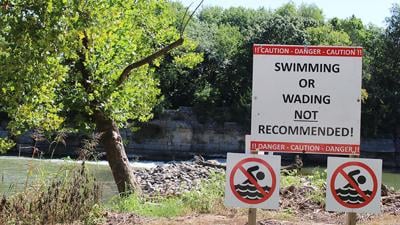

The Jefferson County Council has extended a ban on swimming at Rockford Park in House Springs through the summer.
The council voted 5-2 to ban swimming and wading through April 30, 2027, when the provision will sunset, unless the council votes again to uphold the ban.
Councilmen Charles Groeteke (District 4, Barnhart) and Tim Brown (District 6, De Soto) voted against the bill. Both council members voted against the same bill when it was first passed in October.
Officials have determined the river access at the park, 4320 Hwy. W, is dangerous for swimming and wading. While the water may look calm on the surface, officials have said powerful and strong currents under the surface can suck unsuspecting swimmers underwater.
Park visitors often try to swim across the Big River to a series of bluffs to jump off the rocks into the water. However, swimming across the river can be treacherous, due to a low-head dam upriver of the park’s access point.
The county-owned park has been the site of at least seven drownings in the last decade. The most recent incident occurred June 28, 2025, when a 44-year-old man from Overland drowned on the Big River.
Councilman Brian Haskins (District 1, High Ridge) said he appreciated his colleagues’ support in passing the ban. He said many people’s first reaction when they see someone drowning is to try to help, often leading to the bystander’s endangerment or death.
Multiple large signs will be placed around the park informing visitors of the ordinance in multiple languages, Haskins said. Since the Parks and Recreation Department does not have park rangers, Haskins said Sheriff’s Office deputies will enforce the ordinance and write tickets for those breaking the law.
Haskins and Bob Tullock (District 7, House Springs) said the ban will protect first responders. The ordinance permits first responders to use the river access point for water rescue training.
Tullock also credited Groeteke for helping coordinate federal efforts to remove the low-head dam from the Big River near the park’s access point. In December, the council approved a $400,000 grant from the U.S. Fish and Wildlife Service’s National Fish Passage Program, which will be used to remediate the mill dam to restore natural water flow.
The project will be completed in phases, with the entire project estimated to cost $2.5 million. The county is expected to receive another estimated $2 million over the next three years as the project is completed.
While the U.S. Fish and Wildlife Service is primarily focused on restoring the Big River to its natural flow and protecting endangered animals, project documents state there may be an added safety benefit for parkgoers. Removing the dam will likely reduce the water pressure flow through the area, which could make it safer for swimmers.
“It looks like this (swimming ban) isn’t a permanent thing,” Tullock said. “I’m very happy to support the sunset provision in this. We’ll see where this (project) is at next year and revisit it.”
County Executive Dennis Gannon cautioned that there is still federal funding that needs to be approved for the project, and in addition, the project may take years to complete.
“There’s no assurance that we’re going to get the funds for Rockford Park from the federal government,” Gannon said. “Although they’ve approved it, there’s still one final piece missing that has to be approved. You may be looking at this (swimming ban) for another year, or moving to shut (the park) down while they renovate.”