


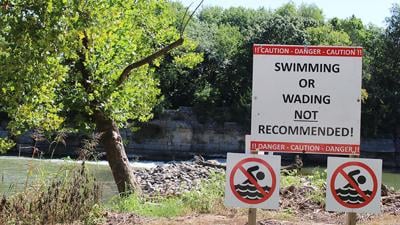

The Jefferson County Council took a preliminary vote last week to ban swimming and wading at Rockford Park in House Springs.
At the same meeting, the council called upon federal representatives to approve funding to remove or modify a low-head dam on the Big River near the park, in an effort to make the spot safer for swimming.
The county-owned park has been the site of numerous drownings in the last decade, and local fire protection districts have been called to the park at least four times this summer for water rescues.
The most recent incident occurred on June 28, when a 44-year-old man from Overland drowned on the Big River. Before rescue crews arrived, a Jefferson County Sheriff’s Office deputy had already jumped into the water, attempting to locate and rescue the man.
Strong and swift currents directly downriver of the low-head dam often take swimmers by surprise, authorities have said, dragging them underwater in a whirlpool-like pattern.
In March 2024, the council voted to change the name of the park from Rockford Beach to Rockford Park and to ban alcohol and marijuana, in the hopes of preventing future drownings. At that time, the council stopped short of outright banning swimming at the access point in the park.
Since last year’s vote, the makeup of the council has changed, with council members Billy Crow (District 2, Arnold), Lori Arons (District 3, Imperial) and Tim Brown (District 6, De Soto) joining the council.
The council voted 6-1 Sept. 8 to ban swimming and wading at the park, with Councilman Charles Groeteke (District 4, Barnhart) voting against the measure.
However, that was a preliminary vote, and the bill requires two more votes before final passage, which will likely take place at the next regular meeting at 6:30 p.m. on Monday, Sept. 22, at the Jefferson County Administrative Office, 729 Maple St. in Hillsboro.
Councilman Bob Tullock, who previously had voted against a swimming ban, indicated at an August work session that he’d had a change of heart and ultimately voted in favor of the ban in last week’s preliminary vote. He said first responders risk their lives when entering the Big River to save drowning victims.
“The main reason I decided to go ahead and support this at this time is due to the risk to first responders,” Tullock said. “Not only did they risk their lives during the drownings that we had, but multiplied at times by four or five, by the drownings that we didn’t have but could have had. And I would like to see this get resolved, and I have no problem suspending (swimming and wading) to do that.”
Councilman Brian Haskins (District 1, High Ridge), who first proposed the ban in 2024, said the preliminary vote was an example of county government working together to increase public safety.
“In government, every once in a while, we do get it right,” Haskins said. “Sometimes we’re at odds with each other over some very important issues, but sometimes we get it right. It’s a win for the county, the public and the safety of our first responders.”
Groeteke said he had doubts that the Sheriff’s Office could enforce the ban.
“Are you going to have a member of the Sheriff’s Office down there all the time to enforce (the ban)?” Groeteke asked. “(Sheriff Dave Marshak) can’t fill all his positions now that he has budgeted for, due to a lack of officers. I just don’t know how you’d do it. He’s budgeted for the number of officers he needs, but he can’t fill the positions.”
Sheriff Dave Marshak said in a written statement that his department supports the council’s legislative efforts. The Sheriff’s Office will be working with the Jefferson County Parks and Recreation Department to enhance signage at the park for visitors, “many of whom travel from outside the area,” he said.
“Recent observations show a significant number of vehicles with out-of-state plates, particularly from Illinois, and a large portion of visitors representing Hispanic communities,” Marshak said. “Clear and accessible signage will help ensure all visitors are aware of the new rules and can plan accordingly.”
Marshak said if park visitors swim or wade in the Big River at Rockford Park after the ban is in effect, deputies would issue them citations, with the alleged violators facing various penalties determined by the municipal courts.
“During peak times, deputies spend more time patrolling parks and river access points, and we expect that to continue (with the ban in place),” Marshak said. “Overall, I don’t anticipate major issues arising from this decision, as most of the challenges we’ve seen in the past have come from people outside our community.”
Sunset clause
Before the ban was taken up for a vote last week, Tullock amended the measure to include a sunset provision. He said the ban will be lifted on April 30, 2026, unless the council votes to continue it.
Tullock said it is important that the council review the ban annually before the normal swimming season begins to ensure county, state and federal officials continue to work to make the river safer.
Crow said he favored the ban and would have liked to see the sunset provision extended through the swimming season.
“I’m all for this bill, and I know baby steps are the way we like to go, and so I understand the amendment is what it takes to get it across the finish line,” Crow said. “It just seems odd that most, if not all, the accidents and the drownings happen in the summer, and we’re just banning during the winter. It would have been nice to see it go until 2027.”
High Ridge Fire Protection District Chief John Barton said he is in favor of the ban, agreeing with Tullock that a permanent ban is not the way to go.
For a water rescue on the Big River, High Ridge Fire and other supporting agencies, like the Cedar Hill and Eureka fire protection districts, respond to the scene with more than 20 first responders, Barton said.
He said a water rescue can be a taxing and often traumatic experience for his firefighters.
“We understand there are a couple more hurdles we have to clear, but I’m optimistic (the ban will pass),” Barton said. “I think this is a great solution to help with public safety right now. I think their decision to have a sunset clause built into it, therefore, having to revisit every year to extend it, makes complete sense because nobody wants to take away swimming access permanently. We just want to see the river conditions modified to where it can be done relatively safely.”
Resolution
Also on Sept. 8, the council voted unanimously to approve a resolution requesting the help of Missouri U.S. senators and representatives to get federal funding to address the low-head dams along the Big River in the county.
According to the resolution, the council is requesting funding for a project included in the 2019 U.S. Army Corps of Engineers study called the “St. Louis Riverfront-Meramec River Basin Ecosystem Restoration Feasibility Study with Integrated Environmental Assessment.”
Included in the study are plans to reduce the downstream spread of contaminated mining sediment on the Big River; restore floodplains in the Big River and Meramec River systems; and preserve the natural habitat found along the rivers.
Costs for any approved project construction would be shared by the Corps of Engineers (65 percent) and the Missouri Department of Natural Resources (35 percent), according to the study.
Groeteke said he’s hopeful Congress will fund at least a portion of the U.S. Army Corps’ plan to remove or significantly modify the Rockford Park dam, potentially making it safer for swimmers.