

A Jefferson County woman has founded a ministry that will bring together at-risk youth and trauma survivors with wild mustangs that need taming in the hope that those horses will find forever homes and that those who work with the horses will find healing.
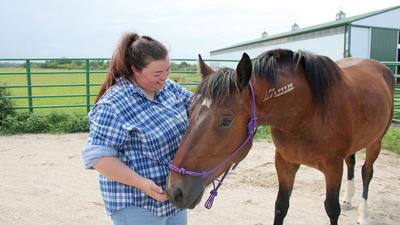
Connected Colts Ministry founder Mallory McBrayer began Connected Colts Ministry earlier this year to provide faith-based programs for at-risk youth and trauma survivors.
McBrayer, 32, of the Festus area said she has one formerly wild mustang right now and is working to adopt more for the program.
She and her partner, Jason Henson, plan to start offering lessons in six to eight weeks, but first they must build a training facility that meets federal requirements for holding wild horses.
The facility grounds, which are south of Festus, will include a shelter for the horses, including a tack and feed area, a round pin structure for the programs’ lessons and a perimeter, no-climb horse fence around the property.
Once the ministry is up and running, McBrayer will run the horse programs, and Henson, who co-owns and operates a home repair and new construction business, will take care of property management and safety.
Henson, 50, said he and McBrayer want to start lessons right away, but taking the time to build the facility safely is important.
“I’m a stickler in that everything has to look good (at the facility) and has to be right.”
Getting started
McBrayer said she has wanted to find a way to help both people and horses since she was young, so the new Christian ministry has been years in the making.
“This is something I wanted to start for probably 10 years, and the timing hasn’t been right,” McBrayer said. “When I was a teenager, I went through some trauma and kind of found that horses were a safe place; horses were where I could relax and be myself.”
McBrayer said she’s taken riding lessons since she was 10 and began focusing on training, or “gentling,” wild mustangs about eight years ago.
“What a lot of people don’t know is that mustangs are highly overpopulated (in the U.S.),” she said. “What happens is cattle ranchers are killing off (the mustangs’) natural predators because they’re also natural predators to cattle. We have about 50,000 horses sitting in government-run pens that need homes.
“The idea of helping horses that are really in need and don’t have a place to go, sitting there with no purpose, I want to give them a purpose and get them to loving homes.”
Helping people
McBrayer said people from all backgrounds and with or without horse experience are welcome to join her programs.
Neither McBrayer nor Henson is a licensed therapist, so the lessons focus on training the horse and developing a relationship with the horse.
“There are wonderful programs out there for equine-assisted learning or equine-assisted therapy,” McBrayer said. “The reason we chose not to go that route is because it tends to get expensive for people. We really just want anybody to be able to spend time with a horse, not just those who have the money.”
McBrayer said her programs are a good way to introduce people to horses for the first time since they don’t include riding. One focus of the programs is liberty work, a style of training a horse without using ropes or reins. The horse is free to move around the training area and it’s up to the trainer to build a trusting relationship with the horse, McBrayer said.
“In our trauma survivors (program), we use liberty work, which is all based off of consent,” McBrayer. “They get to see this training process happen at the horse’s pace, and with the horse’s consent, which is super beneficial for them, because as trauma survivors, at some point they’ve had that consent revoked.”
McBrayer said both horse and trainer learn together as they move through the program. Ideally, she said, the participants will work with three horses in the program – two resident horses that will stay full-time at the facility, and one that rotates every 30-90 days to new homes.
“There are tons of benefits (for trainers) as far as building confidence, teaching them to be assertive and fair,” McBrayer said. “Your horse can make mistakes, but you have to be fair about it when you correct, right? You have to be in control of your emotions, and you have to correct the horse as needed.
“You see this change in people getting more assertive and understanding boundaries when they start training.”
Helping horses
McBrayer boards her 4-year-old mustang, Fame, at a farm in Richwoods but the horse will be transferred to McBrayer and Henson’s facility once it’s completed.
Fame is a shy and sweet horse who loves people, McBrayer said.
In her experience, she said, wild horses have a unique desire to connect with their trainers, unlike some domestic horses.
“Any horse is going to be unpredictable because they’re animals,” McBrayer said. “All horses bite, all horses kick. The biggest difference I’ve found is that once you build that relationship, (wild horses) try really hard for you. Domestic horses, some of them don’t really care because you’re just another person to them.”
The horses in the program will most likely be 3 years old or older, McBrayer said and will come from failed adoption situations.
She said some people adopt wild horses with good intentions, but discover they aren’t equipped to handle them, or their facilities are not up to federal standards to hold them.
“We have a lady out in Kansas City who was pressured by an owner of a storefront – which is kind of like a private adoption event – to get a horse that was way outside of her experience level,” McBrayer said. “She’s like, ‘I can’t do anything with this horse; this horse is still wild.’”
It will cost about $6,000 to construct a facility that will meet federal standards for holding wild horses, McBrayer said.
Henson said domestic horses require a 5-foot perimeter fence, and wild horses require a 6-foot, no-climb fence.
“When you bring in the wild mustangs, you have to meet certain specifications as far as the size of fencing, their height, the square footage,” Henson said. “If your dog gets out, that’s one thing, but if your horse gets out, that’s totally different.”
Fundraising
The waitlist to join a program at Connected Colts is about 50 people long, McBrayer said.
While there’s a lot of interest in joining the ministry, she said, more funding must be secured before programming can begin.
The ministry accepts donations and horse sponsorships on its website, connectedcoltsministries.org. According to the website, sponsoring a horse includes contributing to veterinarian fees, feed, hay and training costs. In return, the sponsor receives a private meet and greet with the horse and trainers and regular photo updates, among other things.
The ministry will hold a cornhole tournament fundraiser at 2 p.m. Sunday, Aug. 4, at Cornhole Central in Pevely. It costs $50 to register a team.
McBrayer said more updates on the cornhole tournament and other upcoming fundraisers may be found on the Connected Colts Facebook page.
While six to eight weeks is the goal for getting their horse programs off the ground, Henson and McBrayer said the ministry will be a long-term work in progress.
The two have plans to eventually move to a larger property where they can comfortably fit more horses and expand their programs to include Bible study sessions.
“Like every other project, you’re going to start off and get to a point where everything is running and we ask, ‘What can we do to make it better?’” Henson said. “‘How can we help more people? How can we help more horses?’”