


After merging with Comtrea two months ago, Compass Health Network has begun expanding medical, dental and behavioral health services in Jefferson County.
In Festus, county residents soon will have access to a new behavioral health crisis center and a new primary care, dental and behavioral health services facility.
In addition, a primary care, behavioral health and dental services facility is in the works in High Ridge, and a dental facility will be offered in Arnold.
Behavioral health crisis center
Compass’ new behavioral health crisis center will be housed in a building at 222 N. Mill St. next to the Festus Fire Department. The building will be renovated to fit the needs of people in crisis, said Lauren Moyer, Compass’ executive vice president of Clinical Innovation.
She said the renovations are expected to begin this month, and plans call for the center to be open by the start of next year.
The crisis center will be open 24/7, Moyer said.
“That is so crucial because it really helps people to not have to go the ER unnecessarily,” she said. “Crises don’t happen Monday 8 a.m. to 5 p.m. They also happen on a Saturday at 2 a.m. We really just want to make sure that we’re there for the community like we have been in our other communities.”
First responders and hospitals may refer people in crisis to go to the crisis center, or they may just walk in. Once at the crisis center, patients’ needs will be assessed, and they will be linked to appropriate services, she said.
Lisa Flamion, a mental health coordinator for the Jefferson County Sheriff’s Office, said it made her day when she learned that Compass was opening a behavioral health crisis center.
“It’s definitely a big deal,” she said. “It changes the way we are able to respond to people in crisis.”
Flamion said rather than take a person in crisis to a hospital where they will have to sit and wait for 12 or more hours, a law enforcement officer may take a person to this crisis center where they will be seen almost immediately by a psychiatric doctor or nurse.
Not only will the crisis center meet patients’ immediate needs, once discharged, they will have a care plan, access to medication and a follow-up appointment with a community-based provider.
Flamion said there are probably about 15 crisis centers in the state, and right now the closest one is in Wentzville.
Katrina McDonald Fuller, Compass’ executive vice president of corporate services, said the building for the crisis center currently houses a psychosocial rehabilitation program and well-being center that will be relocated to 109 N. Mill St.
She said the psychosocial rehabilitation program is for adults diagnosed with a serious mental illness and works to prevent them from living in isolation and provides them with education, socialization and skill-building opportunities.
More projects underway
Moyer said Compass has three other projects in the works, all expected to be up and running by fall 2024, she said.
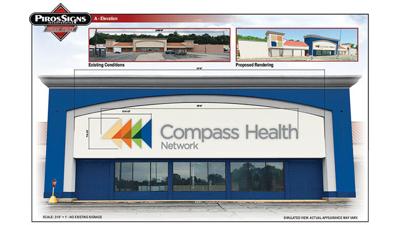
Compass has begun to renovate the 70,000-square-foot building at 1275 Truman Blvd. that used to house a Shop ‘n Save in Festus for a comprehensive primary care, dental and behavioral health services facility.
In High Ridge, a building will be added to property at 1817 Gravois Road and will house a primary care, behavioral health and dental services. The existing building on the property offers services for people with behavioral health and substance use disorders.
Moyer said Compass has leased a dental facility at 1845 Jeffco Blvd in Arnold to provide dental clinics for people with private insurance and Medicaid. However, it also will offer a sliding fee scale for customers without dental insurance.
“That (clinic) is going to add like 10 additional dental chairs,” she said. “We’ve realized that was a crucial need.”
Moyer explained that when Compass sees a need, it tries to fill it.
“We can continue to grow as much as we need to meet the needs of the community,” she said. “I think that’s the special thing about Compass. Even though we are a larger entity, we are a very fast-moving one. I know sometimes when you get larger entities, you think there’s a lot of bureaucracy, and that’s just not what we are about.”
Moyer said since the merger on July 1, Compass has hired 35 new team members, with plans to hire about 40 more in the next 60 days to boost the nonprofit organization’s ability to meet the growing health care demands in Jefferson County.
She said Compass’ goal is to find additional property to open up more clinics so people won’t have to travel as far to get the care they need.
“We are truly about meeting the gap where it needs to be filled,” she said. “It’s not (about) going where everyone else is; it’s really about going where no one is so people can get access to care.”
Compass also has taken over the 988 Suicide and Crisis Lifeline call service in Jefferson County, achieving a 100 percent answer rate within just one second, officials said.
Moyer said there is a caveat – right now not everyone calling in Jefferson County will be routed to a Compass-staffed 988 line, explaining that the current system routes a call based on the caller’s area code.
She said that will change when the Federal Communications Commission goes live with geo-routing system that will be able to locate the caller.
The change was supposed to happen this summer, but it is still being tested, Moyer added.
“They have told us within the next three months that it will likely be rolled out, which will be critical,” she said.
Moyer also pointed out that 30 percent of the people calling 988 are calling for information for a loved one or to learn how to de-escalate a crisis.
She said Compass has mobile crisis staff members who can go to a caller’s home at any hour if they feel someone’s needs aren’t being met over the phone.
“Sometimes people have a fear and a stigma that we’re going to involve the police,” she said. “Only about 8 percent of our calls actually involve us having to engage the police and that’s because it’s a critical, dire situation like someone has a gun to their head.”