
The city of Arnold will spend up to $950,000 to determine how five railroad crossings could be improved or eliminated.
Judy Wagner, Arnold project engineer, said the study will start Jan. 1.
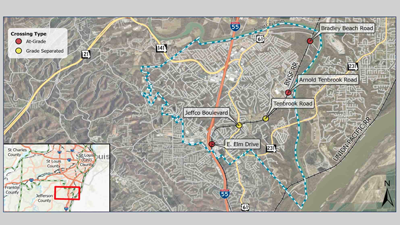
The 16-month study will examine railroad crossings on East Elm Drive, Jeffco Boulevard, Tenbrook Road, Arnold Tenbrook Road and Bradley Beach Road, according to city documents. BNSF Railway owns the railroad tracks that run through the city.
City Council members voted 7-0 on Nov. 20 to hire GFT Infrastructure Inc. of Kansas City to complete the study. Ward 4 Councilman Gary Plunk was absent from the meeting.
Wagner said GFT was one of six engineering firms to submit proposals during the qualified-based selection process, which means the firm was hired based on its ability to complete the project, not cost considerations.
She said Arnold received a $750,000 railroad crossing elimination grant through the U.S. Department of Transportation to cover most of the study’s cost; the city will pay $200,000 for its share.
“The study will include project management, planning and alternatives study; initial environmental screening; traffic study; social and economic studies; and most importantly, community involvement,” Wagner said.
The agreement with GFT said the company will hold at least two public meetings during the study to allow the public to review existing conditions, initial concept developments and draft recommendations.
As part of the study, four meetings will be held with stakeholders, which may include city and county government members, railroad representatives, people from the private sector, business organization, state agencies and federal contacts.
There also will be up to six one-on-one meetings with representatives from BNSF Railway, the Arnold Chamber of Commerce, Arnold business associations, the Fox C-6 School District, emergency management services and major business or property owners in the study area.
“I included funding for two different public input meetings in the contract to be sure the public has input in the early stages of the study,” Wagner said.
The five crossings are in the BNSF Railway River Subdivision, which spans about 4.1 miles between where the tracks cross Bradley Beach Road inside Arnold City Park in the northern portion of the city to East Elm Drive in the southern portion of Arnold.
There are two different types of railroad crossings – at grade, which means the tracks go across the road, and grade separated, which means the tracks go over the road.
Three of the crossings to be studied are at grade and include the ones on Bradley Beach Road, Arnold Tenbrook Road and East Elm Drive.
The two grade-separated crossings go over Tenbrook Road and Jeffco Boulevard.
Wagner said the crossing in Arnold City Park on Bradley Beach Road is dangerous because people currently walk across the tracks while in the park.
She said the crossing on Arnold Tenbrook Road causes traffic to back up in the city’s industrial park area.
Wagner said the bridge that carries trains over Tenbrook Road has a low clearance for vehicles and is narrow.
She said the bridge that goes over Jeffco Boulevard does not have enough room for people to walk under without walking in traffic lanes.
Wagner said the East Elm Drive crossing is so low that vehicles and trains may collide.
The study will produce strategies to enhance safety at the crossings; reduce the risk of crashes and traffic delays; improve traffic flow; increase rail operation efficiency; and advance the roadway and rail infrastructure, according to council documents.
Wagner said safety improvements may include installing gates, signals or building new bridges. She said for the three crossings where train tracks cross over roads, bridges may be built to either carry the tracks over the road or the road over the tracks.
“We need to improve the safety at each of these crossings for either traffic or pedestrians,” Wagner said. “The study is a requirement to implement construction of safety improvements.”
Wagner said the study is not expected to impact traffic, and people may see traffic counters used near the crossings in February or March.
According to the agreement, the city will receive a draft project management plan by March 2, and it will receive a draft partial project planning package by Dec. 1, 2026. A draft of the full project planning package is expected to be ready for city officials to review on April 1, 2027.
“We will use the information and recommendations from the study to apply for future construction grants,” Wagner said. “We have to have a study before BNSF will allow work on the tracks.
“We hope that some of the improvements will be low cost and can be implemented in a year or two. Some of the more involved solutions, such as grade separation, will take a couple of years and a funding source, which could take years or a successful grant application.”