


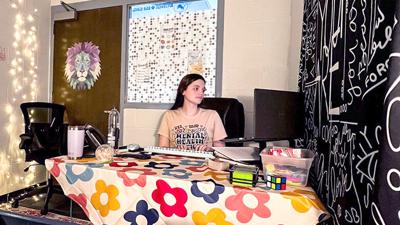

Jefferson County school officials say they are seeing positive results from the counseling services Chestnut Health System began providing to students with substance abuse issues at five Jefferson County school districts’ high schools last fall.
The counseling services began this school year at Fox and Seckman high schools in the Fox C-6 School District, Northwest High in the Northwest R-1 School District, Herculaneum High in the Dunklin R-5 School District, Jefferson High in the Jefferson R-7 School District and Windsor High in the Windsor C-1 School District.
Chestnut is funding the program with a $2.7 million grant it received last year from the Center for Substance Abuse Treatment (CSAT). Funding from the grant, called Enhancement and Expansion of Treatment and Recovery Services for Adolescents, Transitional Aged Youth and their Families, or TREE grant, is spread out over five years.
“Having it for multiple years is always a good benefit,” Fox Superintendent Paul Fregeau said. “Usually, these are one-offs, and then it is what do you do to replace it? A five-year grant allows us to build and improve as we move forward. It is amazing they got that kind of grant.”
Chestnut, which has an office at 102 Fourth St. in Hillsboro, began operating in Jefferson County in March 2020 and provides resources for adolescents and adults.
Lora Passetti, Chestnut’s evidence-based practice center program director, said the organization applied for the TREE grant in 2021 but did not receive the grant until midway through 2023.
“It was a very pleasant surprise,” she said. “(CSAT) did a couple of rounds of funding. We were in the second round.”
Lori Epley, Chestnut’s director of project access, said the grant covers costs to have a counselor work at either Fox or Seckman high schools and Northwest High every school day. She said counselors also provide services at the other three high schools as needed, and a peer recovery specialist works with students at each high school when needed.
As of March, 14 students were receiving counseling through the grant program, Epley said.
“We have five staff trained in evidence-based practices,” she said. “They have been trained in three different evidenced-based practices to help kids who are struggling with substance use, including vaping and tobacco. Once they identify a youth who is struggling with those substances, they will enroll them in the program and explain the process to them. They provide the services in the school during the school day.”
Doréan Dow, Northwest assistant superintendent of secondary education, said Chestnut provides the school districts with regular updates on participation and enrollment in the program.
She also said the district is working with Chestnut to find ways to identify students who may need help with a substance issue.
“We have too many students who are struggling to find healthy coping strategies for the challenges they face,” Dow said. “Times have changed, and our students are experiencing stress, anxiety and depression at higher levels than we have seen in the past. This can lead students to try to self-medicate with nicotine, illegal drugs or alcohol. Providing a safe place for them to share their triggers and help them find replacement tools for dealing with these challenges is critical for lifelong mental and physical health.”
Dunkin assistant superintendent Joe Willis said the counseling program is important to have available for students.
“Instead of just looking at ways of disciplining students when things come up, (the program) is a proactive way of instructing kids on why not to go down that road,” he said. “It also gives a way of when a kid does make a mistake, it is not just discipline; it gives them counseling to move on from the mistake.”
How it works
Epley said Chestnut must serve at least 50 students in the program in the first year of the grant, and it has to treat at least 100 students every year for the next four years.
She said schools typically refer students to Chestnuts after they have been found either using or bringing a substance like tobacco or marijuana to school.
Epley said most students in the program are struggling with marijuana use, which she says seems to have increased since Missouri residents voted in November 2022 to legalize the use of recreational marijuana for those 21 and older.
“They may see their parents or other adults in their life using (marijuana),” she said. “I think that creates a big challenge. The clinicians and the peer support specialist are doing a great job trying to educate these kids on the difference between an adult using and an adolescent using. It has different impacts.”
Epley said students meet one-on-one with a counselor once a week, and the students also meet one-on-one with the peer support specialist once a week. She said it typically takes 12 to 14 weeks for a student to complete the program, but some students may finish sooner and some may take longer to finish.
Epley said one of the biggest benefits of the program is that students meet with Chestnut staff members during the school day.
“It really eliminates a lot of the barriers that most families encounter with transportation or getting children to an outside group after school,” she said.
Epley said the program appears successful, with many students either reducing substance use or abstaining from use for long periods of time.
She said the program also helps with more than substance abuse issues.
“They talk about their goals,” Epley said. “Do you want to get a job? Do you want to apply to college? They have been working closely with them, and they have seen a lot of success. Several of the students have gotten jobs and their driver’s licenses. Some of them have applied to college and community college and have been accepted. Not only are there successes with the abstinence part of it, but with other life skills that they are learning and succeeding in.”
Dow said it helps to know the program will be in place for at least five years.
“It is rare to receive a full-time individual you can count on for five years at no cost to the district,” she said. “Benefits to this long-term commitment from Chestnut are that our TREE counselor can establish the solid relationships with these students needed for sustaining these replacement behaviors and the time needed to practice new habits, as well as fostering relationships with our staff so we can all move quickly and efficiently to support these young people. These are life changes our students are making, and having the same person and program to count on as these new, positive behaviors become lifelong healthy habits is more likely to bring about sustained success.”