


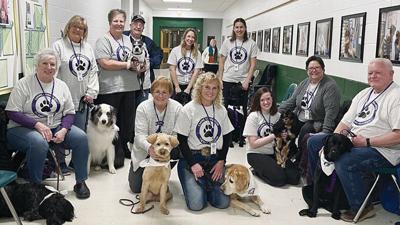
Volunteers with the new Canine Companion Therapy Program work to bring the unconditional love dogs provide to the Jefferson Countians who need it the most.
Gayln Bratcher, one of the group’s members, said CCTP serves local residents who may benefit from touch therapy with a dog, including those who live in nursing homes, children grieving the loss of a loved one, patients undergoing strenuous treatment or people with special needs. When invited, CCTP volunteers and their dogs travel to nursing homes, schools, hospitals or other locations at no charge to provide therapy.
Rodney and Laura Bickel of the Festus area founded the nonprofit organization in December, and so far, 12 local dog handlers have signed on to participate.
Bratcher, 63, of De Soto said the organization is growing quickly, with the first advanced dog training class scheduled this month for handlers interested in the program. Before CCTP was created, people who wanted to train their dogs for a therapy program often had to travel to St. Louis for classes, which is inconvenient.
She said many of the CCTP members were once part of the Tails with Tales program, which was founded in 2016, in partnership with Comtrea, and had teams of trained volunteers who took their therapy dogs to schools, libraries and care centers where children and others read to the canine friends. But, the Tails with Tales program disbanded during the COVID-19 pandemic.
“We decided we’re not going to partner with another organization. We have a lot of weight in our community, as well as experienced handlers. We just needed to have our own organization so nobody could pull the rug on us again,” Bratcher said.
Handler Tammy Popp, 62, of Pevely said CCTP debuted its therapy dogs at the Tim Tebow Foundation’s Night to Shine event on Feb. 7 at St. Andrew’s Church in De Soto. The foundation invites people with special needs to attend a night of celebration, complete with dinner, music, dancing and karaoke.
At the Night to Shine event, the handlers and their therapy dogs were made available to attendees who needed time to decompress in a side hallway of the church, away from all the excitement.
“It was the first time that group met together as an organization,” Popp said. “The adults who have disabilities were just so thrilled to see all the dogs. There were people in wheelchairs, a person who was blind, people who were nonverbal, ambulatory people, everyone with crowns on their head. The dogs just don’t react to those things – they just want to be petted.”
Popp and her therapy dog, a 6-year-old yellow Labrador named Luke, are part of CCTP and provide services at the Missouri School for the Blind in St. Louis. Popp has taught math at the school for nine years.
“If students are having a bad day, they’ll sit on a bean bag and have (Luke) curl up next to them,” Popp said. “He’s happy, the kids get to pet him and they’re able to calm down. He’s marvelous at that.”
Bratcher has two therapy dogs in the program, Wren and Kimber.
“At rehab facilities, the dogs will walk with people, so they’re walking and paying attention to the dog and not how far down the hall they went,” she said. “One time (a patient) went, ‘Wow, I walked twice as far today with the dog than I usually go.’ That’s the stuff that makes me feel good; I get goosebumps knowing I got to share these dogs I love with someone else to make their day.”
Training
Bratcher is a manager and trainer at Pawjama Party Kennels in Pevely, where she’s worked for 10 years. Dogs enrolled in CCTP train at the kennel, as well as out in the community, to ensure they can handle all types of sensory environments. The handlers work with them to make sure the dogs won’t react negatively if they hear sudden loud noises, if they are grabbed by small children or if someone moves quickly near them.
Training takes place at several places in the county, including the Pony Bird Home assisted living facility in
De Soto, the De Soto Rural Fire Protection District stations and True Value Hardware in Oakville.
The dogs must pass the Canine Good Citizen course, which teaches them basic manners, and the Community Canine class, which teaches them how to behave well in public, before being accepted in CCTP, Bratcher said.
“We’re teaching them how to approach clients, how to greet and how to be safe around medical equipment,” she said. “We’ll be looking for other places in the community that might let us come in and visit because the dogs need to be OK with going to different places.”
Bratcher said one of the most important things about CCTP is that it has insurance, which provides a level of assurance for businesses, which, in turn, allows the dogs and handlers to visit more people.
“The dogs have gone through this strenuous training program, and they are ready to be out there,” Bratcher said. “You know we don’t have dogs that are going to bite people, that aren’t going to jump on people, and the handlers have been taught how to approach and what to say and do.”
Bratcher said the group is looking for more businesses or community groups that want CCTP handlers and dogs to visit.
“The more places we get, the more teams we get,” she said.
Real results
Joyce Bitter, 68, of Crystal City is a retired Festus Police Department dispatch supervisor and began training with her Boston terrier, Emma, when the dog was about 9 months old. Now 9, Emma recently was honored by Mercy Hospital Jefferson in Crystal City with the “Gotcha Award” for her help with a patient.
Bitter said she and Emma often walk with cardiac patients along a small track at the hospital. One day, Emma began to walk with a patient and Bitter noticed the dog acting out of character.
“Emma was lagging behind, not being her normal peppy little self,” she said. “I kind of joked with her, ‘Come on Emma, pick up with the pace a little bit,’ and about a third of the way around the track she literally sat down and would not walk anymore. I excused myself, thinking I missed one of her cues and she needed to go outside pretty badly. (A hospital staff member) said, ‘You know that lady you were walking with? They just took her to the emergency room. She’s having some kind of cardiac incident.’”
After speaking more with hospital staff members and reviewing video footage from the track, Bitter said she realized Emma had sat down and refused to move at almost the same time the patient began to experience a medical emergency.
“She knew, she just knew for some reason,” Bitter said. “It was just so amazing that she noticed that.”
Bratcher said the therapy dogs also can provide much-needed support for cancer patients undergoing treatment. Oftentimes patients must wait at a center before and after treatment, which can be nerve-wracking and tiring.
Bratcher, a breast cancer survivor, said when she finally “rang the bell” at her treatment center, signifying she was cancer-free, the hallway was lined with therapy dogs and handlers to celebrate with her.
“With therapy dogs, you can talk to somebody who’s not saying, ‘So, what are you here for today?’ Or ‘What cancer do you have?’” Bratcher said. “Dogs don’t do that to you. They don’t ask questions. They are just there for you.”
Similarly, therapy dogs act as nonjudgmental reading partners for children, Bitter said. CCTP takes the therapy dogs to elementary schools or libraries so children may read to them.
“The dogs don’t giggle at children,” Bratcher said. “Dogs give such unconditional love – they can lie there with them and relax.”
For more information about the program, visit mok9therapy.org or the Canine Companion Therapy Program’s Facebook page.