
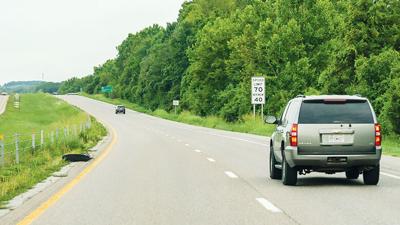
Despite a recent law change, 75-mph speed limit signs won’t be going up in Jefferson County anytime or on I-70 anytime soon.
A new law permitting the Missouri Department of Transportation to increase rural interstate and freeway speed limits from 70 to 75 mph takes effect Aug. 28, but MoDOT is cautioning drivers not to speed up just yet.
Officials said no speed limit changes will take effect until a full evaluation of eligible locations is complete.
“There’s a balance to be struck here between efficient traffic movement and safety, so we’re taking careful consideration of any potential location, what the roadway is like there and how people use it,” said MoDOT Director Ed Hassinger. “Our mission at MoDOT is to provide a safe and reliable transportation system, so this evaluation helps us make sure any changes to the speed limit don’t come at the expense of a safe trip.”
According to MoDOT’s statement, under the new law, MoDOT retains the ability to set highway speed limits and has a responsibility to set limits that are reasonably safe considering the various factors of each roadway. It provided a list of factors being evaluated that include: current traffic volumes, truck traffic volumes, crash history, terrain, road design, including the presence of safety countermeasures, existing speed limits of border states in eligible areas near the state line and active construction.
Jefferson County is considered part of the St. Louis Metropolitan Statistical Area and is not eligible for the speed limit increase, Taylor Brune, MoDOT’s communication director, told the Leader on Aug. 20.
She said Franklin County and most, if not all of Cape Girardeau County, would not be eligible either “as they’re both part of their respective metropolitan areas.”
“We’re evaluating eligible locations in Ste. Genevieve County,” she said.
MoDOT also said I-70’s speed limit would not increase during the rebuild and expansion delivered through the Improve I-70 Program, and it would reevaluate this corridor upon completion of the work.
The state statute defines rural interstate as the part of the federal interstate highway system that is not located in an urban area. The term “urbanized area” is an area of 50,000 population at a density at or greater than one thousand persons per square mile.
The statute further defines freeway as a limited access, divided highway of at least 10 miles in length with four or more lanes which is not part of the federal interstate system of highways and which does not have any crossovers or accesses from streets, roads or other highways at the same grade level as such divided highway within 10 miles of such divided highway.
“We’re hoping to complete this review of the eligible locations by the end of the year and provide an update on the path forward,” Hassinger said. “For now, we implore drivers to obey the posted speed limits, especially in our hundreds of work zones across the state.”
According to the American Safety Council, President Richard Nixon set the maximum national speed limit on interstates at 55 mph. That maximum increased to 65 mph in the 1980s and then in 1995, Congress decided to give speed limits back to individual states. Since then, 35 states increased their limits to 70 mph or higher.
According to the Insurance Institute for Highway Safety, neighboring states of Kansas, Nebraska and Arkansas have speed limits up to 75 mph on rural interstates while motorists can travel up to 80 mph on some sections of rural interstate in Oklahoma.
The American Safety Council said the fastest road in America is a 40-mile stretch of toll road between Austin and San Antonio, Texas, which allows drivers to travel 85 mph.